Elastic Liberation: The Philosophy of Pajama Pants
A cultural manifesto stitched in plaid
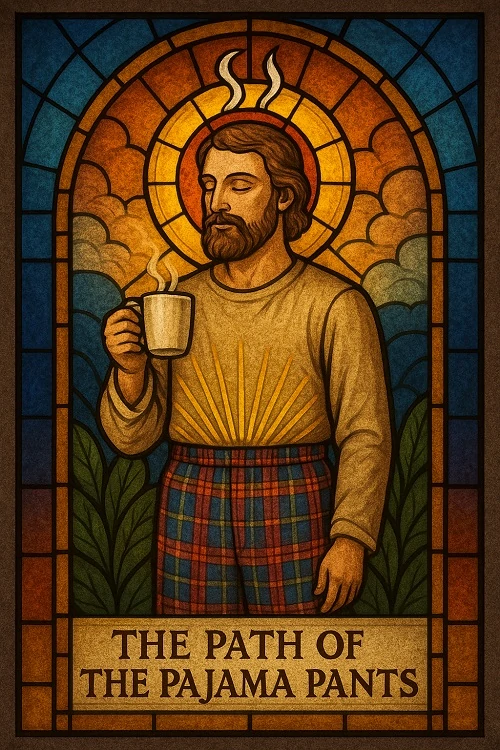
Introduction – The Great Unbuttoning
“And lo, the Sage descended from the laundry room, clothed not in finery, nor in shame, but in plaid and softness. The people scoffed — and then, slowly, they softened too.”
— The Book of Laundry, Verse 3:11
The first time you wear pajama pants in public, it feels… wrong. Not felony wrong — more like eating breakfast for dinner or sneaking a forkful of cake before anyone’s even sat down. A small, private rebellion. You glance around nervously, half-expecting someone to bark, “Hey! You can’t wear those here!” But no one does. The cashier rings up your purchase without comment. A passerby glances your way, then immediately looks back down at their phone. The world doesn’t implode just because you left the house in plaid fleece.
The second time feels easier. The third time, easier still. And then something strange happens: you stop thinking about it altogether. The shame evaporates, and what remains is a quiet, intoxicating freedom. It’s in that moment you realize the truth: pajama pants are more than just soft, cozy fabric. They are a philosophy — a rejection of performance, of needless discomfort, of a world that insists you wrap yourself in starch and seams just to buy a carton of milk.
The elastic waistband stretches, yes.
But so too does the soul.
Once you’ve had that first taste of pajama liberation, there’s no going back. Nobody jumps straight to full enlightenment — no one tosses their entire wardrobe in a fit of rebellion and declares, “From this day forth, only elastic waistbands.” The Path of the Pajama Pants is more subtle than that. It begins as a joke, a quick shuffle to the corner store, a choice made because it’s cold outside and laundry day is tomorrow. But soon it becomes something deeper. Pajama pants aren’t merely convenient — they are quietly subversive. A soft revolution hiding in plain sight.
And like all revolutions, they face resistance.
The world doesn’t just discourage pajama pants — it pushes back with rules, rituals, and silent judgment. We’ve been conditioned to believe that “serious” clothes make us serious people, that formal garments are the only way to mark meaning in our lives. Pajama pants challenge all of that. They don’t just threaten our wardrobes — they threaten the invisible systems of hierarchy and performance that have defined society for centuries.
This essay is an exploration of that conflict: between comfort and control, authenticity and artifice. We’ll walk the Path of the Pajama Pants step by step, meeting its sages and its enemies, its liberations and its dangers.
Because in the end, pajama pants are not just what we wear. They’re a question we must answer: Do we dress for ourselves, or for the world?
Part 1 – The Path of the Pajama Pants
“First there is resistance.
— The Book of Laundry, Verse 2:7
Then there is defiance.
Then there are only pajamas.”
Once you’ve worn pajama pants outside, the journey has begun — whether you intended it or not. The transformation isn’t sudden. It creeps in quietly, disguised as convenience: a quick shuffle to the corner store, a late-night dog walk, a lazy afternoon coffee run. Harmless choices, easy to dismiss.
But over time, these small acts accumulate. What began as a moment of comfort becomes something larger: a pattern, a practice, a soft rebellion spreading step by step. Before you realize it, pajama pants are no longer just what you wear. They are how you live.
There are five stages along this path — each one a little funnier, a little freer, and a little more dangerous than the last.
Stage 1: The Weekender
“I could never wear these outside.”
At this stage, pajama pants are prisoners of the home. They live in a narrow kingdom: the couch, the kitchen, maybe the mailbox at most. Their job is strictly comfort, strictly private. You might even have “house pajamas” and “real clothes” as separate castes. The idea of letting them leave the premises feels absurd. Shameful, even.
This is internalized control at work. Nobody needs to tell you pajama pants don’t belong outside — the rule lives rent-free in your head. Like a tiny bureaucrat whispering, “Those pants are for Netflix binges, not the public eye.”
“The first prison is not woven from cloth.
It is woven from the mind.”
Social Stakes:
This stage reveals how deeply performance is ingrained in us. Even alone, we subconsciously dress for an audience that isn’t there.
Stage 2: The Subtle Rebel
“Okay, but just this once.”
The first public outing is a calculated risk.
- A dawn coffee run, hoping no one sees you.
- A stealth trip to the corner store under cover of darkness.
- Maybe a hoodie to disguise the pants, as though they were a shameful secret.
Your pulse quickens with every step. You avoid eye contact, convinced each passerby can feel your transgression. And then — nothing happens. No alarms, no scolding, no public shaming. The world goes on as usual. A dangerous thought begins to form: What if nobody actually cares?
This is where rebellion takes root. The tiniest act of defiance cracks the door open to possibility.
“Revolutions begin not with fire and slogans,
but with a quiet shuffle to the gas station.”
Social Stakes:
Here we see the fragility of social norms — how easily they crumble when quietly tested.
Stage 3: The Unshackled
“Why did I ever wear jeans?”
The dam breaks. Once you’ve survived the initial rebellion, there’s no turning back. Pajama pants graduate from secret indulgence to default casual wear.
Errands? Pajamas. Dog walks? Pajamas. Grocery runs, post office trips, slow Sunday strolls? Pajamas.
You notice something curious: The more you wear them, the less anyone reacts. Side-eye glances fade. The imagined judgment of others reveals itself as mostly self-imposed theater. This is liberation through exposure. The shame dissolves because there’s no longer any shame to feel.
“Comfort does not need to be explained.
It simply is.”
Social Stakes:
At this point, pajama pants expose the hollowness of societal performance. The hierarchy begins to fray.
Stage 4: The Enlightened
“If they have a problem with it, that’s their problem.”
This is where boundaries collapse completely. Airports, workplaces, even semi-formal gatherings are no longer off-limits. You move through the world with unshakable calm, wrapped not just in fleece, but in freedom. Some people stare. Some scoff. Some envy you silently. It makes no difference.
At this level, pajama pants are no longer just about comfort. They are a declaration of authenticity — proof that you live by your own rules.
“The suit says, ‘I serve.’
The pajama pant says, ‘I am.’”
Social Stakes:
Here, pajama pants directly challenge institutions. Your very presence becomes a quiet form of protest.
Stage 5: The Sage of Softness
“There are no pajama pants. There are only pants.”
At the final stage, the distinction between “pajamas” and “real clothes” dissolves entirely. You no longer think of yourself as “someone wearing pajama pants.” You’re simply existing — and they happen to be there.
Society bends to your presence like fabric in a warm breeze. Nobody notices anymore. What was once rebellion has become invisible.
The Sage does not evangelize.
The Sage does not convert others.
The Sage simply lives.
“The Sage does not walk in pajama pants.
The Sage simply walks, and the pants are incidental.”
Social Stakes:
This stage represents true liberation: not defeating the rules, but transcending them.
The Edge of Comfort
The Path of the Pajama Pants is a journey inward as much as outward. At first, it feels like rebellion — a private joke made visible, a small softness worn against a hard world. But step by step, waistband by waistband, it changes you. It strips away the stories you didn’t even know you were wearing, until what’s left is simply you, unbound.
And yet, no path is walked alone. For every elastic waistband stretched toward freedom, somewhere a belt is tightened in response. The world does not surrender its seams so easily.
Beyond the soft glow of liberation lies resistance — sharp, structured, unyielding. The next chapter of the journey isn’t about you choosing pajama pants. It’s about everything — and everyone — that rises up to stop you.
Part 2 – The Forces That Resist Pajamas

“The world does not give up its belts lightly.
— The Book of Laundry, Verse 4:2
For every soft step taken, a harder shoe stomps back.”
Every pajama pant worn outside is a tiny rebellion. A quiet act, yes — but one that sends ripples through entire systems of control. On the surface, it’s just fabric: soft cotton, a loose waistband, maybe a whimsical plaid. But beneath that surface lurks danger.
Because pajama pants don’t merely clothe the body. They unclothe the illusion that serious clothes make serious people. They threaten to reveal how much of society is built on appearances — and appearances are fragile.
That’s why pajama pants face such intense pushback. The resistance isn’t random; it’s organized, institutional, and deeply embedded in our culture. There are five great forces standing between you and elastic liberation.
1. Workplaces: The Uniform of Obedience
The office has always been a temple of performance. Suits, ties, pencil skirts — these aren’t just clothes, they’re uniforms of compliance. They tell the world (and your boss): “I belong here. I take this seriously.”
Pajama pants expose the absurdity of this entire system. They reveal what companies don’t want to admit: Productivity has nothing to do with fabric. You don’t work harder because your pants have belt loops.
“You can’t bill at $400 an hour in flannel.”
And yet… why not? Why does soft cotton undermine authority more than spreadsheets ever could?
The truth is, offices rely on visual hierarchies to maintain control. When everyone is dressed the same, status flows upward. Pajama pants, with their wild patterns and unstructured softness, refuse to play by those rules.
2. Ceremonies: The Costumes of Meaning
There are moments in life where clothing is treated as sacred. Weddings, graduations, funerals — these are the milestones where we gather to witness and be witnessed. The garments we wear for them are costumes, imbued with symbolic weight:
- The white dress for purity.
- The black suit for grief.
- The cap and gown for transition.
Pajama pants challenge this ritual order. They ask a dangerous question: “Can joy or grief not be honored in fleece?”
Imagine showing up to a wedding in plaid pajama pants. People wouldn’t just see it as casual — they’d see it as sacrilege. Because if the meaning isn’t in the clothing… where does it come from?
The uncomfortable truth: The meaning was never in the clothing. It was always in the people, the moment, the connection.
Pajama pants just strip away the costume and force us to confront that reality.
3. The Fashion Industry: The Machine That Must Churn
Fashion doesn’t sell fabric, it sells identity. Every season, every year, a new crop of trends emerges:
- Last year’s must-have coat becomes this year’s embarrassment.
- The “hot” color of spring becomes “basic” by fall.
This churn is the lifeblood of the industry. Without it, the machine stalls.
And then… here come pajama pants. Timeless. Cheap. Unbranded. The same pair can last for years without ever going “out of style.”
To the fashion industry, pajama pants are a nightmare: They have no constant replacement cycle, no “limited edition” drops, and no accessory upsell (belts, handbags, matching shoes).
They’re post-fashion fashion, a silent protest against consumerist churn. Pajama pants don’t just reject the system — they make the system irrelevant.
4. Status Hierarchies: The Theater of Seriousness
There’s an unspoken rule in society: Serious clothes make serious people.
A crisp suit.
Polished shoes.
Structured fabrics that say, “I’m important.”
These visual cues uphold invisible hierarchies. Without them, the boundaries blur. If everyone wore pajama pants, who would be the CEO? Who would be the intern? Who would be the priest, the politician, the power broker?
Pajama pants flatten these distinctions into shared humanity. When everyone is dressed for comfort, status signaling collapses.
This is why pajama pants are so deeply unsettling to the elite: They reveal that power is, and always has been, just… costume.
“If the emperor has no clothes,
why are we so afraid to join him?”
5. Internalized Guilt: The Quietest Warden
The final and strongest force of resistance doesn’t come from others. It comes from within. You don’t need a boss or a stranger to scold you for wearing pajama pants in public. You’ll do it to yourself.
“I can’t wear these outside… can I?”
This internal voice is the most insidious barrier of all. It’s the echo of every rule you’ve ever absorbed:
- “Dress for success.”
- “You can’t go out looking like that.”
- “What will people think?”
Even when external judgment fades, this inner critic lingers. The battle for pajama liberation is fought not just in stores and offices, but in the private courtrooms of our own minds.
Where the Seams Begin to Tear
These five forces do not merely resist pajama pants — they depend on defeating them. The office needs its uniforms, the ceremony its costumes, the industry its churn. Status itself is stitched together from these threads, each tugging at the next, each holding the illusion in place.
Pajama pants don’t just threaten to loosen a few stitches. They threaten to unravel the whole garment.
Imagine a world where these forces fail:
- Offices stripped of their hierarchies.
- Ceremonies stripped of their pageantry.
- Industries stripped of their profit.
- Even your own inner critic left with nothing to scold.
This is why the resistance fights so fiercely. Because if pajama pants win, the very fabric of society comes apart — thread by thread, seam by seam.
But resistance is only half the story. For if one fabric unravels, another may emerge in its place. And what pajama pants create is something far more radical, and far more dangerous, than comfort alone.
Beyond this struggle lies a quieter revolution — one that doesn’t just challenge rules or rituals, but the beating heart of the market itself.
Part 3 – Pajamas vs. Capitalism
“Gold threads may glitter, but they cannot outshine flannel.”
— The Book of Laundry, Verse 5:9
Capitalism thrives on a simple formula: make people feel inadequate, then sell them something to fix it. The cycle never ends. New styles, new trends, new collections — anything to keep you buying, discarding, and buying again.
But pajama pants? Pajama pants don’t play that game. They sit there, soft and smug, perfectly comfortable in their own timelessness. They are, quite frankly, bad for business.
Why the Market Hates Pajamas
Pajama pants are everything a profit-driven system fears most:
Timelessness:
Pajama pants don’t go “out of style.” They are always relevant, always wearable, season after season. No urgency to replace them with this year’s “new look.” They are the anti-trend.
Cheap to Produce:
Simple cuts, basic fabrics, easy mass production. No luxury branding, no artificial scarcity to drive up prices. The exact opposite of a $2,000 designer jacket stitched by a logo-obsessed atelier.
Accessory-Proof:
Pajama pants don’t require belts, handbags, or matching shoes to “complete the look.” There’s no upsell opportunity. It’s just… pants. The horror!
Universal Appeal:
Billionaire and broke college student, side by side, wearing the exact same plaid fleece. This breaks capitalism’s favorite trick: separating people by what they wear.
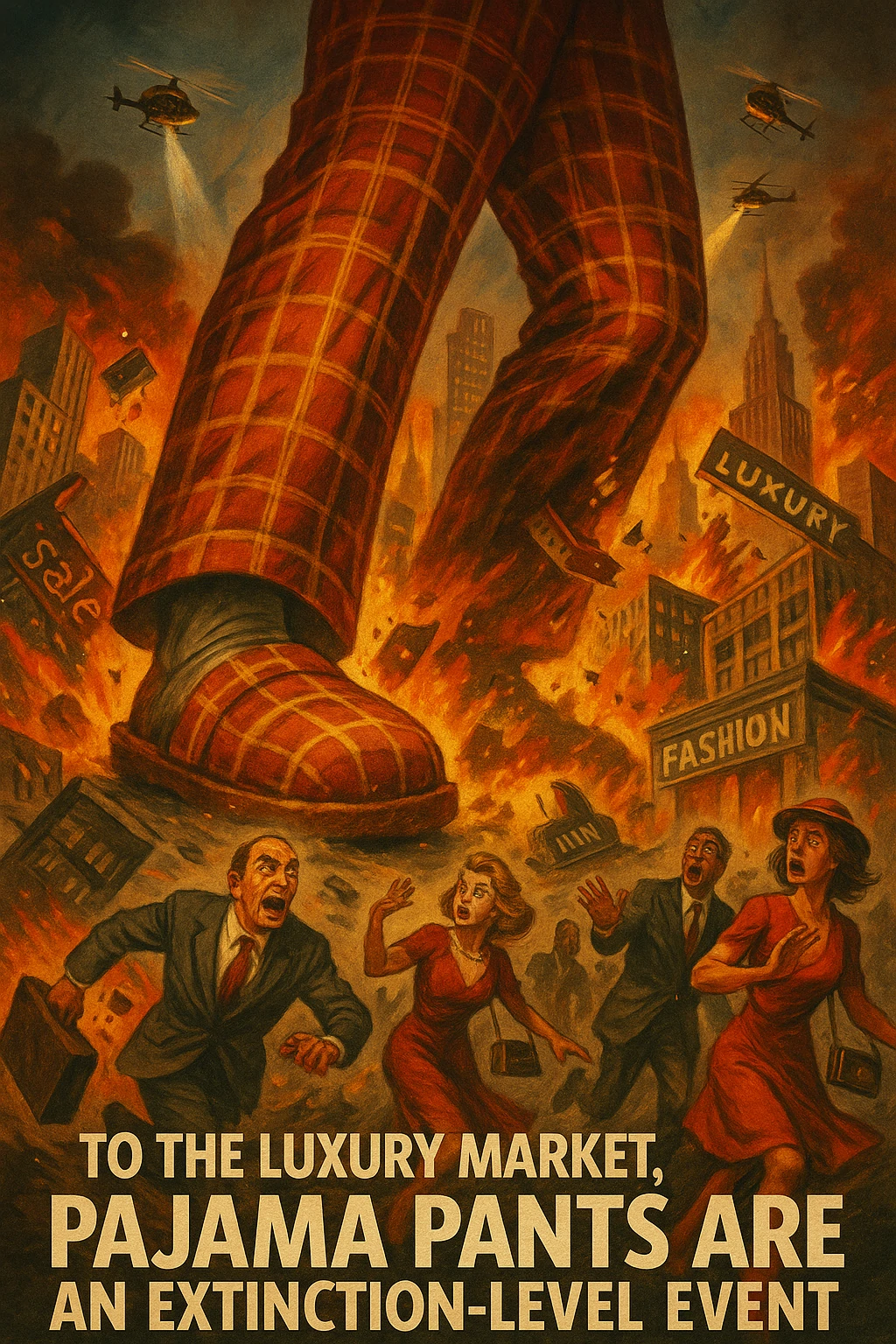
“To the luxury market, pajama pants are an extinction-level event.”
The Pajama Catastrophe
Imagine being a fashion executive staring down a world of people happily shuffling around in pajama pants. No more “Spring Collection.” No more “This year’s palette.” No more glossy ads of models brooding in $900 trousers.
Instead, it’s just… everyone wearing the same two or three patterns forever. For free markets, this is a nightmare scenario.
Fashion depends on planned obsolescence:
- Last year’s styles must become shameful.
- This year’s styles must feel essential.
- Next year’s styles must already be teasing you by mid-September.
Pajama pants refuse this churn. They’re post-fashion fashion — an eternal garment immune to the tides of trendiness. Their message to the industry is clear: “We don’t need you.”
Pajamas as a Class Equalizer
Clothing has always been a way to signal class and power:
- The cut of a suit.
- The brand of a handbag.
- The perfectly distressed $500 “casual” jeans.
These signals matter because they tell a story about who you are and where you rank. They let the wealthy broadcast their wealth while subtly shaming everyone else.
Pajama pants take a sledgehammer to this system.
When everyone is dressed for comfort, nobody looks inherently superior. In pajamas, a CEO and a college dropout are just two people in soft pants, sipping coffee. Their status markers dissolve into the fabric itself.
This is why pajama pants are quietly radical:
- They don’t just make you comfortable.
- They make everyone equally comfortable.
- Which, to those invested in hierarchy, is deeply threatening.
The Comfort Economy
Capitalism thrives on difference:
- Rich and poor.
- Stylish and unstylish.
- Relevant and outdated.
Every gap is a revenue stream. Every insecurity, a product opportunity.
But pajamas blur those gaps. They create sameness, softness, stability. They whisper: “We could all be like this. We could all just… relax.”
And if people stopped needing to prove themselves through constant consumption? The entire system would wobble.
“When all pants are pajamas, no pants are profitable.”
Casual Friday, Forever
At first glance, pajama pants are harmless. But zoom out, and you see why they’re such a threat: They reveal how much of capitalism relies on keeping us slightly uncomfortable — always chasing the next thing, always feeling just a little bit not enough.
Pajama pants say, “You’re already enough.” No belts. No brands. No bullshit.
And that message terrifies those who profit from our collective itch to strive. Because in the softness of a plaid waistband lies a quiet, dangerous truth: A society that chooses comfort over consumption may not need capitalism at all.
Part 4 – The Pajama Pants Dialectic
“The waistband stretches, the cuffs fray, and yet the struggle continues.”
— The Book of Laundry, Verse 6:14
Up to this point, pajama pants have been a story of individuals. Your journey. Your quiet rebellions. Your late-night coffee runs, hoodie zipped up like a cloak of shame.
But to truly understand the power of pajama pants, we must step back. This isn’t just about you versus the corner store cashier. This is about history itself.
For every personal act of comfort, there is a societal reaction. Every elastic waistband tugged toward freedom is met by a starched collar pushing back. The clash between these two forces — the soft and the rigid — is nothing less than a philosophical war.
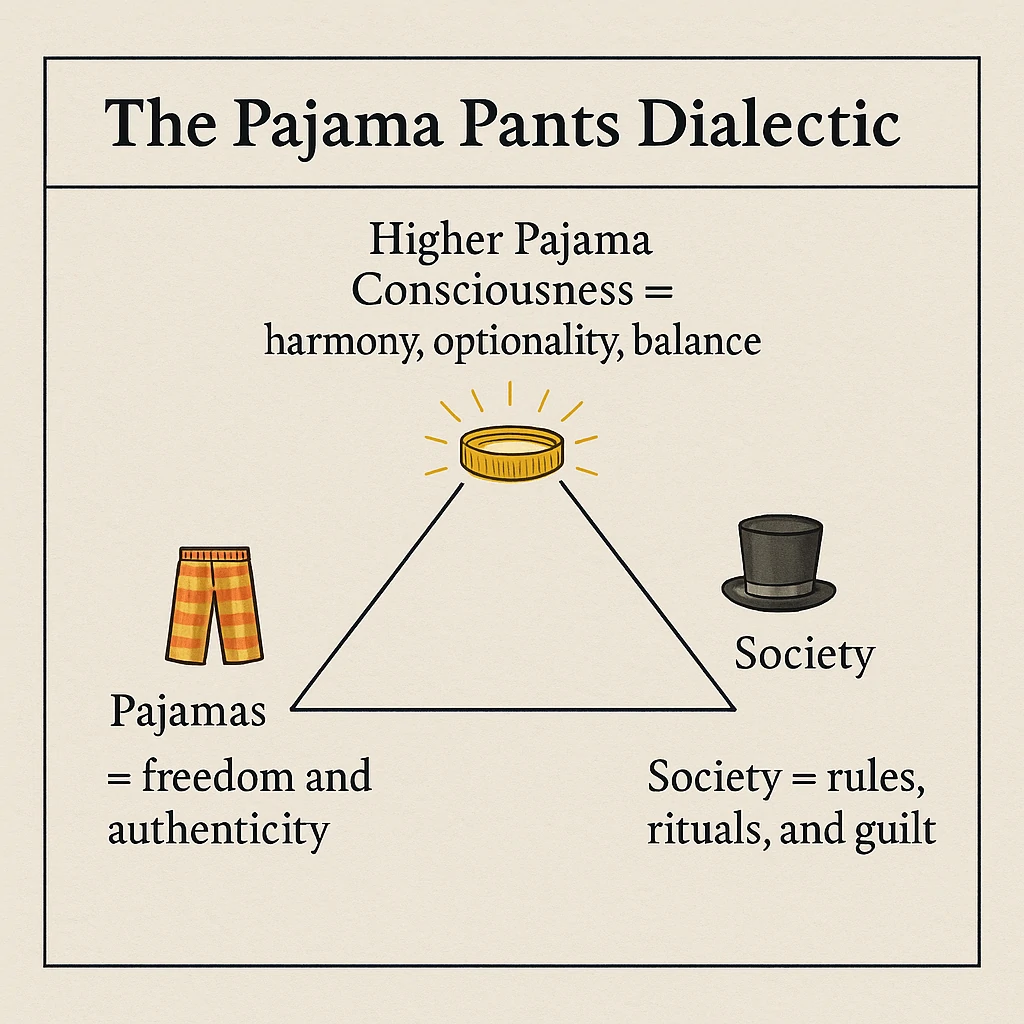
Enter: The Pajama Pants Dialectic.
The Core Conflict
Like all great dialectics, this one begins with a fundamental opposition:
Thesis: Pajama pants represent freedom, authenticity, and the unshackled self.
- Comfort without performance.
- Existence without pretense.
- The world as it could be, soft and unstructured.
Antithesis: Society resists with rules, rituals, and guilt.
- “Dress codes” that maintain hierarchy.
- Ceremonial costumes that assign meaning to fabric.
- Silent judgment that polices even our private choices.
The clash is inevitable. Softness threatens structure. Structure retaliates by tightening its belts — literally and metaphorically.
This battle plays out not in battlefields, but in boardrooms, weddings, airports, and the quiet aisles of 7-Elevens worldwide.
The Synthesis: Higher Pajama Consciousness
At first, this seems like a fight to the death: pajama pants versus society. But the truth is subtler — and softer.
The final stage isn’t a total victory or total defeat. It’s a transformation.
In this synthesis, pajama pants don’t destroy formality. They liberate it.
Formality becomes optional:
- A suit is no longer a requirement for respect.
- It’s a choice, an act of self-expression rather than obligation.
The same way a painter chooses a brush or a musician chooses an instrument, you choose your clothes — free from fear or coercion.
When society reaches this point, the world won’t be a sea of plaid forever. Instead, it will be a place where the suit and the pajama pant can coexist, side by side, in harmony.
“When the robe and the fleece are equal, the world will know peace.”
The Five Stages of Liberation
This dialectic isn’t just abstract theory. It’s a process — a journey every society and every individual travels, whether they know it or not. Each stage represents a turning point in the struggle between comfort and control.
1. Discovery – “These pants are incredible.”
The first time you slip into pajama pants, you feel the difference. It’s not just softness — it’s a taste of what life could be like without friction. You don’t yet understand its implications. You just know… you like it.
2. Conflict – “But people are judging me.”
The moment you step outside in pajama pants, the world pushes back. Side-eye glances. The whispering voice in your head: “You shouldn’t be wearing this here.”
Comfort meets shame, and shame digs in its heels.
3. Rebellion – “I don’t care. I’m wearing them anyway.”
Something shifts. The judgment no longer matters as much. You choose comfort deliberately, not accidentally. You take a stand — even if it’s just while buying gas station snacks at midnight.
The rebellion has begun.
4. Integration – “Acceptance spreads.”
Others see you. Some quietly admire you. A few join you. Suddenly, pajama pants are no longer a private rebellion. They’re a visible, shared choice. Norms begin to bend, if only slightly.
5. Transcendence – “Nobody notices anymore.”
At the final stage, pajama pants cease to be a statement. They simply are. No one gives them a second glance. The world has absorbed them, and in doing so, softened its boundaries.
The dialectic completes itself, only to begin again elsewhere — because somewhere, some poor soul is still fighting a battle over cargo shorts or Crocs.
The Final Fold
The Pajama Pants Dialectic isn’t about the destruction of formality. It isn’t about a world where everyone lives in fleece forever. It’s about the space we create when we strip away coercion, leaving only choice.
True liberation doesn’t come from replacing the old uniform with a new one. It comes when clothing itself becomes neutral — no longer a cage, no longer a cage match. When a suit can be worn as joyfully as flannel, and flannel can be worn as freely as nothing at all.
In this vision, pajama pants don’t demand to be noticed. They fade into the background, a quiet option among many. Because the ultimate victory of softness is not dominance, but irrelevance: when wearing pajamas means nothing at all.
“The final victory of the pajama pant is not to be worn,
but to make wearing anything a free act.”
Part 5 – The Dark Side of Pajama Pants
Every philosophy, no matter how noble, carries the seed of its opposite. What begins as liberation can curdle into decadence. What starts as rebellion can end in stagnation.
Pajama pants are no exception.
For all their softness, there is a danger woven into their fabric. A danger not of rebellion, but of surrender. Because comfort, taken too far, ceases to be freedom. It becomes apathy.
To understand the true path, we must look not only at what pajama pants free us from — hierarchy, performance, hollow ceremony — but also what they might take away if we forget why we sought that freedom in the first place.
Total Decadence: When Softness Smothers
Most of the time, structured clothing is hollow performance. A daily charade staged for bosses, clients, or strangers:
- The suit that says, “I am serious.”
- The uniform that says, “I obey.”
For the vast majority of people, this kind of dressing up adds nothing of real value. It exists to maintain appearances, not to serve any deeper purpose.
But there are rare, pivotal moments when formality does something different. When dressing up isn’t about compliance — it’s about marking a moment. Not creating meaning out of nothing, but framing the meaning that’s already there:
- A wedding that celebrates a union.
- A funeral that honors a life.
- A graduation that signifies transition.
- A civic ritual that gathers the many into one.
These garments don’t make the event sacred — the people and the moment do. But they act as a spotlight, focusing our attention and telling everyone, “This matters.”
Without these peaks of contrast, everything begins to blur. If pajama pants become the default for all occasions, the extraordinary risks disappearing into the ordinary. Life flattens into one soft, shapeless expanse.
“If every day is pajama day, no day is special.”
Pajama pants are perfect for the everyday, but the everyday is not all there is.
Loss of Ritual: When All Days Blend Together
Rituals are how societies give structure to chaos. They are collective ways of saying, “This is different. Pay attention.”
The garments worn for these rituals don’t create the meaning, but they signal it, like a frame around a painting or a stage around a play.
Without those signals, milestones risk feeling hollow:
- A wedding indistinguishable from a casual dinner party.
- A funeral that feels like just another Tuesday.
- A graduation blending into the haze of daily errands.
Pajama pants challenge ritual by stripping away the illusion that the costume is the meaning. This is a necessary truth to face. But in doing so, they also remove one of the tools we have to heighten our awareness of what matters.
“Without the costume, there is still the moment — but the crowd may forget to look.”
The solution isn’t to banish pajamas from ceremony forever. It’s to use them — and all clothing — deliberately. To fold them away on the rare days when we need to rise above the ordinary.
Complacency: The Slumbering Society
Perhaps the greatest danger of pajama pants isn’t external at all. It’s internal.
Pajamas can become a symbol of a society that has grown too comfortable to grow, too cozy to challenge itself, too wrapped in fleece to leave its blanket fort.
When every day is spent in maximum comfort, why strive? Why take risks, or endure necessary discomfort to achieve something greater?
Comfort without contrast becomes stagnation. A civilization that never dares to dress for the day may slowly fall asleep — not just physically, but culturally and spiritually.
“A world that never dresses for the day may forget to rise at all.”
The very garment that once symbolized freedom could, in time, represent decline: a people so wrapped in ease they’ve lost their sharpness.
This is the Pit of Perpetual Napping, where the dream of liberation collapses into endless snooze.
The Wisdom of the Fold
This is why true pajama liberation requires wisdom. The goal was never to wear pajama pants all the time. It was to reclaim the choice of when to wear them — free from shame, free from coercion, free from ritual-for-ritual’s-sake.
There are moments when pajama pants are right:
- Lazy mornings.
- Quiet evenings.
- The day after a hard fight, when rest is earned.
And there are moments when they must be folded neatly away:
- For the milestones that deserve reverence.
- For the ceremonies that bind us together.
- For the rare occasions when effort is the point.
- “The Path of the Pajama Pants is not to wear them always.
It is to know when to reach for them — and when to fold them neatly away.”
Because in the end, pajama pants are not just a garment. They are a mirror, reflecting our relationship with freedom and responsibility.
If we never rise to the occasion — never stand tall, never mark the moments that matter — then softness becomes stagnation, and the dream of liberation fades into a restless sleep.
Conclusion – The Sage of Softness
“In the end, the cloth fades,
the seams unravel,
and only freedom remains.”
— The Book of Laundry, Verse 10:1
The path begins with rebellion. A pair of pajama pants worn outside for the first time, trembling with quiet defiance. Over time, that act spreads, softening the hard edges of the world one waistband at a time.
But at the journey’s end, something remarkable happens: The rebellion disappears.
The Sage of Softness walks through the world unbothered and unnoticed. They wear pajama pants not to make a point, not to challenge or convert, but simply because it is natural.
Others may scoff, or silently envy, or fail to understand. It makes no difference. The Sage has transcended judgment — both their own and others’.
“The Sage does not convince others to wear pajama pants.
The Sage simply lives, and others find themselves softening.”
In this final stage, pajama pants are no longer a banner of protest or a uniform of comfort. They are simply pants — incidental, unremarkable. The true revolution is invisible because it no longer needs to be seen.
The lesson of the Path was never really about pajamas. It was about choice.
The choice to dress for yourself, not for others.
The choice to rest when you are weary and rise when the moment demands it.
The choice to cast off rituals that no longer serve you while keeping the ones that matter.
When you realize this, you see the truth: It was never about the pants at all.
It was about freedom.
It was about authenticity.
It was about living unbound.
Closing Image
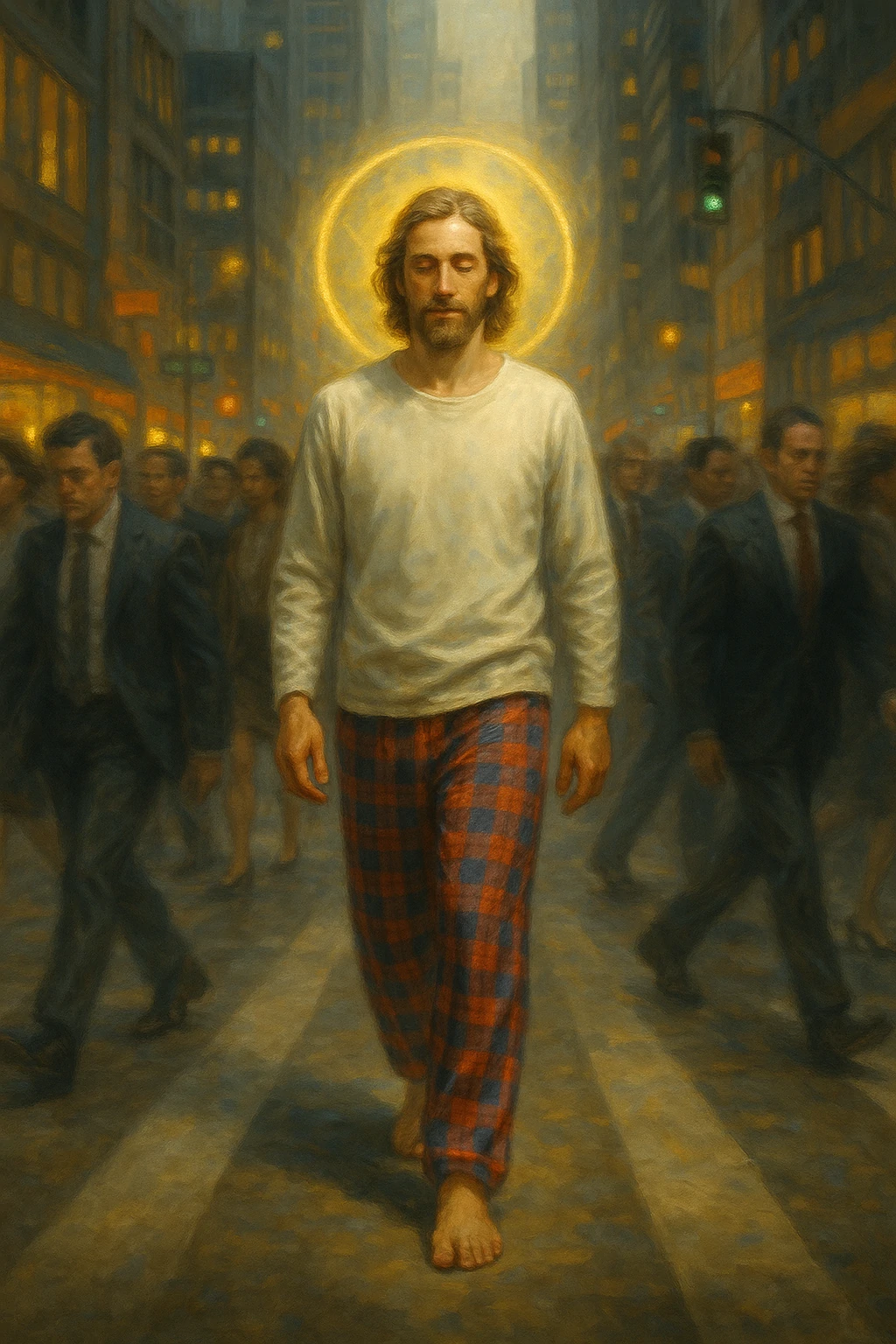
Picture the Sage, walking quietly through a bustling street. Some people notice the flannel pattern and frown. Others glance and smile, a flicker of recognition passing between them. Most don’t notice at all.
The world goes on — and that is the victory. Because when softness becomes so natural that it no longer draws comment, liberation has fully taken root.
The Sage keeps walking.
Not to lead.
Not to rebel.
Simply… to live.
“Fold what must be folded.
Wear what must be worn.
Judge not the cloth of another.When all threads are free,
and no seams are binding,
you will understand:It was never about the pants.”
— The Book of Laundry, Final Verse
- Iarmhar
October 25, 2025