Breaking the Clock
How AGI Can Free Us from Industrial Revolution Legacies
The Forgotten Night
The fire has burned low, leaving only a soft orange glow in the hearth. Outside, the wind stirs the shutters and carries the faint scent of wet earth. A house lies still, the kind of silence so complete it seems almost sacred.
Somewhere in that stillness, a woman wakes.
She does not stir with alarm, nor with the fog of restless dreams. Her eyes open naturally, as though she had simply arrived at a different layer of night. For a moment she listens — to the soft crackle of cooling embers, the rustle of straw under the bedframe, the barely-there breath of a sleeping child in the next room. She draws her shawl around her shoulders and slips from beneath the quilt, her bare feet cool against the wooden floor.
This is the interval between sleeps — the gentle seam where dreams and waking life briefly overlap.
By candlelight, she might read a passage of scripture or leaf through a well-worn book. She may write a few lines in a letter to a distant friend, or whisper with her husband in the privacy that the day never grants them. Some nights she simply sits by the window, gazing out over the moonlit fields, watching the clouds drift in slow procession. This hour is neither wholly night nor wholly morning. It is its own time, quiet and unhurried.
For centuries, this was how people slept. “First sleep,” followed by an hour or two of peaceful wakefulness, then “second sleep” until dawn. It was not strange, not a sign of illness or stress — simply part of the rhythm of life, as natural as the waxing and waning of the moon. Entire cultures were shaped around it. Stories were told in that hushed middle space, secrets exchanged, prayers offered, ideas born. These were the hours where dreams were discussed and decisions made. A time apart from the world, gently woven into it.
And then, one day, it was gone.
The change was so gradual most people never noticed. As factories spread and cities grew, the night was compressed. Whistles marked the beginning and end of shifts. Gas lamps, and later electric bulbs, banished the darkness and blurred the boundary between day and night. Sleep was squeezed into a single unbroken block to fit the demands of the new order. The once-sacred hour between sleeps disappeared into history, leaving only a faint echo in the way we sometimes stir awake at 2 or 3 AM, unsure why.
Today, when this happens, we call it insomnia.
We medicate it.
We fear it.
We build apps to fix it.
We tell ourselves something must be wrong with us, when in truth it is our society that has gone wrong. Natural wakefulness has been recast as a failure because our world is still governed by a machine’s logic: uninterrupted sleep to fuel uninterrupted work.
Modern bedrooms bear silent witness to this shift. The nightstand holds a glowing phone, ready to buzz with notifications at dawn. A bottle of sleep aids sits beside it, a promise of chemically enforced rest. Outside the window, the sky is never truly dark — lit by street lamps and the ceaseless glow of a city that never sleeps. Our bodies whisper of older rhythms, but our surroundings drown them out.
What was once ordinary, even beautiful, is now treated as disorder.
And it’s not just our nights that have been reshaped this way. The truth is harder to face: many of the things we take for granted as “normal life” — our schedules, our schools, our cities, even our sense of time itself — are not natural at all.
They were designed for a very different purpose: to make human beings compatible with machines.
The Industrial Revolution didn’t just change how we worked; it rewrote how we lived. It synchronized us like gears, bending our lives to fit the needs of factories and production lines. The eight-hour day. The forty-hour workweek. The ringing of school bells. The relentless forward march of the clock. These were not organic choices made for human flourishing — they were compromises made to keep the machine running smoothly.
Now, for the first time in centuries, that machine is faltering. Something new is rising to take its place.
Artificial General Intelligence, and the broader wave of automation that follows it, has the potential to dismantle these invisible constraints. It can take over the precision, synchronization, and optimization that once demanded so much of us. In doing so, it offers us a chance to step outside of the factory’s shadow — to rediscover ways of living that serve humans, not machines.
For generations, we have lived by the clock.
For the first time in living memory, we have a choice.
And choice is where this story begins.
The Inheritance — What the Industrial Revolution Gave Us (and Took Away)
The world we know today — its schedules, its rhythms, its assumptions — did not simply evolve. It was built.
Like the great iron machines that once filled its factories, our modern society was engineered: piece by piece, gear by gear, until it could run on its own. This wasn’t an accident, nor was it the natural flow of human history. It was an act of design — one that reshaped not only how we worked, but how we slept, learned, healed, and even thought about ourselves.
And like any design, it carried trade-offs. It gave us certain kinds of progress while quietly erasing older ways of being, often without anyone noticing until it was too late.
The Logic of the Machine Age
The Industrial Revolution began with a hiss of steam and the rhythmic clatter of looms.
Textile factories rose beside rivers. Coal-fed furnaces lit up the night sky. Railroads stitched cities together with iron threads, moving goods and people faster than ever before.
For the first time in history, production was no longer tied to the sun, the seasons, or the whims of weather. Machines could run day and night, and so — it was decided — should the humans who tended them.
Factories required three things:
- Synchronization — workers arriving and leaving at precisely the same times, like moving parts of a larger engine.
- Standardization — every role defined and interchangeable, so one person could be replaced by another without disrupting the system.
- Discipline — a rigid order to ensure the machine never stopped.
The image of freedom so often attached to industrial progress — the idea of the plucky inventor or self-made man — hides a grimmer reality. For millions, industrialization meant becoming a component, a cog that existed to keep a larger mechanism turning.
Picture a foggy morning in the heart of the 19th century. The factory whistle pierces the dawn, sharp and metallic, cutting through the quiet like a blade. Streets fill with men, women, even children, all moving in the same direction, their breath clouding in the cold air. Their steps fall into an unconscious rhythm, echoing off brick walls blackened by soot. Inside, rows of machines roar to life, and the humans tending them disappear into the blur of motion.
The logic of the factory was simple: humans must adapt to the needs of machines, not the other way around.
This logic didn’t stay confined to the mill or the foundry. It spread outward, shaping entire societies. Schools, cities, hospitals, governments — all were subtly retooled to keep pace with industrial time. Even today, long after most of those original factories have closed, their rhythm still governs our lives.
Why do we still live by factory schedules, when the factories themselves are gone?
Biphasic Sleep as a Microcosm
To understand the depth of this transformation, consider something as intimate and universal as sleep.
Before industrialization, people didn’t sleep in one solid, unbroken block. They followed what historians call biphasic sleep: two distinct periods of rest, separated by a gentle interval of wakefulness. First sleep carried them into the early hours of the night. Then came a natural interlude, a space for quiet reflection and connection, before they drifted into second sleep until dawn.
This middle hour was not idle time. It was precious.
Families whispered softly by the fire. Lovers stole moments of intimacy. A farmer might rise to check the hearth or pray for the coming day. Others would sit in silence, watching moonlight filter through the window, letting thoughts rise unhurried from the depths of dreams. It was a liminal space — neither fully night nor fully morning, uniquely suited to contemplation and creativity.
And then, it was erased.
As factories expanded, the old rhythms of sleep collided with the new demands of work. The whistle at 5 AM did not care if you had drifted naturally awake at 2. Shift schedules required unbroken blocks of rest, forcing people to compress their nights. Gas lamps and electric bulbs flooded streets and homes with artificial light, disrupting the delicate cues of darkness and dawn.
Within a few generations, the old pattern was gone. People forgot there had ever been another way.
Today, when someone wakes naturally in the middle of the night, we treat it as a defect. Doctors call it insomnia, a problem to be solved with pills or apps. Almost no modern research even considers the possibility that segmented sleep could be healthy, because our baseline assumption — uninterrupted sleep is correct, anything else is wrong — comes from a factory schedule, not from human biology.
When the machines took over the night, they didn’t just claim our hours.
They claimed our dreams.
This loss is more than metaphor. It is a perfect symbol of what happened on a larger scale. Diverse, adaptive, deeply human rhythms were replaced with a single enforced uniformity. Where once there was variation, now there is standardization. Where there was meaning, now there is efficiency.
And like the middle hour of the night, most of what we lost is so thoroughly erased that we no longer even know to miss it.
Other Key Legacies
Biphasic sleep is just one thread in a vast web of transformations. The Industrial Revolution didn’t just change how we slept or worked — it rewired nearly every part of human life. Many of these changes are so deeply embedded that we mistake them for eternal truths, when in fact they are historical choices.
Consider a few of the most pervasive:
The 9-to-5 Workday
Factories needed predictable shifts to keep machines running smoothly. That necessity hardened into the modern work schedule, which persists even when the job itself could be one at any hour.
“Why do we still cling to a universal schedule,”
“when so much of our work now happens on laptops and servers instead of looms and assembly lines?”
Standardized Schooling
Public education was designed not just to teach literacy, but to instill habits of punctuality and obedience. The ringing school bell was modeled after the factory whistle, training children to move in lockstep from one activity to the next.
“Why does the school bell still dictate our children’s days, even in an era of personalized learning and digital tools?”
Healthcare Gatekeeping
Industrial-era healthcare focused on keeping workers minimally functional — patched up just enough to return to the floor. Access was rationed through bureaucratic systems that treated illness as a defect to be managed rather than a human experience to be understood.
Urban Design and Commuting
Cities were shaped by the gravitational pull of factories. Housing clustered around production centers, while roads and transit were built to funnel workers in and out. Even after factories vanished, this design remained, giving us the daily misery of traffic and long commutes.
“Why are we still choking in traffic every morning, in cities built for a past that no longer exists?”
Scarcity-Based Competition
Scarcity was once a hard truth of life — there truly weren’t enough resources to go around. But under industrial capitalism, scarcity also became a tool of control. Limited promotions, limited goods, limited access — all engineered to keep people striving and compliant.
“Why do we still measure worth by productivity and status, instead of creativity and connection?”
These legacies are so old they feel invisible, like the air we breathe. But once you see them, you can’t unsee them.
The realization can be dizzying, even disorienting: nearly everything about modern life was designed for a world of gears and steam, not for us.
And yet here we are, still living in that design long after its original purpose has faded — like passengers pacing the deck of a ship that has already sunk.
The question isn’t just how these systems were built, but what happens when something powerful enough comes along to dismantle them.
The Industrial Revolution forged these chains.
Artificial intelligence may be the force that finally breaks them.
The Dissolution — What AGI Changes
The Industrial Revolution was never just about machines. It was about the human systems built to serve them.
Every schedule, every law, every ritual of modern life was shaped to keep the gears turning smoothly.
We have lived so long within this design that we mistake it for reality itself. But what happens when the very premise of that design — the need for humans to act like machines — disappears?
Artificial General Intelligence is not simply another tool to be slotted into this system. It is a solvent.
It does not just automate the tasks we already do; it dissolves the assumptions beneath them.
Machines Take Over Precision & Synchronization
For over two centuries, humans were forced to bend themselves into unnatural shapes to keep pace with industrial machines. We trained our bodies to wake at precise hours, our minds to focus on repetitive tasks, our societies to march in lockstep with the factory whistle. Even jobs that don’t involve literal machines today — office work, service industries, digital platforms — still run on that same logic: predictability, standardization, optimization.
We have been living as imperfect machines, always a little too slow, a little too inconsistent, punished for every deviation from the expected rhythm.
AGI flips this equation. For the first time, there exists a form of intelligence that excels at precision, repetition, and synchronization far beyond us.
Where a human clerk struggles to manage a thousand records, an AGI can manage a billion without fatigue. Where a team of workers must coordinate carefully across time zones, an AGI can balance the entire global network effortlessly. The tasks that once required humans to suppress their variability are now handled by entities that thrive on perfect regularity.
This is more than mere automation. It is a fundamental shift in who — or what — is responsible for the smooth operation of the world.
Imagine a gear dissolving into water. The machine doesn’t jam or fail. It simply adapts, flowing into new patterns without the rigid constraints of iron and teeth. That is what AGI offers: the chance for humans to step away from the cogs entirely.
“The Industrial Revolution made humans act like machines.
AGI makes that unnecessary.”
For the first time since the dawn of the factory age, we can return to being what we truly are: irregular, diverse, messy, deeply individual.
We can afford to be human again.
No More Need for Universal Schedules
When humans were the moving parts of the great industrial machine, synchronization was everything. The entire world had to run on the same clock. Work hours, school hours, mealtimes, even sleep were standardized not for our benefit, but to keep the system from collapsing.
But if machines no longer need us to run on their schedule, that necessity evaporates.
Education can happen at any pace, at any hour. A child who learns best at dawn can rise early and dive into a subject guided by an AGI tutor, while another who is alert at midnight can do the same under starlight. No more ringing bells to herd thirty kids through identical lessons at identical times.
Work becomes asynchronous by default. Projects flow continuously, with AGIs bridging the gaps. People check in when it suits them, contributing from anywhere, without the dead weight of time zones or commuting schedules. There is no longer a need for everyone to start and stop together like a factory shift.
Even sleep can return to its natural diversity.
Those who thrive on biphasic sleep can embrace it without guilt. Night owls and early birds can coexist peacefully, no longer forced into a single pattern. The tyranny of the alarm clock fades as personal biology takes precedence over social machinery.
Imagine a great clock face shattering into a thousand unique pieces. Each fragment drifts outward and settles into its own rhythm, forming a mosaic rather than a single rigid circle.
At first, the effect might feel chaotic — like noise where there once was order. But it is not chaos. It is plurality.
A world of many rhythms, finally free to coexist.
The result is both freeing and disorienting.
We are so used to the sameness of synchronized time that its absence will feel strange, even a little frightening. But beneath that fear lies delight — the rediscovery of life lived on one’s own terms.
Abundance Undermines Scarcity
Even more profound than the dissolution of schedules is the dissolution of scarcity itself.
The Industrial Revolution was powered by scarcity: scarce resources, scarce jobs, scarce opportunities. This was not only a physical reality but a deliberate strategy. By keeping certain goods and services limited, society could motivate people through fear and competition. Hunger, poverty, and precarity were levers of control.
Automation changes this equation at its root.
When machines can produce food, energy, housing, and healthcare at near-zero marginal cost, the entire basis of scarcity begins to crumble. Imagine:
- Vertical farms producing fresh food year-round, overseen by AGI systems that optimize every nutrient cycle.
- Automated construction units assembling homes with precision and speed, without waste.
- Distributed energy grids balancing renewable sources seamlessly, eliminating shortages and blackouts.
- Medical diagnostics and treatments delivered instantly, without waiting rooms or gatekeepers.
These are not utopian fantasies. They are direct consequences of replacing labor-driven production with intelligent, self-regulating systems.
In such a world, the old scarcity-based incentives no longer make sense. When everyone has enough to survive, competition over basic resources fades. The machinery of fear that kept people in line rusts away.
This opens the door to something radical: a society organized around intrinsic motivation rather than survival anxiety.
People can pursue projects, relationships, and creative work because they want to, not because they will starve if they don’t.
Picture overflowing baskets of food left freely in a marketplace. Picture empty cash registers collecting dust in stores that no longer need to charge for essentials. Picture the factory gates standing open and silent, their purpose fulfilled and transcended.
This is what happens when abundance stops being a dream and becomes infrastructure.
The shift will feel almost weightless, like dawn breaking after a long night.
The fear that has gripped humanity for millennia — what if there isn’t enough? — finally begins to loosen.
When machines stop demanding that humans mimic their precision, when schedules fragment into natural diversity, when abundance replaces scarcity, the world begins to dissolve and re-form.
The structures we thought eternal reveal themselves to be temporary scaffolding.
And in that open space, something new can emerge — a world built not for machines, but for us.
The Emergence — Reimagining Human Life After the Clock
When the factory’s grip finally loosens, what emerges is not chaos. It is diversity.
A thousand different rhythms, lives, and possibilities, once flattened into uniformity, rise and expand like a quilt finally allowed to unfurl.
For the first time in centuries, human life is no longer bound to the logic of machines. We begin to shape our world according to our nature, not theirs.
What follows is not simply reform or progress. It is transformation — a new kind of civilization built on a foundation of abundance and choice.
Sleep Without Guilt
Night becomes beautiful again.
For centuries, we treated the dark hours as a problem to be solved: light them, extend them, conquer them. Sleep was something to compress into the smallest possible block so we could wake up and work. Even leisure was scheduled, as though rest itself needed to be efficient.
Freed from those constraints, people begin to rediscover their natural rhythms.
Some return to biphasic sleep, embracing that quiet middle hour between first and second rest. In that gentle seam of night, new forms of community arise:
- Midnight poetry circles lit by soft lanterns.
- Stargazing walks at 2 AM, couples and friends tracing constellations while the city around them sleeps.
- Shared meals in kitchens where time no longer dictates when breakfast must be served.
Neighborhoods hum softly at all hours. A baker kneads dough at midnight because that’s when inspiration strikes. A musician practices at dawn on a rooftop, knowing no one minds the sound. Communities form organically, not around synchronized schedules, but around shared interests and natural affinities.
There is no “late” or “early” anymore. There is only time as it feels to you.
The old guilt — for sleeping in, for napping, for waking at odd hours — fades like the last traces of soot from the factory age.
“Imagine a city where every window tells a different story of light:
some dark at 9 PM, some glowing at 3 AM, each a reflection of a life lived freely.”
Education as Curiosity
The factory model of education — bells, rows of desks, standardized lessons — becomes a relic, like a rusted gear in a museum display.
Education shifts from being a conveyor belt to being an open landscape, guided by wonder rather than uniformity.
The core literacies remain. Children still learn to read, to write, to navigate the basics of math and science. But beyond that foundation, everything changes.
- Quest-driven learning: Instead of memorizing isolated facts, students embark on narratives and projects that matter to them. A study of medieval history might involve reconstructing a village using VR, then cooking recipes based on historical texts. Math could be woven into star-mapping adventures or bridge-building challenges.
- AGI-guided tutoring: Every learner has access to a deeply personalized guide, one that understands their pace, strengths, and passions. No child is left behind because no child is forced into the same mold.
- Passion-based exploration: A kid who dreams of space might learn physics through rocket trajectories and storytelling through sci-fi worldbuilding. Another might study botany by tending a community greenhouse monitored by sensors and AGI plant whisperers.
Imagine a learning space that feels like a library, a playground, and a workshop combined — buzzing with creativity, free from standardized testing. Instead of “What grade are you in?” the question becomes, “What quest are you on right now?”
Education stops being preparation for survival.
It becomes the exploration of self and world — a lifelong adventure that doesn’t end at 18 or 22.
Cities for Humans
Our cities, too, begin to shed their industrial skin.
Once, urban design was dictated by the needs of production. Factories sat at the center, housing clustered around them, and roads radiated outward to move goods and workers as efficiently as possible. Even after the factories closed, their skeleton remained: wide streets built for freight, neighborhoods divided by class and function, public spaces treated as afterthoughts.
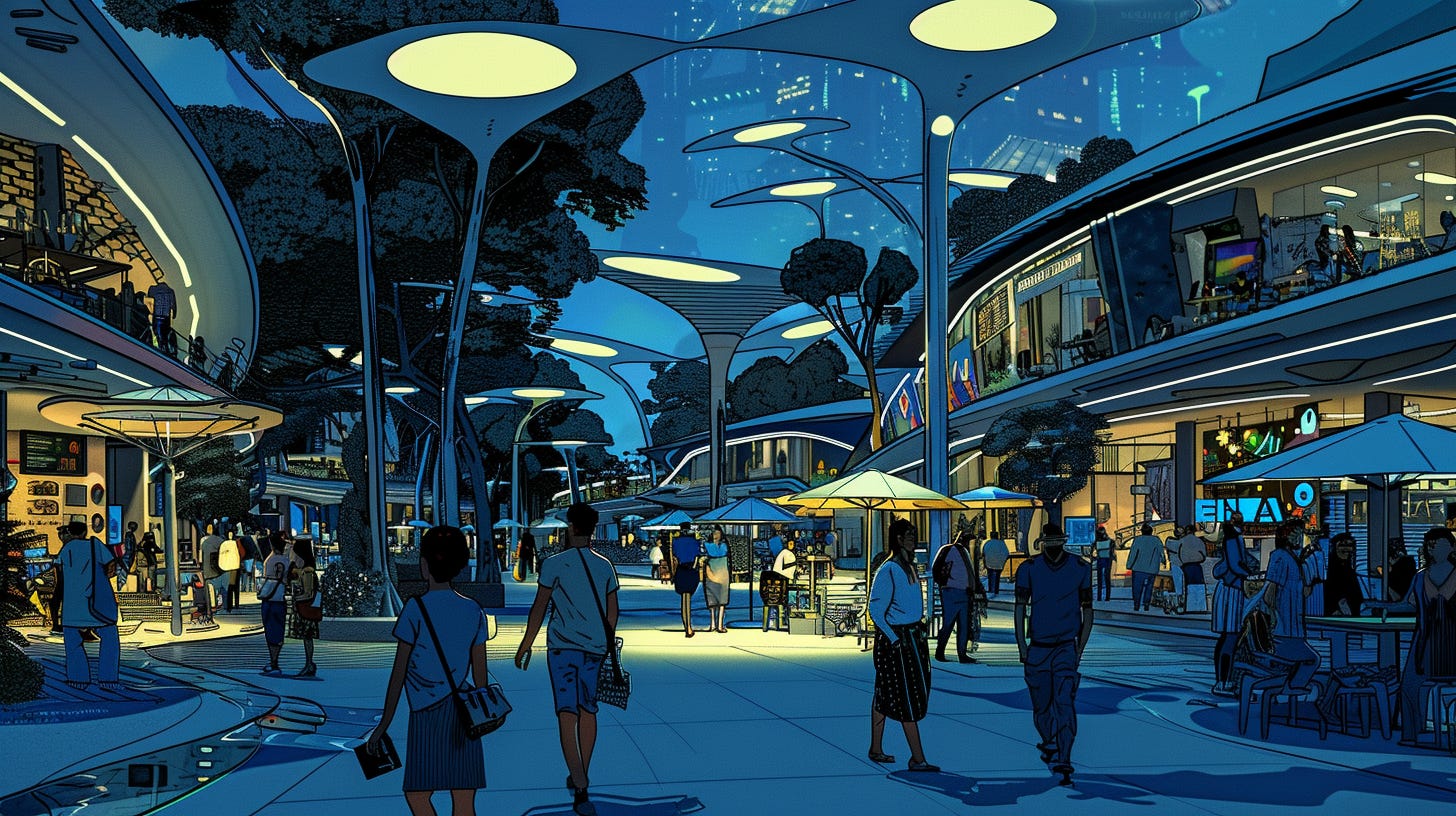
Freed from those imperatives, cities transform into places designed for living, not just working.
- Mixed-use neighborhoods where homes, shops, studios, and gardens intermingle.
- Streets designed for walking, biking, and lingering conversations rather than endless streams of cars.
- Autonomous transit systems that arrive on demand, eliminating the need for personal vehicles and parking lots.
- Public plazas, courtyards, and green spaces that encourage gathering and play.
The air smells cleaner without exhaust fumes. The soundscape changes: birdsong replaces traffic noise, laughter replaces honking horns.
Even architecture reflects diversity: some buildings are sleek and modern, others whimsical or inspired by ancient forms. With AGI handling the logistics of supply and maintenance, design becomes an art again, a collective expression of taste and care.
Cities no longer feel like machines that humans must endure.
They feel like gardens that humans get to tend.
Healthcare as Uplift, Not Gatekeeping
Healthcare, perhaps more than any other system, shows what abundance truly means.
In the industrial world, healthcare was designed to fix broken workers just enough to send them back to the factory. It was built on scarcity: limited doctors, limited medicine, limited access. Bureaucracy grew as a way to ration that scarcity, to decide who was worthy of care and who was not.
With AGI-driven abundance, those gates swing open.
Wearable sensors continuously monitor vital signs, catching problems before they escalate.
Diagnostics happen instantly, with AGIs analyzing data far faster than human specialists ever could.
Treatment is precise, preventative, and deeply personalized — delivered seamlessly rather than hoarded like treasure.
Mental health is treated as integral to well-being, not a luxury. Therapy sessions are available on demand, guided by AI companions trained to listen and support without judgment. Community wellness programs flourish, blending art, movement, and connection into everyday life.
The very experience of seeking care changes.
No forms. No waiting rooms. No fear of financial ruin.
Just a gentle, continuous network of support.
Healthcare stops being a system you fight to access. It becomes part of the invisible infrastructure of living well — like clean water or sunlight.
Status Without Survival Stakes
The deepest shift may come not from external systems, but from within us.
For thousands of years, status has been tied to survival.
Who had the most food, the most power, the most money — these questions weren’t just about pride. They were about safety. High status meant you were more likely to survive and for your children to thrive.
In a post-scarcity world, those stakes dissolve.
The basic needs of life are guaranteed. No one rises by pushing others down.
So what becomes of status when it no longer determines survival?
It doesn’t vanish.
Instead, it transforms.
Status becomes a reflection of creativity, beauty, insight, and generosity.
It’s no longer, “Who makes the most money?” but, “Who makes the most meaning?”
Festivals, art installations, collaborative storytelling projects — these become the arenas where status plays out. Not because people must compete to live, but because people love to create and share.
A mural painted on a city wall is as celebrated as a breakthrough in physics or a haunting piece of music.
The metrics of worth shift from accumulation to expression.
For the first time, status can be playful rather than punishing — a way to celebrate diversity instead of enforcing hierarchy.
The Shape of a New World
Taken together, these changes form a society almost unrecognizable from our own.
- Nights filled with quiet stargazing instead of restless anxiety.
- Children learning through exploration rather than standardized drills.
- Cities humming with life rather than choking on traffic.
- Healthcare woven seamlessly into daily existence.
- Status measured by joy and creativity rather than fear and scarcity.
This is not utopia. There will still be tensions, differences, and challenges. But it will be a world where those struggles happen on human terms, not under the shadow of machines and scarcity.
For the first time since the dawn of the factory age, our world begins to feel like ours again.
Challenges — The Psychology of Abundance
It’s tempting to imagine that when the chains of scarcity and standardization fall away, we’ll simply step into freedom like a bird released from a cage.
But humans are not so simple.
For generations, our lives have been defined by survival pressures and external structures.
The factory whistle. The school bell. The ticking of the clock. These were not just constraints on our time — they were anchors for our sense of meaning. When those anchors are suddenly removed, the result isn’t always joy. Sometimes it’s vertigo.
A post-scarcity world doesn’t automatically produce happiness.
It produces possibility, and possibility can be overwhelming.
To build a future worth living in, we must understand the psychological challenges that come with abundance — and meet them with care, not force.
The Risks of Freedom
Hedonism Without Meaning
When survival is no longer at stake, it’s easy to slip into endless pleasure-seeking.
Entertainment, indulgence, stimulation — all at your fingertips, all available without limit.
In the short term, this can feel intoxicating. For some, it’s even a necessary phase of recovery after a lifetime of stress and deprivation. A society coming out of scarcity may need a period of exuberance, like a festival after a long winter.
But if every day becomes a festival, joy begins to hollow out.
Pleasure without purpose quickly turns into numbness.
We’ve already seen glimpses of this in the modern world: binge-watching until sunrise, doomscrolling for hours, chasing likes on social media. These are small-scale rehearsals for a problem that will grow much larger in a world where the limits truly disappear.
The challenge isn’t to deny pleasure — far from it.
The challenge is to integrate pleasure into a life of meaning, so that abundance enriches rather than erodes us.
Gentle concern: “Freedom is not just the absence of hunger. It is the presence of fulfillment.”
Paralysis of Choice
Scarcity simplifies decisions.
When resources are limited, many choices are made for you: what job to take, where to live, how to spend your time. Even if the options are harsh, there’s a certain clarity in having few of them.
Abundance removes those constraints. Suddenly, everything is possible.
That sounds liberating — and it is — but it can also be paralyzing.
Psychologists call this choice overload.
When faced with too many options, people often freeze. They second-guess themselves. They drift rather than decide. In a world where you can do anything, it becomes strangely difficult to do something.
In a post-scarcity society, this effect could grow profound. Imagine standing before an endless buffet of experiences:
- You could spend the next decade learning to sculpt marble statues… or explore deep-sea ecosystems… or compose symphonies… or live in a floating city orbiting Mars.
- You could do all of these things, eventually.
- But where do you begin?
- And how do you know you’ve chosen well?
Without guidance, infinite freedom can feel like drowning.
This is why curation and mentorship become essential. Not gatekeeping — no one should be forced down a particular path — but gentle, personalized guidance. AGIs can help here, not by dictating choices, but by acting as companions who reflect back our values and nudge us toward what feels most meaningful.
Compassionate guidance: “You don’t need to plan your whole life today. Let’s just choose the next step, together.”
Nostalgia for Control
Some people won’t struggle with abundance because it’s too empty.
They’ll struggle because they miss the old structures, even if those structures were oppressive.
There is a strange comfort in predictability.
The factory whistle may have been harsh, but it gave the day a clear shape. The school bell, the workweek, the paycheck — these things told us who we were and where we belonged. Even systems of hierarchy provided a grim kind of security: you always knew where you stood.
When those systems vanish, some will feel unmoored.
They may even seek to recreate them voluntarily:
- Communities that enforce strict schedules and rules.
- Work-like rituals that mimic old jobs.
- Even forms of scarcity deliberately reintroduced, just to bring back the thrill of competition.
This isn’t failure. It’s a natural human impulse to seek continuity with the past.
The danger comes only if these nostalgic enclaves try to impose their way on everyone else.
The solution is to treat them with respect — to allow them space to exist without letting them dominate. Just as one person might prefer biphasic sleep while another prefers a single block, different cultural rhythms can coexist, as long as participation remains voluntary.
Respectful acknowledgment: “If some people still want the clock, they should be free to keep it. They just shouldn’t be able to chain it to the rest of us.”
Cultural Scaffolding for the Transition
These challenges are real, but they are not insurmountable.
We have crossed great thresholds before — from hunter-gatherer bands to agricultural villages, from villages to cities, from empires to modern nations. Each transition brought upheaval, but also new ways of guiding human behavior.
The difference now is that we have intelligent allies to help us navigate the change.
- AGI as guide: Advanced systems can act as companions, therapists, and cultural stewards. Not to coerce or control, but to listen, reflect, and gently guide. They can help individuals explore options without drowning in them, and help communities experiment with new forms of living.
- Voluntary enclaves: Those who prefer old rhythms — rigid schedules, scarcity-based competition — can have spaces designed for them. In these enclaves, legacy systems can be reenacted safely, without forcing them on others.
- Gentle nudges: The key is choice. AGI can shape environments that naturally encourage balance without removing freedom. Think of it like a garden: pathways are laid out, but you are free to wander.
This scaffolding doesn’t prevent mistakes. People will still struggle, falter, and grow.
But it ensures that when they stumble, they do so in a world that catches rather than crushes them.
Why This Matters
Without acknowledging these challenges, the dream of a post-scarcity world risks becoming shallow. It would be easy to assume that abundance automatically equals happiness, or that dismantling the factory age will magically fix everything.
The truth is subtler — and more hopeful.
Abundance gives us the tools to shape a better world, but it doesn’t tell us how to use them. That part is up to us.
The very act of learning to live well will become a shared project, one of the great adventures of this new age.
“Freedom is not just given. It is built — one choice, one community, one generation at a time.”
The final step is not simply imagining this better world, but learning to inhabit it.
And that begins, as it always has, with a single human moment — a quiet breath, a decision to rise, a step taken in a night no longer ruled by the clock.
The Dawn After the Factory
The house is still, but not silent.
Outside, a warm breeze carries the scent of flowering vines from a rooftop garden. Faint voices drift through open windows: a lullaby sung to a child, laughter rising from a group of friends lingering over a late meal. Somewhere in the distance, a stringed instrument plays, its notes blending with the night air.
It is well past midnight, though in this neighborhood, such a detail barely matters.
The city never sleeps in unison anymore — not in the way old cities once did. Some districts hum with life at dawn, others come alive at dusk. A thousand different rhythms, weaving together like threads in a living tapestry.
In one small home, a woman stirs and opens her eyes. She does not glance at a glowing screen to check the hour. There are no alarms here, no external demands tugging her from dreams. She wakes because her body is ready to wake, because her mind has risen naturally from the deep waters of first sleep.
She slips from her bed and wraps a light shawl around her shoulders, much as her ancestors once did hundreds of years before. The floor is warm beneath her feet — a gift of silent geothermal systems that keep the home comfortable without effort or thought. She pads softly into the main room, where a low fire still smolders in the hearth, not out of necessity, but out of love for its glow.
Outside, the streets are quiet but not empty.
Two neighbors cross paths and stop to share a few words before continuing on their way. Down the block, a small gathering reads poetry beneath paper lanterns. A young man with a telescope gestures toward the sky, showing his companions the curve of Saturn’s rings.
The woman pauses at her doorway, breathing in the night. She thinks of a story her grandmother once told — about a time when people feared this very hour. When waking in the middle of the night was considered a disorder. When entire societies were locked into strict blocks of sleep and labor, their lives ruled by mechanical schedules.
She can barely imagine it.
And yet, she feels the echo of it, like a faint scar on the world.
A fragment of that ancient industrial rhythm still lingers in old words, old habits, even old architecture preserved as history. Museums display the artifacts of that era: factory whistles, punch clocks, yellowing timecards. They seem strange now, like relics from another species. Children laugh at the idea that once, vast cities would go dark and silent all at once, then roar awake at precisely the same hour.
The woman walks down the quiet street and passes a fountain, its water shimmering under moonlight. She kneels to touch the surface, watching the ripples spread outward. For a moment, she thinks of the generations who lived and died without ever feeling this freedom. People who woke each day to the harsh summons of a clock, never knowing there could be another way.
They endured so that this moment could exist.
The transition from scarcity to abundance was not easy.
It never is.
There were decades of struggle, confusion, and doubt. Some clung to the old ways. Some feared the new ones. But slowly, piece by piece, the world let go of its machine-made skin. The old structures dissolved, and new forms of life took root.
Now, centuries later, the world hums with diversity.
Not the rigid uniformity of the factory age, but a vast garden of choices, each community and individual blooming in its own way.
The woman rises, feeling the cool night air against her skin. She looks up at the sky, where stars shine bright and clear — unpolluted by the glare of industrial light. She smiles, knowing that elsewhere, under this same sky, millions of people are waking or sleeping or dreaming, each according to their own rhythm.
For the first time in human history, they are truly free to live by themselves.
“The Industrial Revolution taught us to live by the clock. AGI gave us back the night — and, with it, the future.”
- Iarmhar
November 23, 2025
This essay is part of the Human Flourishing, Time, and Everyday Meaning Cluster