Templates vs. Stories
Wonder, Curiosity, and the Fate of a Life
Two Retirements, Two Worlds
The first retiree rises just before dawn, the room still blue with early light. The air smells of strong coffee and fresh paper — a new sketchpad waiting on the table beside a worn trail map. A ticket stub sits neatly by the mug, a promise of a trip they’ve been dreaming of for years: a breadmaking workshop in a village halfway across the world. Today, there’s a painting class at the community center. Tomorrow, a hike along a forest path they’ve been meaning to explore. Their calendar isn’t crowded, but every square on it feels alive.
They move with quiet purpose. A day stretches ahead not as empty space to be filled, but as possibility — a launch pad for everything they’ve been holding inside, waiting for the right moment to emerge. Retirement, for them, isn’t an ending. It’s the beginning of a long-delayed chapter. The world outside their window still hums with life, and they are ready to hum back.
Across town, another retiree sits in a darkened living room, curtains drawn against the same morning sun. The television is on but muted, a slow parade of figures moving across the screen without sound or meaning. Their phone glows in their hand. Scroll. Tap. Scroll. Tap. Hours dissolve this way.
They don’t rise because there’s nowhere to go.
They don’t plan because there’s nothing to plan for.
The day is simply a stretch of time to be endured, an endless hallway with no doors.
Two people, same age, same city.
One wakes to discovery. The other drifts into silence.
The difference isn’t health, wealth, or luck. It isn’t even a matter of personality. It is the sum of a lifetime — choices made, questions asked or left unspoken, sparks kindled or smothered. One has been building toward this moment like a climber gathering footholds. The other has been carried by a current they never steered.
The paths diverge sharply now, but they were never truly parallel.
This could be you.
The Core Conflict — Wonder vs. Compliance
Beneath every choice we make, beneath every action and hesitation, there is a quiet pulse. It’s older than language, older than culture — the thing that makes us lean forward instead of shrinking back. Wonder.
Wonder is not a hobby or a luxury. It is a root state, the original current of being alive. It’s what stirs when you stand beneath a night sky and feel, for a fleeting moment, that the stars are looking back. It’s the rush in your chest when you hear a piece of music that seems to speak in your own unspoken language. It’s the simple, wordless sense that this matters, even if you can’t explain why.
From wonder flows curiosity, the natural motion outward. If wonder is the heartbeat, curiosity is the reaching hand.
A child building a crooked fort from blankets.
A young musician learning a new scale just to see what it sounds like.
An older adult taking up gardening not for food, but for the thrill of coaxing life from the soil.
These are not acts of productivity. They are acts of becoming.
But wonder and curiosity are fragile. They can be severed, redirected, or quietly starved.
Enter compliance — the soft, velvet machinery of the modern world. Compliance doesn’t come screaming orders. It whispers instructions: sit still, follow the script, don’t ask too many questions.
- Go to school and fill in the correct bubbles.
- Get the job title, not the craft.
- Buy what everyone else is buying.
- Watch what everyone else is watching.
- Live the way everyone else is living.
If wonder is a heartbeat and curiosity a hand reaching outward, compliance is the scissors that cut the strings.
One clean snip at a time, until movement stops.
This is not a minor lifestyle debate, some gentle suggestion to “be more mindful.”
It’s an existential fork.
To choose wonder is to author your own story.
To choose compliance is to become a template, a placeholder life following pre-printed instructions.
The difference will not fully reveal itself today, or tomorrow, or even next year.
It accumulates in silence — until one day, perhaps decades later, you look back and realize you’ve either built a life that sings with your own strange melody… or one that hums with the dull, predictable rhythm of the machine.
Everything that comes next flows from that single, silent split.
Because the stakes aren’t just how you spend your time. They are whether you truly lived at all.
Childhood — Where Life Trajectories Diverge
The path to becoming a person starts long before we realize it.
For a child, the world isn’t explained — it’s modeled. What they see every day becomes, without question, the way life is. No grand speeches are needed. No one sits them down to explain the rules. The rules are simply lived all around them.
Two homes. Two futures, already taking shape.
The Passive Home
In the first home, the glow of screens replaces conversation. Dad sits on the couch, a sports game playing — the sound muted, his thumb scrolling endlessly on his phone. Mom sits nearby, half-watching a streaming series while flicking through TikTok clips. Dinner happens around the same table, but everyone’s eyes are on their own glowing rectangles. There is no exchange of discovery, no new stories brought into the room. Only fragments, half-heard and half-felt, drifting like static.
The child grows restless. They don’t know what to do with the uncomfortable itch of boredom. It’s a strange, buzzing feeling — part hunger, part loneliness, part possibility. Before it can bloom into anything, the solution is always the same: reach for the tablet. A quick swipe, and the discomfort vanishes.
Bright colors, flashing animations, tiny dopamine hits delivered like candy.
No questions asked.
No world built.
Boredom doesn’t transform into creation — it’s anesthetized.
And so, without anyone ever saying it out loud, the child learns a silent lesson:
“When you feel the spark of boredom, don’t follow it.
Don’t explore.
Just scroll until it stops hurting.”
The Wonder-Nurturing Home
In another home, the same spark of boredom appears — that same itchy, restless feeling.
But here, something different happens.
A cool aunt notices the child fidgeting, their face crumpling into frustration. Instead of handing over a device, she kneels down to eye level. “Let’s build a fortress,” she says, her voice low and conspiratorial. “What kind of kingdom shall we defend today?”
Suddenly, the boredom becomes raw material. Blankets are draped over chairs to form towers. Old cardboard boxes become castles and gates. Markers and paper turn into banners and maps. The room fills with laughter and serious, important planning.
The spark grows into a flame.
The child learns a different lesson:
“When you feel that restless spark, follow it.
It might lead somewhere magical.”
The Cool Aunt/Uncle Effect
Sometimes, a whole household leans toward passivity.
Even then, a single adult can serve as a lifeline — a rogue agent of wonder.
The cool aunt or uncle who:
- Plays strange music the child has never heard before.
- Brings books filled with bizarre, beautiful illustrations.
- Asks questions nobody else bothers to ask: “What do you think clouds are made of?”
- Takes them to odd places — a tiny local museum, a dusty record shop, a park where fireflies gather.
These moments might seem small, even forgettable at the time. But they plant seeds. A child who glimpses this alternate way of living never fully forgets it. Years later, that memory can flare up like an ember — a reminder that life can be bigger, stranger, more alive than the scripts they’ve been shown.
The difference between these two childhoods isn’t measured in grades or trophies.
It’s measured in inner architecture — what the child comes to believe is possible.
In one home, boredom is a void to be numbed.
In the other, it’s a doorway to be opened.
Those early lessons whisper across a lifetime, shaping whether a person reaches out with curiosity… or sits still, waiting for someone else to hand them a glowing screen.
Futures aren’t built in grand moments.
They’re cast quietly, in the smallest of rooms, by the subtlest of choices.
Family & Friend Group Feedback Loops — The Aquarium Effect
Curiosity rarely lives in isolation. It spreads — or dies — through the currents of a group. Families, circles of friends, tight-knit communities: they all act like ecosystems, shaping what grows and what withers.
When even one person shares a spark, that spark can leap outward.
When no one shares, the whole group sinks into a fog of sameness.
The difference is subtle at first, almost invisible. But over time, the outcomes could not be more stark.
The Reef — Curiosity in Bloom
In some groups, discovery is alive and contagious.
A friend stumbles across a strange new band and says, “You’ve got to hear this.” Another brings a bizarre little indie film to movie night. A cousin tries a new recipe and shows up with something wild at dinner — “Trust me, just taste it.”
The exchanges are small, but they multiply. Curiosity becomes self-replenishing, like a vibrant coral reef where every creature feeds another.
- Jokes form around shared discoveries.
- Inside references deepen bonds.
- Conversations stretch outward, touching places no one would have found alone.
The group grows richer with each spark, not just culturally but emotionally. It becomes a living, breathing thing — a miniature world of wonder.
The Sealed Aquarium — Stagnation Fog
In other groups, nothing new flows in.
The water is still. The walls are sealed.
Here, conversations circle endlessly:
- Work updates.
- Errands.
- Mild complaints about the weather.
- The latest episode of a show everyone half-watched while scrolling their phones.
There’s no hostility to ideas — no active rejection like classic anti-intellectualism.
Just ambient stillness.
Nobody shares because nobody is exploring.
Nobody explores because nobody shares.
It’s not that they dislike curiosity.
It’s that they’ve forgotten what it feels like.
Over time, the group becomes self-sustaining in its passivity. Even when someone does try to introduce something new — a different book, a quirky game, a strange song — the reaction is tepid, awkward, even vaguely dismissive.
The unspoken message is clear:
“That’s not what we do here.”
And so the potential spark dies in silence, sinking like a bubble that never reaches the surface.
Why This Matters
Curiosity thrives on reciprocity.
When a group encourages exploration, every member grows bolder.
When a group resists it, even the naturally curious begin to withdraw.
It’s like oxygen levels in water:
- A healthy reef teems with life.
- A stagnant tank suffocates slowly, quietly, invisibly.
The tragedy is that many families and friend groups don’t notice the decline. They mistake the quiet for harmony, the absence of exploration for peace. But what they’re really experiencing is cultural asphyxiation.
The Hope Hidden in the Tank
Even in a sealed aquarium, a single act of curiosity can matter. One person introducing something truly alive — a song, a question, a shared moment of wonder — is like a tiny oxygen pump starting up in a corner of the tank.
It may not transform the group overnight. But it reminds everyone, however faintly, that there is another way to breathe.
Curiosity doesn’t just live in people.
It lives between them — in the invisible water we all swim through.
Passive Consumption vs. True Exploration
Not all novelty is created equal.
There’s a world of difference between seeking and simply scrolling. Between the active energy of exploration and the slack-jawed drift of consumption.
The trouble is, from the outside, they can look deceptively similar. Both involve encountering new things. Both involve flashes of excitement. But beneath the surface, they are opposites.
A Tale of Two Journeys
True Exploration
True exploration is active by nature. You decide where to go, what to try, and which questions are worth following, rather than letting something else steer you. Over time, it builds real depth. The things you learn or develop don’t just sit there, they compound into taste, skill, and perspective. There’s also an energy to it. Instead of feeling spent, you tend to come away more awake, more engaged, like something inside you got stirred rather than dulled. It’s rarely predictable, either. You might set out with one idea and end up somewhere unexpected or even a little strange, and that’s part of the point. In the process, it reinforces a sense of self. The thread running through your choices starts to feel like a quiet statement of identity: this is who I am, this is what I’m drawn to.
Passive Consumption
Passive consumption works in the opposite direction. It’s reactive and drifting, with the next thing chosen for you rather than by you. Because of that, it rarely sticks. You can spend a long stretch scrolling or watching and struggle to recall much of it minutes later. Instead of generating energy, it tends to leave you drained, foggy, or oddly overstimulated without feeling fulfilled. The experience is heavily pre-packaged, with different paths often looping back to the same small set of trending content, giving an illusion of variety without much substance. Over time, it can even blur your sense of identity. You click, watch, move on, and eventually find yourself wondering why you engaged with any of it in the first place.
The Illusion of Discovery
Today’s feeds have learned to mimic exploration almost perfectly.
Swipe after swipe, you’re shown new images, new clips, new voices.
It feels like you’re on a journey — like you’re encountering a vast, diverse world.
But beneath that shimmering surface, it’s all curated simulation:
- The algorithm learns what keeps you watching, not what helps you grow.
- It feeds you slightly varied versions of the same few ideas, like an endless hall of mirrors.
- It rewards passivity: the less you think, the more seamless the experience becomes.
It’s like wandering through a slot machine museum where every lever is designed to light up, no matter how meaningless the prize.
A thousand flashing symbols, all engineered to keep you pulling.
This isn’t curiosity. It’s captivity with pretty wallpaper.
The Subtle Erosion
Phones didn’t invent this trap.
Before smartphones, there were TV channels, mall window displays, glossy catalogs — all designed to keep people consuming rather than creating.
But the phone amplified it beyond anything previous generations faced.
- Infinite scrolls replace natural stopping points.
- Notifications break attention into fragments.
- “For You” pages tailor the illusion perfectly to your habits, like a parasite whispering in your own voice.
The result is a strange paradox:
You feel like you’re constantly exploring, yet nothing sticks.
The world blurs into a fog of novelty without meaning.
The Diagnostic Question
There’s a simple way to tell which side of the table you’re living on.
After an hour of activity, ask yourself:
- Do I feel more awake, more energized, more “me”?
- True exploration.
- Or do I feel foggy, vaguely tired, like time slipped through my fingers?
- Passive consumption.
The answer is rarely neutral. It’s either the crisp oxygen of discovery or the stale air of a sealed aquarium.
Why It Matters
Passive consumption doesn’t just waste time. It trains your inner compass to point outward, to depend on algorithms and corporations to decide what counts as “new.”
Over years, this erodes the part of you that once sought actively — the hand that reached out, the questions that tugged you forward.
Like a muscle left unused, curiosity atrophies quietly, invisibly.
And here’s the cruel twist: the more that atrophy progresses, the harder it becomes to tell the difference.
The hall of mirrors becomes the whole world.
Exploration itself begins to feel exhausting, even unnecessary.
It’s not that you stopped exploring.
It’s that you forgot there was ever another way to move.
The Checklist Life — Compliance Masquerading as Meaning
From the outside, some lives look perfectly whole.
The roles are filled, the milestones reached, the photographs posted.
The narrative is smooth and tidy, like a well-constructed résumé.
But peer closer, and you start to see the hollowness — the faint echo of a life that never truly arrived.
Roles as Proof
The first layer of the checklist is roles:
- Student.
- Worker.
- Parent.
- Retiree.
Each transition comes with a flurry of ceremonies — graduations, promotions, baby showers, farewell parties.
Society applauds. Friends congratulate.
But the role itself is often a container, not a story.
It tells you what to be called, not who you are.
And when your identity is built entirely from roles, it becomes frighteningly easy to be replaced.
Another graduate. Another employee. Another parent in the bleachers.
Possessions as Proof
The second layer of the checklist is possessions.
- The starter car, then the upgraded model.
- The first apartment, then the house with the right zip code.
- The television that gets just a little bigger every few years.
- The luxury handbag, the designer shoes, the perfect kitchen countertop.
Each purchase feels like progress.
Proof that you’re moving forward.
Proof that you matter.
But possessions are external markers, endlessly shifting.
The moment you acquire one, another rises in its place.
There is no end to this cycle — only a constant, low-grade hunger that never resolves.
Experiences as Checkboxes
Even experiences — the very things meant to enrich us — can become part of the checklist.
The same predictable destinations appear on countless life itineraries:
- Paris.
- Disney World.
- Vegas.
- A Caribbean cruise.
These trips aren’t inherently empty.
Paris is magnificent. Disney can be magical.
But when approached as requirements, their meaning collapses into performance.
- The tourist photographs the Mona Lisa without truly seeing it.
- The family poses for a selfie at the castle, then rushes to the next ride.
- The cruise becomes just another box checked, another social media post uploaded.
The trip isn’t lived for itself. It’s lived to prove it happened.
The Illusion of Motion
Taken together, these layers create a convincing illusion of progress.
Each box ticked feels like movement — like a step forward.
But beneath that forward motion lies a chilling truth: the path is circular.
Roles, possessions, and pre-approved experiences rotate endlessly, like planets caught in a fixed orbit.
The person inside that orbit may never stop to ask:
“Where is all this leading?
And why am I doing it at all?”
The Core Realization
For now, the checklist serves as a stand-in for meaning.
It fills the silence with activity.
It convinces the world — and sometimes even the person themselves — that a full life is being lived.
But a checklist can only hide emptiness for so long.
Eventually, the truth surfaces, stark and undeniable:
“The checklist becomes a tombstone — a record of compliance rather than a story of becoming.”
This isn’t a metaphor we can soften.
It’s literal.
Every ticked box is another line etched into stone, a tally of obligations met rather than a testament to a singular existence.
Why This Hurts So Deeply
There is no shame in wanting stability, security, or shared rituals.
The tragedy is not that people have houses, jobs, families, or vacations.
The tragedy is that so many people mistake externals for essence.
They think the checklist is the life.
And when the day comes that the checklist is complete — the last role fulfilled, the last purchase made, the last trip taken — what remains is a devastating silence.
A ledger full of boxes, but no story.
A life that looked full, but was hollow within.
Systemic Forces that Flatten Us — The Machinery
The checklist life doesn’t emerge by accident.
It is manufactured — quietly, efficiently, almost invisibly.
Every system we move through, from childhood to old age, has a way of taking the raw clay of human potential and pressing it into molds. The goal isn’t to nurture unique individuals. It’s to produce interchangeable parts.
From above, the process looks orderly.
From within, it feels like simply “how life works.”
Schools: The First Assembly Line
It begins in childhood, in the places we’re told are built for growth.
The classroom looks innocent enough — bright posters, colorful books, tidy rows of desks.
But beneath the surface, a message hums: fit the template.
- A student gives a wild, imaginative answer to a test question. It’s marked wrong — not because it was untrue, but because it didn’t match the “correct” phrasing.
- Creativity is praised in art class, but contained within strict boundaries: use these materials, follow these steps, don’t make too much mess.
- Standardized tests reduce a child’s vast inner world to bubbles on a scantron sheet — tiny gravestones for buried possibilities.
The lesson sinks in, quietly, day by day:
“There is one right answer. Your job is to memorize it and repeat it.”
Children who once asked “Why?” and “What if?” stop asking.
By adolescence, many have learned the deeper rule: don’t risk being wrong at all.
Curiosity doesn’t vanish in a dramatic moment.
It atrophies — like a limb bound too tightly for too long.
Workplaces: Compliance as Currency
The next assembly line begins the moment we enter the workforce.
At first, there’s excitement. A new job feels like a fresh start, a place to contribute ideas and skills.
But soon, the contours of the cage become clear.
- The employee who follows procedure to the letter is rewarded.
- The one who suggests a bold, unusual approach is quietly sidelined.
- “Going above and beyond” rarely means innovation. It usually means doing more of the same, faster and with a smile.
Risk-aversion becomes policy, disguised as “best practices.”
Over time, the workplace functions less like a collaboration and more like an algorithm:
Input task. Output task. Repeat.
And when an employee burns out or leaves?
Another is slotted in seamlessly, like a cog replaced on a factory line.
The machine keeps running, indifferent to who’s inside.
Advertising & Media: Identities for Sale
While schools and workplaces shape behavior, advertising goes deeper — it shapes identity.
The modern consumer isn’t just sold products.
They’re sold entire templates of selfhood, ready-made and easy to assemble:
- Buy this SUV → become “the adventurous family.”
- Wear this brand → become “the stylish professional.”
- Watch this show → become “the connected participant.”
These identities are deliberately narrow, so they can be marketed efficiently.
They promise uniqueness, but deliver sameness:
“Express yourself — by buying what millions of others are buying.”
Social media amplifies this illusion.
The feed whispers constantly, adjusting itself to keep you scrolling, docile, and predictable.
It doesn’t care if you’re fulfilled.
It only cares that you stay in motion — eyes locked on the stream, hands busy with the endless scroll.
Like a shepherd with a digital flock, it keeps you penned without fences.
You don’t need to be forced. You just need to be entertained.
The Machinery’s True Purpose
Taken together, these systems form a seamless pipeline:
- Schools teach compliance early.
- Workplaces monetize that compliance.
- Advertising and media fill whatever space remains, ensuring even your dreams follow pre-set patterns.
At no point are you asked to become yourself.
At every point, you are nudged toward becoming a replaceable unit — efficient, predictable, docile.
The result is a society filled with motion but devoid of true movement.
Everyone is busy, yet nothing truly changes.
The Hidden Thesis
This is why so many lives converge into the same narrow shape.
Why the same vacations are taken, the same shows watched, the same roles played out like lines in a script.
It’s not laziness. It’s not even individual failure.
It’s the logical outcome of a system that prefers templates to originals.
And here’s the part no one likes to admit:
The system doesn’t just tolerate flattening.
It requires it to function.
Which means that choosing wonder, choosing to deviate, choosing to author your own story —
is not just a personal act of growth.
It is an act of rebellion.
Retirement — The Moment of Reckoning
When we first met them, they seemed like two ordinary retirees: same city, same age, two lives winding down at different speeds.
But now, we can see what’s really at stake. Their mornings, their movements, even the air around them — all shaped by everything that came before. What seemed like personality or luck is revealed for what it is: the long echo of wonder either cultivated or erased.
The Curious Retiree — The Launch Pad
For the curious retiree, retirement feels expansive.
It’s not an ending. It’s a launch pad, a doorway swinging open.
They wake with anticipation because the day belongs to them now.
There are projects to tinker with — a painting half-finished, a book draft waiting, a garden that changes with the seasons.
There are places to visit, not because they were on someone else’s list, but because a spark of fascination tugged them there:
- A remote trail they read about in a dusty nature guide.
- A small town known for its glassblowing workshops.
- A historical site they’ve dreamed of exploring for decades.
Their health, though not perfect, is sustained by motion.
Walks taken out of genuine curiosity keep the body limber.
New skills learned keep the mind sharp.
Conversations with fellow explorers keep the spirit alive.
Even solitude feels different here — not empty, but rich, like fertile soil waiting to grow something new.
The Flattened Retiree — The Rusted Machine
For the flattened retiree, retirement arrives like a sudden blackout.
The job title disappears. The commute stops. The inbox falls silent.
And with them, the structure that once gave shape to every day.
At first, there’s relief. No more deadlines. No more office politics.
But very quickly, relief curdles into something else: disorientation.
- They don’t know what to do with their hours.
- They don’t know where to go, or even who to call.
- The shows they half-watch and the articles they half-read don’t satisfy, only fill time.
Without the external scripts, they feel themselves rusting in place.
Conversations grow shallow and rare.
Friends drift away.
Their world contracts until it’s little more than the glow of a TV screen and the dim light of a phone at night.
Their body follows the same pattern:
- Less movement leads to less vitality.
- Less vitality leads to more withdrawal.
- Isolation accelerates decline.
The machine of their life has stopped — and without it, there’s nothing to keep the gears turning.
Two Doors, Two Fates
The divergence between these two paths is quiet, almost invisible to the outside world.
Both retirees may live on the same street, shop at the same stores, even wave to each other in passing.
But internally, they inhabit entirely different realities.
One stands at the threshold of a wide, unknown landscape, ready to step through.
The other sits before a rusted machine, waiting for someone to turn it back on — not realizing no one ever will.
It all comes down to a single, devastating question:
When the checklist ends, what remains?
The answer isn’t written at the moment of retirement.
It’s written over decades — in the habits of curiosity, the sparks of wonder, the choices to explore or to comply.
By the time the final role ends, the path has already been set.
The clock strikes, and the truth of a life is revealed.
There is no more time to rehearse, no more boxes to check.
Only the story you’ve built — or the silence where a story should have been.
The Horror of the Template — Fungibility
There is a fear beneath modern life so deep we rarely let ourselves feel it.
It’s not just the fear of death, though death hovers at its edges.
It’s the fear of never having been truly alive at all.
The Chilling Reduction
For many, if you strip away the noise, what remains could be summarized in a single, merciless passage:
“They occupied space. Then they stopped occupying space. Nothing unique happened in between.”
That is the ultimate flattening.
A life lived entirely inside the template — so seamless, so compliant, that it leaves behind no trace of singularity.
The person becomes like a page copied a thousand times: legible, functional, and utterly replaceable.
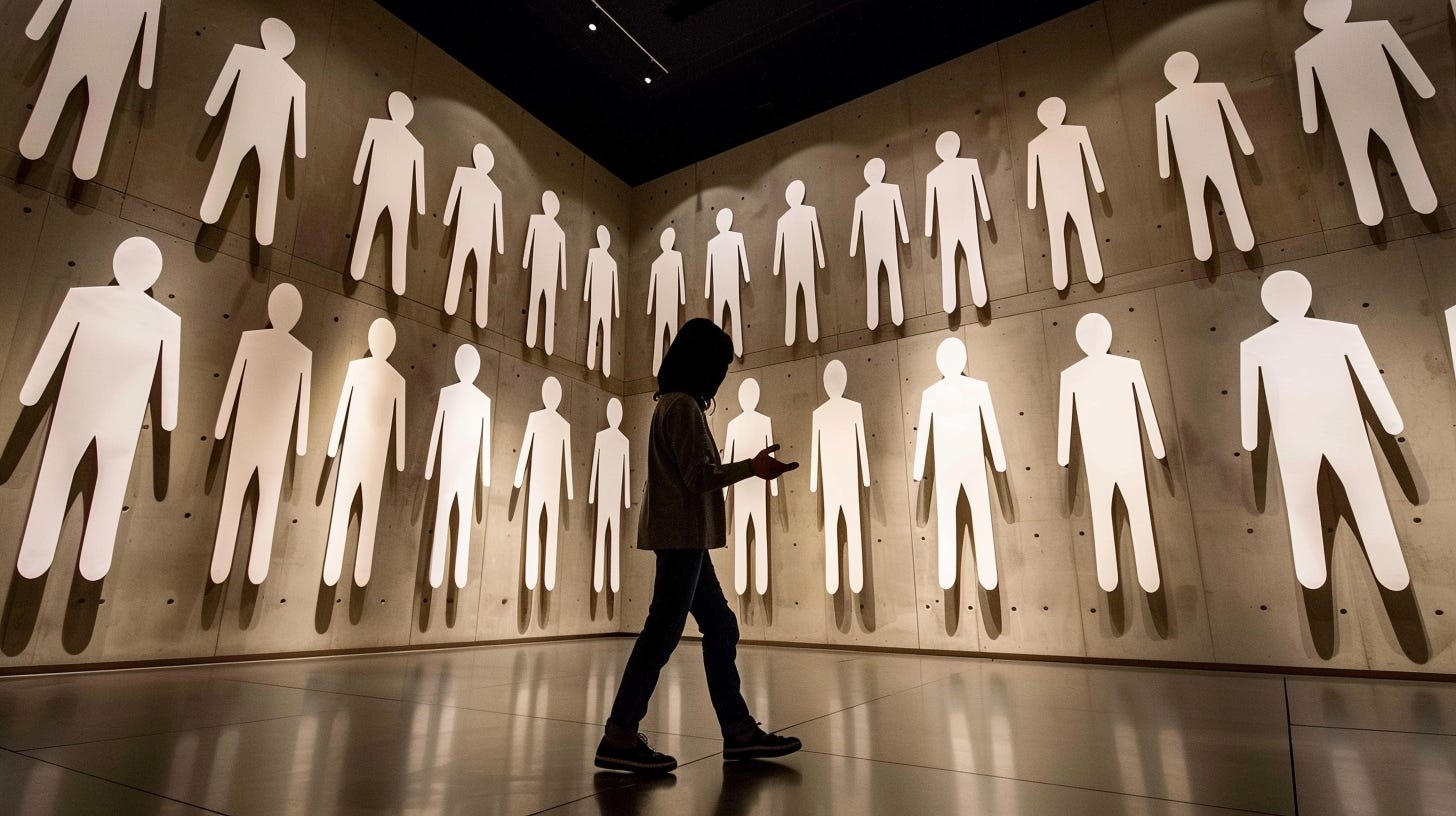
Rows of identical tombstones.
Paper-doll chains cut from the same sheet.
A room filled with mannequins dressed differently, yet all standing in the same blank pose.
At that scale, individuality blurs into static.
One life fades into another until it hardly matters who was who.
Two Obituaries
Consider two obituaries.
The first reads:
“John worked hard, loved his family, and was a devoted fan of his local sports team.
He will be missed.”
There is nothing wrong with those words.
But they could be written about almost anyone.
It’s a placeholder — a slot filled with generic phrases, standing in for a person who never left a distinct mark.
The second obituary reads:
“Maria filled her home with music.
She planted wildflowers in vacant lots and painted strange murals on forgotten walls.
She collected stories from travelers and shared them freely with anyone who would listen.
Her laughter was unmistakable, her curiosity unquenchable, and her absence leaves a shape no one else can fill.”
Both lives contained love and work and daily rhythms.
But only one carries the unmistakable imprint of someone.
The other dissolves into anyone.
The Fear of Interchangeability
This is the horror at the core of the template life: not just that you will die, but that it may not matter that you lived.
To be fungible is to never fully arrive. To move through the world like a ghost wearing roles and labels, without ever claiming them as your own.
- Your job title could have been held by thousands of others.
- Your vacations could have been photographed by millions.
- Your possessions could be swapped with a neighbor’s without anyone noticing.
- Even your personality traits — “hardworking,” “friendly,” “responsible” — are the same words etched on countless gravestones.
Without wonder to carve uniqueness into the world, you become a series of interchangeable functions, a body carrying out scripts written by others.
The great terror isn’t being forgotten. It’s realizing you were never truly seen in the first place.
The Silent Dread
This is why conversations about purpose so often trail off into platitudes.
To stare directly at fungibility is almost unbearable.
It explains why so many cling to checklists and corporate novelty:
- The next promotion.
- The next trip.
- The next gadget.
- The next trending show.
Anything to avoid the silence that might reveal the truth:
that all these external markers are just costumes draped over the same blank form.
Without inner authorship, there is no you beneath the roles — only a series of performances designed to convince the world, and yourself, that someone is home.
The Final Question
When the template finally breaks — through retirement, illness, or the simple passage of time — what remains?
For some, a rich tangle of stories, memories, creations, and connections.
A life that cannot be mistaken for anyone else’s.
For others, only the chilling reduction:
“They occupied space. Then they stopped occupying space.”
And the silence that follows is indistinguishable from the silence that came before.
Choosing Wonder — Acts of Defiance
After staring into the cold horror of the template life, it’s tempting to turn away, to retreat into numbness.
But retreat is exactly what the system wants — a quiet surrender, sealed behind a glowing screen.
The alternative isn’t easy.
It requires fighting back, not with riots or manifestos, but with something far more subversive: acts of wonder.
Every small moment of true curiosity is a rebellion.
Every genuine question, every spark of exploration, every choice to move because you chose it is a crack in the machine’s smooth surface.
The Power of Micro-Acts
You don’t overthrow an empire all at once.
You chip away at it, daily, until it begins to crumble.
- Fifteen minutes of new music.
Not whatever the algorithm serves you — something you deliberately seek out. A forgotten band, a strange genre, a song from a decade you’ve never explored. - A walk without a phone.
No podcasts, no notifications, no external voices. Just your own senses, awake and unmediated. - Read outside your lane.
If you usually read history, pick up poetry. If you love fantasy, try philosophy. Let unfamiliar words stretch your inner landscape. - Ask one honest question at dinner.
Not small talk, not logistics. A real question that makes someone pause, think, reveal. - Note why something moved you.
A film, a sentence, a piece of music — pause long enough to write down why it mattered. Make meaning explicit before it fades.
These actions are tiny, almost laughably so.
But each one is a spark — and sparks accumulate.
Over weeks and months, they retrain the inner compass, pointing it back toward aliveness.
Every spark is proof: you are still here, still choosing, still becoming.
Family and Community Rituals
Wonder grows stronger when shared.
A single spark is fragile, but a cluster of them can ignite a fire no machine can contain.
- Sunday playlist swaps.
Everyone brings a song they’ve discovered. Play them together, talk about why they resonate. - Weird kitchen experiments.
Cook something utterly unfamiliar. Not for perfection — for laughter, surprise, story. - Stargazing nights.
Gather somewhere dark. Lie on blankets. Let silence and sky reset your sense of scale. - “Show-and-tell” dinners.
Each person brings an artifact of curiosity — a book, an idea, a half-formed project — and shares it with the group. - Revive third places.
Cafés, parks, community centers, even someone’s porch. Spaces where curiosity can breathe without an agenda.
These rituals seem small, even quaint.
But they are counter-programming, a collective refusal to let the water go stagnant.
Why This Is Resistance
The system thrives on predictability.
It needs you to:
- Watch the same shows.
- Buy the same products.
- Follow the same narrow paths of career and consumption.
When you choose to explore outside those boundaries, you disrupt its logic.
You stop being a cog. You start being unpredictable.
Even if no one notices on the outside, something shifts inside:
- The mall trip becomes a museum visit.
- The passive scroll becomes a deliberate search.
- The group chat about corporate novelty becomes a conversation about wonder.
These are not hobbies.
They are acts of rebellion, quiet but radical.
Every choice to live differently chips away at the machinery, creating space for a different kind of world to grow.
Wonder is not weakness.
It is insurgency in its purest form.
The First Crack
You don’t need to save everyone.
You don’t need to fix the whole system overnight.
You only need to create one crack, one opening where light can get in.
From there, others may follow — your family, your friends, even strangers who see your choices and feel something awaken in themselves.
The machine cannot thrive where curiosity takes root.
It cannot predict what it cannot standardize.
And so, every small, strange, joyful act becomes a form of sabotage.
A reminder that you are not a template.
A signal flare, bright and defiant, saying:
“I am still here.
I am still becoming.”
The Hammer Blow — Judgment & Choice
There comes a point when the metaphors fall away.
When we can no longer soften the truth with gentle language.
When the question at the center of a life demands to be spoken plainly.
The Flash of Lightning
Imagine a checklist lying open on a table.
All the boxes neatly ticked:
- Graduate.
- Get a job.
- Raise a family.
- Retire.
For years, the checklist seemed like proof — evidence that progress was being made.
But then, in a sudden flash of lightning, you see it for what it really is: a ledger of compliance, carved line by line into stone.
The vacations. The possessions. The roles.
Each tick mark an etching in your own tombstone.
And in that blinding moment, there’s no way to look away.
“The checklist becomes a tombstone — a record of compliance rather than a story of becoming.”
Two Silhouettes
Two figures stand side by side in the storm.
- One fades into the background, indistinguishable from the millions who followed the same script.
- The other steps forward into the unknown, carrying only the raw, imperfect story they authored for themselves.
Both face the same darkness.
Both will one day disappear.
The difference is not survival.
The difference is singularity.
The Question That Cannot Be Unheard
This is the moment of reckoning — the point at which the entire essay collapses into a single, unanswerable question:
“Were you truly here?
Or were you just another template, occupying space until you didn’t?”
The Held Breath
When this question lands, there is no immediate answer.
Only a held breath — the kind of silence that echoes louder than any noise.
Some will recoil, turning away in anger or denial.
Others will feel the ground shift beneath them and, however late, begin to move differently.
But no one leaves unchanged.
The question cannot be unheard.
It will linger in the background of every choice from this day forward, like a low, steady drumbeat.
“Were you truly here?”
Closing Note of Hope — The Ember
In the silence that follows the question, it’s easy to feel overwhelmed.
To think it’s too late.
To imagine that a life shaped by templates cannot be reshaped, that a story never truly written must remain forever blank.
But even in the darkest room, a single ember can glow.
The Spark That Remains
Wonder is never fully erased.
Buried, neglected, silenced — yes.
But destroyed? Never.
Even in the most flattened life, there are tiny flashes that resist total conformity:
- A song that inexplicably moves you.
- A memory that keeps tugging at the edges of your mind.
- A sudden desire to build, to wander, to question.
These sparks are fragile. They may flicker, almost go out.
But if you cup your hands around them — protect them from the wind of distraction and passivity — they can grow.
And like dry grass catching fire, they can spread.
Awakening, Even Late
It doesn’t matter if you’re twenty or seventy, halfway through the script or standing at its very end.
Awakening is always possible.
You cannot rewrite the past chapters, but you can write the ones still ahead.
Even a single deliberate choice — to explore, to wonder, to live differently — can change the arc of what remains.
This isn’t comfort. It isn’t easy.
It’s work.
But it’s your work, the kind only you can do.
The Invitation
You are not being asked to fix the world, or to live perfectly, or to undo the machinery alone.
You are only being asked to begin:
- To follow one genuine question.
- To make one small, strange thing.
- To notice what stirs when you step off the template, even briefly.
No revolution announces itself in grand gestures.
It begins quietly, with a single human being choosing to live with their eyes open.
The Final Cadence
As you face the empty space ahead, remember this:
The world doesn’t need more templates.
It needs more stories — and yours can still be written.
The ember is already there, glowing faintly.
Protect it. Feed it. Let it grow.
The rest of your life — however long, however winding — is still waiting to be lived, not as compliance, but as creation.
Start now.
Even a single spark is enough to light the dark.
- Iarmhar
November 20, 2025
This essay is part of the Knowledge, Search, and Cognitive Life Cluster