The Death and Rebirth of the Third Place
How Culture and Economics Converged to Make Home the New Hangout
Prelude – The Quiet Turning
Once, community smelled like espresso and echoed with conversation. Morning light would spill across café tables cluttered with mugs, open laptops, and the easy murmur of strangers sharing space. It was a ritual of proximity — a quiet proof that life still hummed around you. Yet even then, something had begun to fade. The clatter of cups masked a fatigue that few recognized, a sense that connection was being replaced by performance.
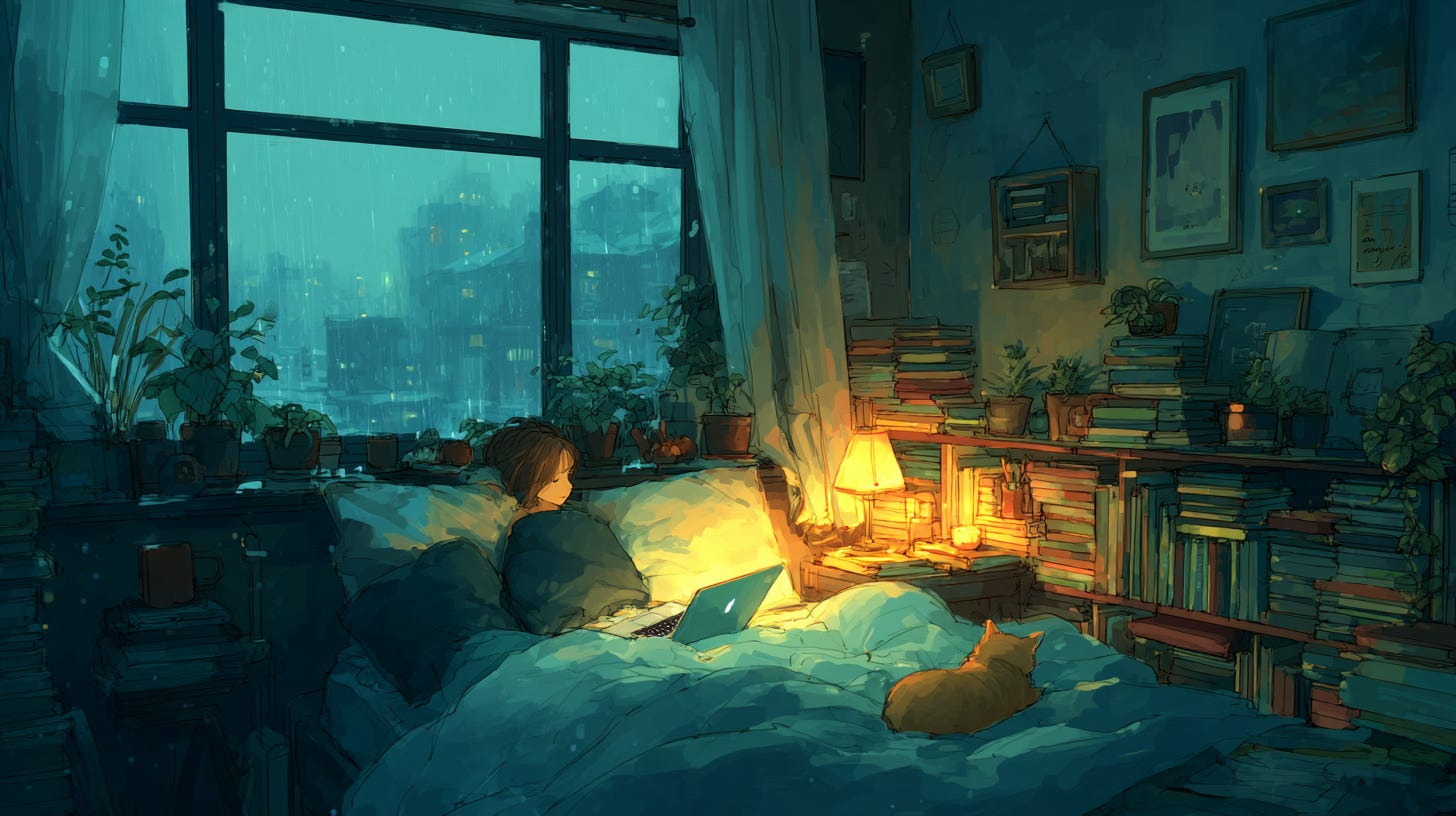
Now the sunlight has dimmed. The hum of conversation has given way to the low whir of an air purifier. The scene is smaller, but it feels more genuine: a darkened room lined with blankets and soft lights, a screen’s glow reflecting off a mug of tea. Here, community hums through fiber optics, its voices carried in messages and shared silences rather than in overlapping chatter.
The “third place” — those public spaces between home and work that once held the social pulse — hasn’t vanished. It’s simply migrated, scattering into thousands of private constellations. What began as necessity has become preference: the quiet over the crowd, the curated over the chaotic. This turning point was driven by two steady undercurrents — the cultural fatigue of a world that demanded constant visibility, and the economic pressure that made public life feel expensive, even exhausting.
What’s emerging from that tension isn’t isolation. It’s transformation. The modern world hasn’t lost its places of gathering; it’s just learning to build them differently — softer, smaller, and closer to home.
The Cultural Current – The Extrovert Era Fades
There was a time when success had a sound — the din of introductions, laughter over cocktails, the rhythm of open offices designed to keep no thought private for long. Mid-century optimism had rewritten the rules of belonging: to be visible was to be alive. Charisma was survival; performance was currency. Workplaces, classrooms, and even leisure demanded presentation — loud voices, firm handshakes, open-plan everything. You didn’t just exist; you networked. The quiet were treated like circuitry with a fault, their reticence something to fix rather than respect.
But the stage lights eventually began to sting. The posturing, the constant self-promotion, the endless reach for relevance — it all became its own kind of noise. By the time the internet matured into the social web, people had learned to curate not just their words but their very existence. The result was a world where everyone performed, and no one quite believed each other. Fluorescent-lit offices glowed long past sunset, workers framed by monitors, scrolling through versions of life that all looked a little too polished to be real. The collective hum of productivity blurred into a kind of static — one that left the soul yearning for silence that didn’t feel like absence.
The backlash was quiet but profound. People began seeking refuge in smaller worlds — tiny ecosystems of comfort and autonomy. Gaming nooks, tea corners, reading dens, hobby desks; islands of calm carved from the digital tide. Online, communities formed not around volume but vibe — shared calm, soft humor, the comfort of being near without being consumed. Connection shifted from spectacle to subtlety.
The new rebellion isn’t volume — it’s discretion. A whispered resistance to the tyranny of constant expression. In its place grows a gentler kind of social life: slow, deliberate, and real.
The Economic Current – Scarcity in the Social Economy
The new quiet wasn’t only emotional — it was financial. For years, the price of participation crept upward until simply being out in public became a small act of economic calculation. The $8 latte, the $25 brunch, the service fees, the tips, the transit costs — all small numbers that stacked up into a quiet barrier. Hanging out became a privilege; leisure turned into a line item. Cafés and bars once meant for anyone willing to show up gradually shifted into micro-luxuries for those who could afford to linger. The rest began staying home — not because they disliked people, but because the math no longer worked.
When the pandemic arrived, it didn’t invent this shift; it just accelerated it. The work-from-home experiment turned permanent for millions, and with it came a new kind of calculus. Why spend an hour commuting to an office that didn’t need you physically present? Why pay for overpriced coffee when your own mug and kettle were an arm’s reach away? The rational choice became the comfortable one. People began redirecting the costs of visibility — fuel, food, fashion — into the infrastructure of solitude. Ergonomic chairs replaced transit passes; soft lighting replaced the corner café; tea and plushies took the place of impulse spending. The office was gone, but comfort remained — this time by design.
From that shift emerged what could be called the austerity pivot. Instead of steady micro-spending to maintain a social presence, people began to invest in permanence. A good desk, a reliable laptop, a space that felt gentle to inhabit. “Build once, maintain forever.” The instinct to economize blended seamlessly with the desire to retreat. Saving money and seeking peace became the same decision. Comfort turned from indulgence to strategy — a hedge against inflation, anxiety, and burnout all at once.
When every latte costs an hour of labor, the soft chair and mug at home start to look like rebellion.
Convergence – The Era of Distributed Coziness
The great withdrawal didn’t end in silence—it blossomed into a new kind of warmth. Across countless apartments, basements, and bedrooms, small sanctuaries began to bloom. The world had been loud for too long; now it found gentler ways to hum.
First came the maker nooks—corners of patience and purpose. Miniature painters hunched over tiny figures; crochet artists crafted plushies with personalities; others stitched embroidery or assembled model kits while soft music drifted from a nearby speaker. The act itself mattered less than the texture of focus, the tactile reassurance that not everything had to happen at the speed of a feed. A hand holding a brush or a needle was a quiet refusal of algorithmic time. And yet, even in these private acts, connection persisted. Photos were shared, streams went live, Discord chats filled with small talk and encouragement. Each home studio became a glowing lantern in the new digital village square.
The digital third spaces that emerged carried the same emotional weight once reserved for cafés and lounges, but they thrived on different terms. In them, nobody had to perform; it was enough simply to be there. A dozen people working silently in a voice channel, a handful painting together while lo-fi beats looped in the background—these were gatherings without pressure, presence without demand. Shared solitude became its own form of intimacy. The internet, once blamed for eroding attention, was rediscovered as a medium for quiet companionship.
And sometimes, these new worlds spilled back into the old one. Hybrid gatherings—a small meetup, a creative salon, a hobby night—emerged not from obligation but from genuine curiosity. People met with intention rather than inertia. A park picnic, a game night, a seasonal art swap—little rituals that reintroduced serendipity without chaos. The city may have dimmed, but the social pulse had not died; it simply changed tempo.
Community no longer lives in buildings. It lives in rhythm—in the pattern of gentle connection, in the slow dance between solitude and togetherness that defines this softer age.
The Extrovert’s Twilight
The spotlight is dimming, and for once, no one is rushing to step beneath it. The performance economy—built on charisma, visibility, and the constant churn of self-promotion—is quietly winding down. For decades, success was measured in how brightly one could glow in the public eye. But as screens multiplied and attention splintered, light lost its meaning. The audience wandered off, tired of applause that never ended and messages that never stopped arriving.
Now, visibility no longer guarantees opportunity; it simply invites exhaustion. The digital stage feels crowded, the applause automated. Entire teams once devoted to “culture” and “engagement” have been downsized, their roles undone by the fatigue of the very audiences they sought to captivate. In the hush that follows, something subtler emerges: depth. Focus, composure, and calm—qualities long mistaken for weakness—begin to define strength in this new landscape. The introvert is no longer the anomaly; they are the blueprint for endurance.
A generational shift is completing what the economy began. The boomers, who built their world on extroverted ideals—handshakes, hustle, and constant motion—are aging out of cultural dominance. In their place rise cohorts who prize boundaries and inner steadiness. For Millennials and Gen Z, “going out” is no longer a moral duty or social marker. It’s an option, chosen when it adds meaning rather than out of fear of missing out.
From this change emerges a new archetype: the Contented Quietist—a person who no longer needs to prove presence through volume. They find satisfaction in calm routines, private joys, and connections that don’t demand spectacle. The world has not gone silent; it has simply tuned itself to a lower frequency, one closer to the human heartbeat than the algorithmic feed.
The era of the networker ends with a whisper, not a pitch.
The Hybrid Future – From Third Place to Living System
Night gives way to a softer kind of dawn. Through the curtains, light filters gently—not the harsh fluorescence of an office or café, but the muted glow of a world learning to breathe again. Out of solitude, something adaptive and beautiful is forming: a civilization redesigning itself for calm.
Homes have become modular sanctuaries—fluid spaces that shift between work, creation, and rest with the ease of thought. A single room may host a morning meeting, an afternoon art project, and an evening of conversation with friends across time zones. Architecture, once obsessed with openness and spectacle, now turns inward: low-stimulus design, mood-responsive lighting, quiet ventilation that feels almost like the rhythm of breath. The home has ceased to be a bunker of isolation; it’s now a living organism tuned to its inhabitant’s emotional weather.
Beneath this lies a deeper transformation—the new economy of maintenance. The endless churn of consumption is giving way to an ethic of care. People no longer seek novelty for its own sake; they tend to what they have. Objects earn affection through longevity, not trend. Repair replaces replacement, and sustainability becomes intimate rather than abstract. Even commerce begins to evolve: brands now sell “comfort ecosystems”—configurable lighting, adaptive furniture, sustainable materials—tools not for showing off but for inhabiting life more gracefully. Emotional durability becomes a design principle.
And as private life matures, public life begins to follow. The next generation of cafés, libraries, and lounges may look and feel very different: ambient light instead of glare, acoustic softness over chatter, furniture that invites lingering without pressure. These will be spaces that honor quiet as much as connection—public rooms that feel like extensions of home rather than departures from it. They will hum with the calm of a species relearning how to share space without spectacle.
We may yet rebuild the commons, quieter this time.
The Soft Light of Autonomy
Evening has given way to something gentler—a soft light that doesn’t demand attention, only awareness. In this quiet illumination, the outlines of a new way of living come into focus. It isn’t louder, faster, or grander than what came before; it’s steadier, closer to the pulse of things that last.
People have begun to reclaim time not as a commodity, but as texture. Days are shaped less by obligation and more by rhythm: the morning cup, the afternoon project, the evening conversation that drifts lazily across screens. Solitude no longer feels like absence, but like sovereignty—a quiet confidence in one’s own company. The walls that once confined now protect; the home is not a retreat, but a tuning fork for a calmer civilization.
Outside, the world is still bright in places—cities buzzing, industries spinning—but inside, another current flows: slower, deliberate, sustainable. It’s the sound of people rediscovering balance after decades of acceleration. Connection has not vanished; it’s simply become more intentional. We’ve learned that intimacy can travel through light, sound, or silence alike.
This isn’t the end of togetherness; it’s its evolution. The third place lives on, scattered among us—faint glows in apartment windows, whispered laughter over headsets, shared stillness between friends who understand that presence doesn’t need performance.
In the hush between notifications, civilization finds its breath again.
- Iarmhar
November 28, 2025
This essay is part of the Human Flourishing, Time, and Everyday Meaning Cluster