The Goblin Economy
What MMO Markets Teach Us About AI Agents and One-Person Companies
Preamble
MMO auction houses may look silly from the outside, but they are surprisingly useful economic laboratories. They show what happens when many independent actors enter a transparent, low-friction marketplace where prices update quickly and competition is immediate. This essay argues that AI agents could make parts of the real digital economy behave more like those game markets. As agents lower the cost of running businesses, one-person companies become more viable, global competition intensifies, margins compress, and “goblin” market actors emerge to hunt for inefficiencies. The result may be a dense reef of tiny automated enterprises rather than an economy dominated only by large firms. Time is money, friend.
TL;DR
- MMO auction houses are useful models for understanding low-friction markets.
- In games like World of Warcraft, players naturally create price wars, arbitrage, specialization, supply shocks, and trading niches.
- Real economies historically did not behave this way because physical logistics, labor, bureaucracy, regulation, and discoverability created huge friction.
- AI agents may reduce many of those frictions by handling support, marketing, research, bookkeeping, workflow coordination, and routine administration.
- As business operations get cheaper to run, the minimum viable size of a company shrinks.
- This makes the One-Person Company more realistic: a single human using agents to operate something that once required a team.
- The key figure is Mr. $5: a lifestyle operator who does not need unicorn growth, only enough income to cover living costs and preserve time autonomy.
- When many operators only need “enough,” they can accept thinner margins than traditional companies.
- Because digital markets are global, operators in lower-cost regions can profit at prices that would be impossible for people in expensive cities.
- This creates a global price floor, where prices drift toward the lowest level at which someone, somewhere, can sustainably operate.
- The downside is neijuan, or involution: intense competition where everyone works harder, prices fall, and rewards keep shrinking.
- “Goblins” are the market specialists who treat the market itself as the game, using arbitrage, undercutting, flipping, bundling, and automated pricing to hunt inefficiencies.
- Incumbent firms may struggle in this environment because they carry payroll, debt, investor expectations, bureaucracy, and slower decision-making.
- Instead of a corporate pyramid, parts of the digital economy may become a reef of micro-enterprises: tiny, specialized, automated ventures filling narrow niches.
- The future digital market may look less like Wall Street and more like an MMO auction house: fast, competitive, weird, opportunistic, and full of tiny actors constantly adjusting by one copper.
The Unexpected Economic Laboratory
The future of digital markets may end up looking less like Wall Street and more like a video game auction house.
That sounds absurd at first glance. Economies are supposed to be shaped by factories, banks, regulations, and corporate giants—not by fantasy worlds full of dragons and wandering adventurers. Yet massively multiplayer online games have unintentionally created some of the most fascinating economic laboratories ever built. When thousands or millions of players interact inside a shared economy, the same forces that shape real markets quickly emerge.
These virtual economies have a few characteristics that make them unusually revealing.
First, they contain large numbers of independent actors. Every player is effectively their own economic agent, making decisions about what to gather, craft, buy, and sell.
Second, prices are typically transparent and updated constantly. Anyone can see what goods are selling for and adjust their strategy immediately.
Third, the barriers to entry are extremely low. A new player can begin participating in the market almost immediately, even with minimal resources.
Fourth, there is very little bureaucracy. There are no regulatory filings, accounting departments, or supply chain managers standing between a player and a sale.
Finally, feedback happens extraordinarily fast. A price change can ripple through a game’s economy in minutes rather than months.
Put these ingredients together and something remarkable happens: complex market behavior emerges almost automatically. Price wars begin. Traders exploit arbitrage opportunities. Certain players specialize in gathering resources while others become dedicated merchants. Entire micro-industries form around particular goods.
In short, MMO economies compress many of the dynamics of real markets into an environment where the rules are simple and the feedback is immediate.
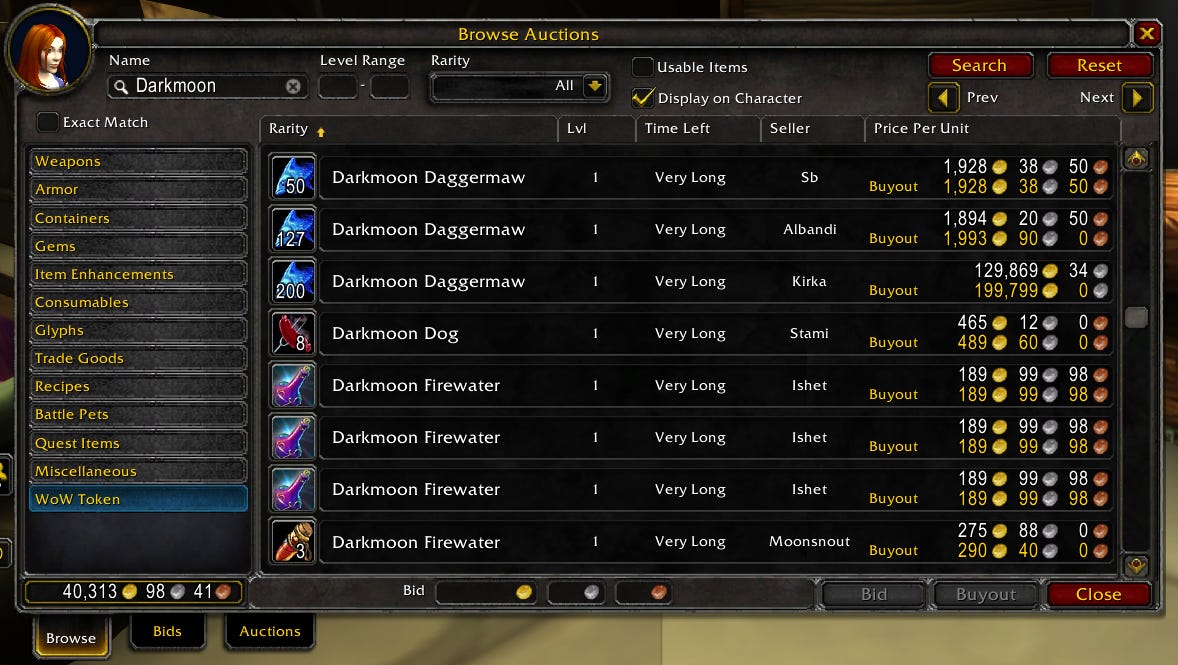
Consider a typical scene inside the auction house of a game like World of Warcraft. A player posts a stack of herbs used to craft potions for 10 gold. Another player notices and lists the same herbs for 9.99. A third player undercuts both of them at 9.50, hoping to move inventory quickly. Within minutes, prices begin shifting as sellers respond to each other’s decisions.
No central authority planned this behavior. It emerges naturally from a handful of incentives: players want to sell their goods, buyers want the lowest price, and everyone can see what the market is doing.
For years this dynamic remained mostly confined to virtual worlds. Real economies were too encumbered by physical supply chains, organizational hierarchies, and regulatory structures to behave quite this way.
But something is beginning to change.
As artificial intelligence agents automate increasing portions of business operations, many of the frictions that historically required large organizations are starting to dissolve. Tasks that once demanded entire teams—customer support, marketing outreach, research, administration—can increasingly be handled by software systems.
When those layers begin to thin out, digital markets start to behave differently.
They begin to look suspiciously like the auction houses that players have been experimenting with for decades.
The argument of this essay is simple: as AI agents remove friction from digital markets, the structure of the real economy may begin to resemble the fast-moving, highly competitive ecosystems that already exist inside massively multiplayer games.
The Auction House as a Market Engine
To understand why MMO economies are so revealing, it helps to look more closely at the beating heart of many of them: the auction house.
In games like World of Warcraft, the auction house functions as a central marketplace where players can buy and sell nearly anything they obtain in the world—herbs gathered in forests, ores mined from mountains, crafted armor, rare mounts, cooking ingredients, enchanting materials, and thousands of other goods.
At first glance it seems simple. Players list items for sale, other players buy them.
But the moment enough participants begin interacting inside that system, recognizable market behavior emerges almost immediately.
The most common phenomenon is the undercutting war. Suppose a player lists a stack of herbs used to craft potions for 10 gold. Another player notices and lists the same herbs for 9.99. A third player decides they want their herbs to sell first and lists them for 9.50. Soon a cascade begins as sellers repeatedly shave tiny amounts off the price to move their inventory ahead of everyone else’s.
These battles can escalate quickly, particularly when supply is abundant. A few players returning from a long farming session may flood the market with hundreds of units of the same resource. Prices drop as sellers compete to move their stock, sometimes collapsing dramatically in the span of an afternoon.
Players also discover arbitrage opportunities. Someone notices that a crafting reagent is listed unusually cheaply, buys the entire supply, and reposts it at a higher price. Others may buy raw materials, convert them into crafted goods, and sell the finished product for a margin. Some traders make fortunes without ever leaving the auction house, simply by observing price gaps and exploiting them.
Over time, specialization emerges. Certain players focus on gathering raw materials—mining ore, harvesting herbs, fishing, or farming rare drops. Others dedicate themselves to crafting professions, turning those materials into potions, armor, or enchantments. A third group becomes pure merchants, buying low and selling high while rarely interacting with the game world itself.
None of this structure is imposed by the game designers. The auction house does not instruct players to become farmers, traders, or arbitrageurs. It simply provides a marketplace and a set of incentives.
From that minimal framework, a complex economy appears.
What makes the system particularly fascinating is how quickly it self-organizes. Within days of a new game server opening, prices stabilize, trading patterns form, and entire supply chains emerge—all without central planning.
The auction house is not just a convenience feature for players. It is a market engine, a machine that converts individual incentives into a functioning economic ecosystem.
And the behaviors it produces—price wars, arbitrage, supply shocks, specialization—are not unique to video games. They are fundamental patterns that appear whenever large numbers of actors interact in transparent, low-friction markets.
Why the Real Economy Never Looked Like This
If the dynamics of MMO auction houses are so fundamental, a natural question follows: why hasn’t the real economy historically behaved the same way?
The answer is friction.
In a game economy, selling an item usually requires only a few steps: obtain the item, list it in the auction house, and wait for a buyer. In the real world, the path between producing something and selling it is far more complicated.
Consider supply chains. Physical goods must be manufactured, transported, warehoused, and distributed before they ever reach a buyer. Each of those steps introduces delays, costs, and coordination problems that do not exist in a virtual marketplace.
Then there are labor costs. Running even a modest business has traditionally required teams of people—customer support staff, marketers, accountants, engineers, managers, logistics coordinators. Paying and coordinating that workforce requires substantial revenue and organizational structure.
On top of that sits bureaucracy. Businesses must manage payroll, taxes, contracts, compliance requirements, and a host of administrative tasks that have little to do with the product itself but are unavoidable in modern economies.
Even discoverability has historically been expensive. If a business wants customers to find its product, it must advertise, build brand recognition, or negotiate distribution through retailers and platforms. Marketing departments and sales teams exist largely to solve this problem.
Finally, there is regulatory overhead. Permits, licensing requirements, legal compliance, and industry-specific rules create additional layers that businesses must navigate before operating at scale.
Taken together, these frictions dramatically raise the cost of participating in markets. A single individual rarely has the time, capital, or expertise to manage all of them alone.
Large corporations emerged in part as a solution to this complexity. They aggregate capital, coordinate large workforces, manage supply chains, navigate regulations, and maintain brand visibility. Their size allows them to absorb the costs and administrative burdens that would overwhelm a small operator.
In other words, the industrial economy favored scale because scale was necessary to manage friction.
This is why real markets historically did not resemble MMO auction houses filled with thousands of tiny independent sellers. The barriers to participation were simply too high.
But those barriers are beginning to shift.
Agents Remove the Friction
For most of the industrial era, friction was the invisible force shaping the structure of the economy. Businesses grew large not simply out of ambition, but because size was often the only way to manage the layers of complexity required to operate.
That assumption is beginning to weaken.
Artificial intelligence agents—software systems capable of performing extended tasks with minimal supervision—are gradually taking over many of the operational functions that once required entire teams. While these systems are still evolving, their trajectory is clear: they increasingly act as automated assistants capable of managing routine business processes.
One of the most obvious areas is support and communication. Customer inquiries, documentation, onboarding, and troubleshooting have historically required dedicated support staff. Agents can now answer questions, guide users through processes, and resolve many common problems automatically.
Agents are also becoming useful in research and development tasks. They can gather information, analyze competing products, synthesize technical documentation, and assist with prototyping ideas far faster than a human working alone.
Even marketing and discovery, long considered essential functions of large organizations, are beginning to shift. Agents can generate content, monitor audience engagement, test messaging, and optimize outreach across platforms with minimal human intervention.
Behind the scenes, many of the most tedious parts of business are also being automated. Bookkeeping, financial tracking, and administrative paperwork can increasingly be handled by software systems that monitor transactions, categorize expenses, and prepare records for compliance.
Perhaps most importantly, agents can coordinate operational workflows. They can move information between systems, trigger actions when conditions are met, and maintain the day-to-day functioning of small digital businesses with very little manual oversight.
None of these capabilities eliminate work entirely, but they dramatically reduce the amount of labor required to keep an operation running.
As these layers of friction shrink, the minimum scale required to participate in a market begins to fall. Tasks that once required entire departments can now be managed by a single person working with a suite of automated tools.
And when that happens, digital markets begin to change shape.
They become faster. Prices adjust more quickly. Entry becomes easier. More participants can compete in narrower niches without needing large teams or large capital reserves.
In other words, the structure of the marketplace begins to move a little closer to the environment we saw earlier: a system where many independent actors can participate directly, responding to incentives and adjusting their behavior in real time.
A system that, in certain respects, begins to look surprisingly similar to a very large auction house.
The Rise of the One-Person Company (OPC)
As agents begin dissolving many of the operational frictions that once required teams, a new organizational form starts to become plausible: the One-Person Company, often abbreviated as OPC.
The idea is simple but surprisingly powerful. Instead of assembling a staff to run a business, a single individual operates the company while delegating much of the routine work to software agents. Tasks that once demanded departments can increasingly be handled through automation and intelligent tools working behind the scenes.
In this model, agents may manage marketing automation, generating content, monitoring engagement, and adjusting outreach strategies. They can handle customer support, answering questions and resolving common issues without requiring a human to be constantly present.
Agents can also assist with product iteration, gathering feedback, analyzing usage patterns, and helping refine features or services over time. Documentation—often one of the most tedious but necessary parts of maintaining a product—can be generated, updated, and organized automatically.
Even the administrative backbone of a business becomes easier to manage. Systems can track revenue, categorize expenses, maintain financial records, and prepare reports for compliance or tax purposes. What once required a bookkeeper or accountant can increasingly be handled through software-assisted workflows.
In this structure, the human operator’s role shifts. Instead of performing each task manually, they act more like a strategist and supervisor. They decide what the business should build, where it should compete, and how it should evolve. The agents handle much of the day-to-day execution.
The result is not the elimination of work, but the compression of organizational scale. Activities that once required a small company can now plausibly be managed by a single individual coordinating a set of automated systems.
That change has an important economic consequence. If the amount of labor required to operate a business falls dramatically, then the minimum scale required for a viable company falls with it.
Businesses no longer need to reach massive revenue levels simply to sustain their internal structure. A small operation can remain viable with far fewer customers and far smaller margins.
And once that threshold drops low enough, entirely new kinds of economic actors begin to appear.
Enter Mr. $5: The Lifestyle Operator
When people talk about startups and entrepreneurship, the cultural image that usually comes to mind is the venture-backed founder. The story tends to follow a familiar arc: build a company, raise capital, chase rapid growth, and eventually exit with a massive valuation.
But the One-Person Company makes another type of entrepreneur increasingly viable—one who has no interest in that trajectory at all.
Call him Mr. $5.
Mr. $5 is not trying to dominate a market or build a unicorn. His ambitions are far more modest. He wants his rent paid. He wants groceries in the fridge. He wants enough income to cover his utilities, a few subscriptions, and perhaps a bit left over for savings.
Most importantly, he wants time autonomy.
If a small automated business generates enough income to meet those needs, Mr. $5 considers the project a success. Growth beyond that point may be welcome, but it is not the central objective. The goal is stability and freedom rather than expansion.
This mindset produces a very different set of economic incentives.
Traditional companies must pursue higher margins because they support payrolls, offices, investors, and often debt obligations. Their cost structures force them to maintain a certain price level simply to remain solvent.
Mr. $5 operates under a much lighter burden. With few overhead costs and agents handling much of the routine work, he can remain profitable at price points that would be unsustainable for larger organizations.
If a product sells for five dollars, that may be perfectly acceptable. A steady stream of small transactions can add up to a comfortable income when the operational costs are minimal.
The result is a subtle but powerful force within markets. When enough operators share this mindset, competition begins to push prices downward. Sellers who only need modest income are willing to accept thinner margins, and their willingness to do so gradually resets expectations across entire categories of digital goods and services.
In other words, once the One-Person Company becomes common, the market begins to fill with participants who are not chasing maximum profit.
They are simply chasing enough.
In competitive markets, “enough” can be a surprisingly low number.
The Global Price Floor
Once the One-Person Company model spreads, the competitive landscape does not just expand locally—it expands globally.
Digital markets already operate across borders. A customer downloading a tool, subscribing to a service, or purchasing a digital asset rarely knows or cares where the seller lives. What matters is whether the product works and whether the price is attractive.
This creates an important dynamic: people living in regions with lower costs of living can operate profitably at price levels that would be difficult for operators in higher-cost economies.
A developer in a city with extremely high rent may need thousands of dollars per month to remain financially stable. Someone in another part of the world may be able to live comfortably on a fraction of that amount. When both participants compete in the same global digital market, their tolerance for low prices differs dramatically.
For the operator with lower living expenses, a product selling for a few dollars per transaction may represent a perfectly sustainable business. For someone with significantly higher costs, those same prices may feel impossibly thin.
The result is the emergence of a global price floor. As more participants from different regions enter the same marketplaces, competition gradually pushes prices toward the lowest level at which someone, somewhere in the world, can operate profitably.
This shift carries several implications.
First, individuals in regions that historically had limited access to global markets can now participate directly in digital commerce. They are not working as outsourced labor for large companies; they are operating their own businesses and selling products or services globally.
Second, prices for many digital goods and services begin to converge toward lower global cost levels. The presence of competitors with lower operating costs reshapes expectations about what things should cost.
Third, the number of potential entrepreneurs expands dramatically. When the infrastructure required to run a business becomes largely digital, and the minimum scale required for viability falls, the barrier to entry drops for people all over the world.
This is not simply outsourcing in a new form. Outsourcing still assumes a large organization hiring labor in another region.
What emerges instead is something different: global entrepreneurship, where individuals from many different places compete directly in the same marketplaces, each bringing their own cost structures, strategies, and ambitions to the table.
And as those participants grow more numerous, the competitive dynamics begin to resemble something very familiar to anyone who has spent time watching an MMO auction house.
Neijuan: When Competition Becomes a Race to the Bottom
China has a word that captures a particular form of economic pressure: neijuan (内卷), often translated into English as involution.
The term describes a situation where competition becomes so intense that participants keep working harder, producing more, or cutting prices further, yet the overall rewards do not meaningfully increase. Instead of progress, the system compresses inward. Effort rises while margins shrink.
In recent years the concept has been widely used in China to describe several industries where competition has become especially fierce. Technology firms have engaged in aggressive price wars to gain market share. Food delivery platforms compete for customers in an environment where drivers, restaurants, and platforms all operate on extremely thin margins. In manufacturing sectors, companies often push efficiency and cost reduction to the point where profitability becomes razor thin.
From the outside, this can look like relentless downward pressure on prices. Firms continue competing because withdrawing from the market means losing customers or relevance, even if the rewards for remaining in the race become smaller over time.
The dynamics may sound surprisingly familiar to anyone who has watched the economy of a large online game.
In the early years of many MMOs, the rise of gold farming created a similar effect inside virtual markets. Groups of players—often operating in regions where the opportunity cost of time was lower—would gather large quantities of in-game resources and sell them for real-world money or flood the in-game economy with supply.
As these players entered the market in large numbers, prices for certain goods began to fall. Materials that once sold for high prices became abundant. Other players complained that the “economy was ruined,” but what they were really observing was something more mundane: a sudden increase in supply combined with participants willing to operate at much lower margins.
In effect, MMO economies briefly experienced global labor arbitrage inside a virtual marketplace.
The arrival of agent-driven businesses could reproduce similar dynamics in digital markets. When thousands of One-Person Companies compete globally—many of them comfortable operating on extremely small margins—the pressure to undercut competitors intensifies.
Each participant adjusts their prices slightly downward in order to attract customers. Others respond. Margins compress further. The cycle continues.
What emerges begins to resemble the conditions described by neijuan: a competitive environment where participants constantly push toward lower costs and prices, not because anyone planned it, but because the incentives of the system make it difficult to do anything else.
In a world filled with OPC operators, global competition, and automated tools that make it easy to adjust prices in real time, the forces that drive neijuan could become a defining feature of digital markets.
The Goblins Arrive
Every MMO economy eventually produces a particular type of player.
They are not the farmers gathering herbs in quiet forests, nor the crafters patiently assembling potions and armor. They are the traders who spend most of their time staring at the auction house interface itself.
In the world of Warcraft lore, the goblins are famous for exactly this kind of behavior: hyper-opportunistic merchants obsessed with profit, constantly looking for angles that others have missed. MMO players adopted the term naturally because it captures a recognizable economic personality.
The goblins of the auction house specialize in aggressive trading strategies.
Some focus on arbitrage, scanning listings for underpriced goods and buying them instantly before relisting them at higher prices. Others rely on automated pricing tools that constantly adjust their listings to remain just slightly cheaper than competitors. Still others specialize in micro-market flipping, identifying obscure items or crafting materials whose prices fluctuate enough to generate consistent profit through repeated buying and selling.
Another common tactic is bundle optimization. A goblin may purchase cheap raw materials, convert them into crafted goods, and sell the finished products at a margin. Or they may break bulk purchases into smaller stacks that sell more easily to individual buyers.
What makes these traders distinctive is not just their tactics but their mindset. They treat the market itself as the game. Instead of venturing into dungeons or exploring the world, they focus almost entirely on understanding how prices move and where inefficiencies appear.
And their behavior has a powerful effect on the economy around them.
Goblins accelerate price discovery. The moment a product becomes underpriced relative to its demand, a trader buys it. If a market becomes oversupplied, they quickly adjust listings downward to move inventory. Their constant probing forces prices toward whatever level the market will bear.
In a digital economy filled with One-Person Companies and automated agents, similar actors are almost certain to emerge.
Some participants will not simply run small businesses selling products. They will build systems designed specifically to monitor markets, detect price gaps, and exploit them. Their tools will scan thousands of listings, track changes in demand, and adjust pricing strategies automatically.
In effect, they will turn the economy itself into their playing field.
The result may feel chaotic, but the chaos serves a purpose. Goblins make markets more efficient by relentlessly hunting for inefficiencies. They compress price differences, move goods where demand exists, and constantly test whether current prices reflect real supply and demand.
Every auction house eventually produces them.
And once they arrive, the pace of the market changes.
The Incumbent Problem
For established companies, the environment described in the previous sections can be deeply uncomfortable.
Large firms did not emerge by accident. They evolved to solve the frictions of the industrial economy—coordinating labor, managing supply chains, navigating regulation, and building distribution networks. That structure worked well in a world where scale was necessary simply to participate in the market.
But that same structure can become a liability when competition shifts toward small, highly flexible operators.
One of the most significant constraints is debt. Many established companies carry financial obligations taken on during earlier stages of growth—loans used to expand operations, acquire competitors, or build infrastructure. Those obligations assume a certain level of revenue and margin. When prices begin to fall rapidly, the debt does not fall with them.
There is also the weight of payroll and organizational overhead. A company with hundreds or thousands of employees must generate enough revenue to sustain salaries, benefits, office space, and the internal machinery required to coordinate such a workforce. Even modest price reductions can have large consequences when multiplied across a large organization.
Investor expectations add another layer of pressure. Public companies and venture-backed firms are typically expected to grow revenue and maintain strong margins. Aggressively lowering prices may protect market share in the short term, but it can also alarm investors who are evaluating performance through financial metrics.
Finally, large organizations often move more slowly simply because of their complexity. Decision-making passes through layers of management, legal review, and strategic planning. In a fast-moving market where prices adjust quickly, that delay can be costly.
Taken together, these constraints make it difficult for incumbents to follow prices downward indefinitely.
Small operators face a very different situation. A One-Person Company supported by agents may have minimal overhead, no payroll obligations, and no investors demanding rapid growth. If the operator’s goal is simply to cover living expenses, the price point required for sustainability can be dramatically lower.
In such a market, competition does not necessarily favor the largest or most established players. Instead, it often favors the actors with the lowest cost structures and the greatest flexibility.
And increasingly, those actors may be individuals rather than institutions.
A Reef of Micro-Enterprises
When enough of these dynamics begin operating at once—agents reducing friction, One-Person Companies entering markets, Mr. $5 operators accepting modest margins, global competition pushing prices downward, and goblin traders constantly probing for inefficiencies—the overall structure of the marketplace begins to change.
The traditional image of the economy resembles a pyramid. At the top sit a relatively small number of large firms controlling significant portions of production and distribution. Beneath them are layers of smaller suppliers, contractors, and workers supporting that structure.
But digital markets shaped by agents and OPCs may begin to look very different.
Instead of a pyramid, they may resemble an ecosystem filled with thousands of small, specialized organisms. Individual operators occupy narrow niches, each offering a particular service, product, or capability. One person may run a tool that converts obscure file formats. Another might manage a small translation pipeline for niche communities. A third might maintain automated services that aggregate or analyze specific kinds of data.
None of these businesses need to be large. In fact, many of them remain deliberately small because the cost of running them is low and the operator’s goals are modest.
It also becomes increasingly common for individuals to maintain multiple micro-income streams. One automated service might generate a small but steady revenue flow. A second project might bring in occasional bursts of income. A third may be experimental, testing whether a new idea can find a market.
Together, these small streams can add up to a meaningful livelihood even if none of them individually resembles a traditional company.
This environment encourages constant experimentation and competition. Because the cost of launching and maintaining a business is lower, participants can test new ideas rapidly. Some ventures succeed, others quietly fade away, and new ones appear in their place.
Over time the marketplace becomes dense with small operators interacting in complex ways. The system does not rely on a few dominant actors controlling large portions of the market. Instead, it functions through the activity of countless participants occupying narrow ecological niches.
The resulting structure begins to look less like the hierarchical organizations of industrial capitalism and more like a reef ecosystem.
On a coral reef, thousands of species coexist, each filling a small role within the larger environment. No single organism dominates the entire system, yet together they create one of the most vibrant and productive ecosystems on Earth.
Digital markets shaped by agents and One-Person Companies may evolve in a similar way—dense, diverse, and constantly adapting as new participants enter and old niches shift.
Civilization After the Auction House
When people imagine economic transformation, they often picture dramatic events: revolutionary technologies, giant corporations rising to dominance, or new industries reshaping the global order.
But not every transformation happens that way.
Sometimes change emerges from the accumulation of many small decisions made by millions of individuals. Each decision is modest on its own, yet together they reshape the structure of the system.
The rise of agent-assisted One-Person Companies may represent one of those quieter transformations.
Rather than being driven primarily by giant startups or massive corporate consolidation, a significant portion of economic activity could gradually shift toward individuals operating small, highly automated ventures. Each one occupies a narrow niche, serving a particular market or solving a specific problem.
For the people running them, these ventures may not look particularly grand. One may generate a few hundred dollars per month. Another might cover a few subscriptions or a utility bill. A third may slowly grow into a reliable income stream that replaces a day job entirely.
Individually, these operations are small. Collectively, they form a dense layer of economic activity that is difficult to see from the vantage point of traditional corporate analysis.
Within that layer, markets may begin to behave in ways that feel familiar to anyone who has spent time watching a virtual economy unfold.
Agents negotiate with other agents on behalf of their human operators. Traders constantly search for small inefficiencies. Goblin-like market specialists flip goods and services at thin margins across thousands of transactions. And somewhere in the background, Mr. $5 quietly runs a handful of automated projects that cover his living expenses and give him the freedom to spend more of his time as he chooses.
The result is not necessarily chaos, but a system that feels more fluid and decentralized than the industrial structures that preceded it.
In such a world, the marketplace begins to resemble a vast auction house—one where prices adjust quickly, niches appear and disappear, and participants continually experiment with new ways to create value.
For many people, the experience of participating in that economy may feel surprisingly familiar.
After all, the basic strategy is simple: find something useful, offer it at a fair price, and if someone else lists the same thing slightly cheaper, adjust accordingly.
Anyone who has ever refreshed an auction listing and undercut a competitor by one copper already understands the basic rules of the game.
- Iarmhar
March 17, 2026
Addendum: Degens Enter the Chat
There is one more class of actor worth adding to the Goblin Economy: the degen.
This is not just another word for speculator. It is not just another word for gambler either. The degen is a very particular creature of online finance culture, best understood through the spirit of WallStreetBets: part retail trader, part shitposter, part spreadsheet goblin, part chaos tourist. He may be trying to make money, yes. But money is not always the deepest motive. Sometimes the real motive is proximity to volatility.
The degen wants to be there when the machine starts shaking.
That distinction matters because WallStreetBets made something visible that more respectable financial discourse often prefers to ignore. Some market participants do not experience volatility as a warning sign. They experience it as weather. They like the storm. They like the screenshots, the memes, the sudden reversals, the absurd theses, the ritual humiliation, the giant green candles, the giant red candles, the feeling that everyone is watching the same ridiculous thing break in real time. Profit is welcome, of course. Profit is the loot drop. It can be converted immediately into anime figures, novelty keyboards, a fridge full of Mountain Dew, or whatever shrine objects belong to the local subculture.
But the core attraction is not always profit.
Sometimes the core attraction is that the market became funny.
This is where the agentic digital economy may become stranger than the stock market. In finance, recklessness has a brutal clearing mechanism. Make enough wrong bets, lose enough money, and eventually the market removes you from the table. A person can still return later, but capital loss matters. It constrains the madness. It turns participation into something with a price floor. The trader can be loud, reckless, ironic, and very online, but if the account goes to zero, the account goes to zero.
In an agentic digital economy, that clearing mechanism may be much weaker.
A bad bet may not mean blowing up a brokerage account. It may mean a failed landing page. An abandoned plugin. A bot that nobody used. A marketplace listing that went nowhere. A strange little AI-generated service that attracted seventeen confused users and then died. A micro-SaaS experiment that cost more in attention than in money. A productized prompt pack that earned enough to buy one disappointing burrito. The degen does not necessarily get liquidated. He simply respawns.
That changes the ecology of chaos.
If participation becomes cheap enough, failure stops functioning as a hard exit. It becomes a loop. Try a thing. Watch it fail. Copy the part that almost worked. Wrap it in a new interface. Point three agents at a different niche. Scrape some public signal. Generate variants. Launch again. Annoy a platform. Discover a loophole. Get rate-limited. Move somewhere else. Post the result. Laugh. Repeat.
This is not the same as entrepreneurship, though it may sometimes produce businesses. It is not the same as arbitrage, though it may sometimes discover arbitrage. It is not even the same as fraud, though some versions will drift toward scams, spam, and platform abuse if nobody stops them. The degen is best understood as a play-driven volatility seeker operating inside markets that have become cheap enough to treat as game spaces.
This is the part finance people should find unsettling.
They already understand what happens when online retail swarms enter financial markets with memes, leverage, boredom, resentment, and a taste for absurd risk. They have seen what happens when price discovery gets mixed with social theater. But at least in finance, the table stakes are real. Losses remove people. Margin calls end stories. Brokerage balances have gravity.
Now imagine a nearby economy where the table stakes are lower, the tools are more automated, the iteration cycles are faster, and the participants can keep coming back.
Oh no.
That is the sound of a familiar human type entering a less self-limiting environment.
The expert class will have trouble modeling this because experts tend to look for stable motives. They understand consumers, producers, investors, firms, workers, criminals, hobbyists, and entrepreneurs. Those categories still matter. But the degen does not fit cleanly inside any of them. He is not simply trying to maximize income. He is not simply trying to build a company. He is not simply trying to consume entertainment. He is using economic systems as an entertainment medium.
The market becomes the game.
The agent becomes the controller.
The volatility becomes the content.
This matters because agentic tools increase the number of handles a small actor can pull. A single person with limited money but abundant curiosity, boredom, and online pattern recognition may be able to test niches, generate assets, monitor marketplaces, deploy bots, watch pricing anomalies, spin up storefronts, produce variants, and coordinate tiny experiments that previously required more labor or institutional backing. Most of these experiments will fail. Many will be stupid. Some will be annoying. A few will be surprisingly effective. And the swarm does not need a high success rate to matter. It only needs enough cheap attempts.
The goblin hunts inefficiency.
The degen hunts the feeling of live instability.
Both become more powerful when agents lower the cost of action.
That does not mean the future digital economy becomes nothing but chaos. Most people will still want useful tools, fair prices, reliable services, good interfaces, and less nonsense in their lives. But it does mean any serious model of agentic markets has to include the people who are not approaching the system with polite institutional motives. Some will arrive as builders. Some as opportunists. Some as scammers. Some as bored retail speculators looking for the next weird game.
And some will arrive because, for the first time, the economy itself looks moddable.
That may be the most important difference. WallStreetBets energy in stock markets was loud, disruptive, and occasionally consequential, but it was still operating inside highly capitalized, heavily regulated financial rails. The agentic digital economy may be much more porous. More surfaces. More niches. More half-formed platforms. More pricing systems. More marketplaces. More brittle automation. More places where a crowd of clever, bored, irony-poisoned participants can ask the ancient goblin question:
What happens if we poke this?
In the old economy, that question was limited by access, capital, credentials, distribution, and labor.
In the agentic economy, the answer may increasingly be: let’s find out by Tuesday.
Update: Apparently We’re Doing This Now
In May of 2026, Google DeepMind announced a partnership with the developers of EVE Online to explore AI research related to memory, continual learning, and long-horizon planning using offline versions of EVE’s universe as a testing environment. Which is, frankly, an extremely funny sentence to be able to write.
It is also deeply revealing.
EVE is not simply “a hard game.” It is a persistent social and economic ecosystem built around logistics, asymmetric information, supply chains, territorial politics, trust networks, market manipulation, industrial coordination, and occasionally catastrophic betrayal. Its players are infamous for optimizing everything they touch into spreadsheet warfare, trade monopolies, intelligence operations, and strange forms of emergent governance.
That makes it an unusually useful environment for studying something frontier AI systems increasingly struggle with: operating coherently inside messy, evolving systems populated by other adaptive actors.
Benchmarks and controlled environments can measure capability in isolation. EVE measures something different. Can an agent maintain useful behavior in a world where conditions change constantly, incentives mutate, alliances shift, information is incomplete, and every other participant is also trying to optimize the system in real time?
The amusing part is that “goblin economics” turned out to be valuable enough that one of the world’s leading AI labs looked at EVE Online and effectively said: yes, this is the kind of environment we should be studying.
This essay is part of the Deflation and the End of Scarcity Economics Cluster