The Throughput Economy
China’s Killshot Against Western Rent-Seeking
Preamble
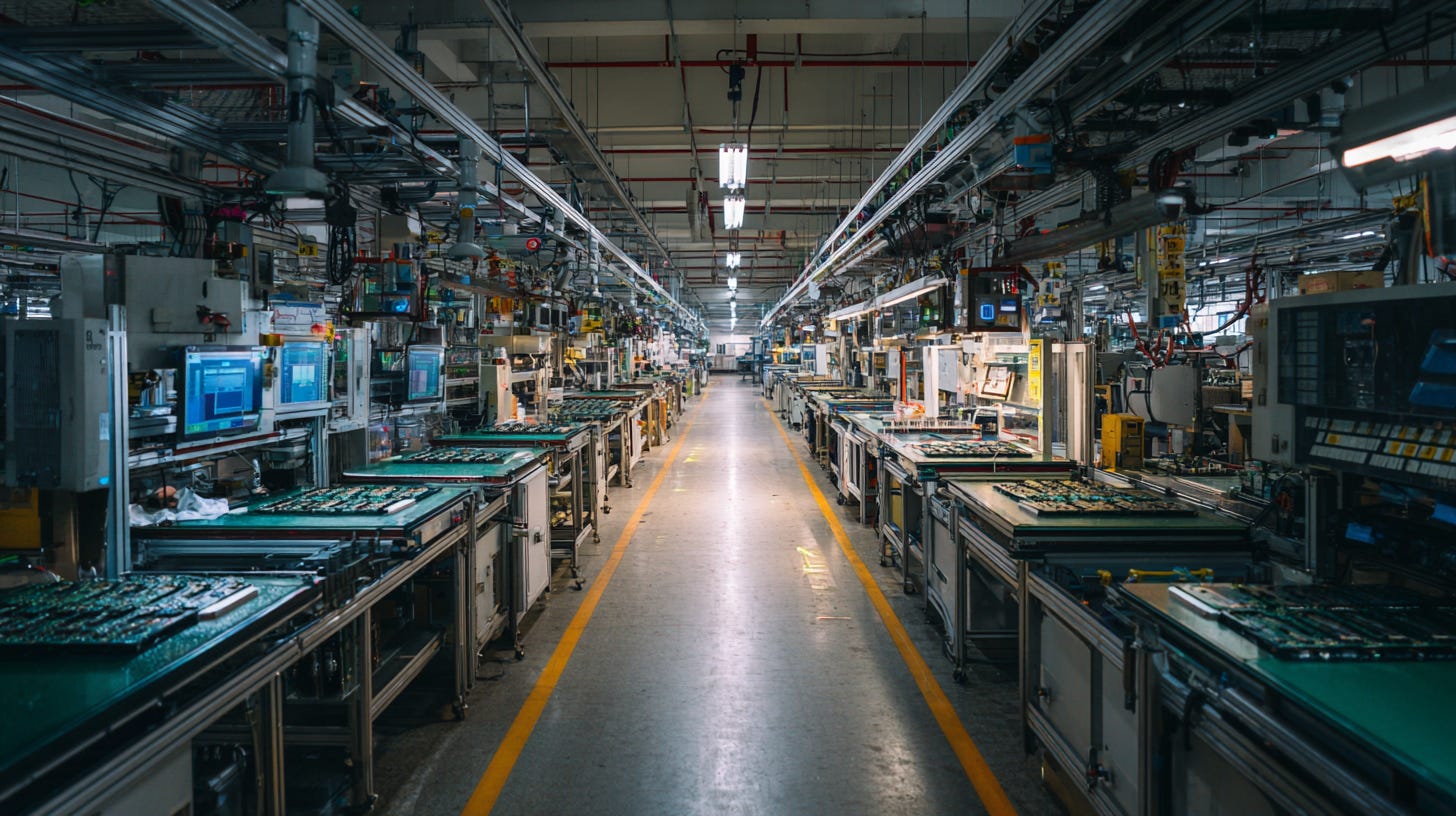
China’s manufacturing rise is no longer just a story about cheap labor. Over the past decade, and especially after COVID, China has consolidated fragmented factories into dense industrial clusters, layered in AI-driven quality control and robotics, and connected that production base directly to global consumers through platforms like Temu, Shein, and Pinduoduo. This essay argues that the result is a throughput economy: a fast, integrated, data-responsive manufacturing system colliding with Western retail models built on markups, branding psychology, slow product cycles, and middlemen. The disruption is not just cheaper goods. It is a structural challenge to how the West prices, sells, and understands consumer products.
TL;DR
- China’s manufacturing advantage is shifting from cheap labor to integrated throughput.
- The old model was fragmented OEM production, where Western brands controlled design, quality standards, distribution, and margins.
- Over the last decade, China consolidated factories into dense industrial clusters that can design, source, produce, iterate, and ship much faster.
- COVID accelerated this consolidation by giving China political cover to shut down weak factories, reorganize supply chains, and push digital logistics.
- AI, robotics, predictive maintenance, and automated quality control now let Chinese factories produce goods with lower labor intensity, more consistency, and faster iteration.
- Platforms like Temu, Shein, and Pinduoduo connect that upgraded factory base directly to global consumers, cutting out many Western retail and brand markups.
- This exposes the weakness of Western mid-tier retail, where many products were priced through branding, shelf control, and psychological ladders rather than true quality.
- China is restoring a “good enough and cheap enough” middle tier that makes many Western private-label and premium products feel overpriced.
- The key advantage is feedback speed: reviews, returns, search data, and demand signals flow back into factories quickly, allowing products to improve on monthly cycles instead of yearly ones.
- Western retailers and governments can slow the shift with tariffs, regulation, and enforcement, but broad resistance is politically difficult because consumers want relief from high prices.
- The global impact extends beyond the West: Mexico, Vietnam, India, Japan, Korea, and Taiwan all face pressure as China’s automated industrial stack compresses margins.
- The new system creates pragmatic soft power by offering material relief rather than ideology: cheaper goods arriving directly at households.
- The open question is whether the throughput economy optimizes for disposability or durability.
- China can build either. The direction will depend on what consumers, platforms, and regulators reward.
From Fragmented OEM to Integrated Industrial Power
Most people felt the last five years as a blur of inflation, political drama, and a vague sense that everyday life was getting harder. Groceries climbed, rent surged, and even simple household items started costing more than they used to. But beneath that noise, something quieter—and far more consequential—was happening on the other side of the world. While the West argued over symptoms, China was rebuilding the foundation of global manufacturing.
COVID was the catalyst, but not in the way Western narratives usually frame it. For China, the pandemic functioned as both a stress test and a moment of political cover. Weak factories could be shuttered without backlash. Supply chains could be reorganized overnight. Entire industrial clusters could be restructured with a speed that would be impossible in any democratic economy. What emerged from that period wasn’t chaos, but a newly consolidated manufacturing ecosystem—tighter, faster, and far more coordinated than before.
Layered onto that industrial base came something new: AI-driven quality control, real-time production monitoring, and robotics scaled far beyond what Western firms adopt in peacetime. By 2025, much of the country’s small-appliance, consumer-electronics, and component manufacturing had quietly shifted into a different mode—less labor-dependent, more automated, and far more responsive to demand signals.
And then the final piece clicked into place. Platforms like Temu, Shein, and Pinduoduo connected these upgraded factories directly to global consumers. No brand gatekeepers. No retail markup ladders. No middlemen controlling margins. Just a hyper-integrated supply chain delivering affordable goods to households that had been hammered by rising prices.
For Western consumers, it feels like a sudden flood of cheap products. For Western retailers, it feels like an ambush. But the real story is simpler: a highly coordinated industrial system is now colliding with a highly fragile retail model. One was built on speed, iteration, and integration. The other was built on rent-seeking, branding psychology, and decades of margin extraction.
The shift didn’t come from ideology. It came from incentives. And the consequences are just beginning to unfold.
China’s Old Weakness: Fragmented Manufacturing
Before China became synonymous with efficiency and scale, its manufacturing base was closer to a loosely connected archipelago than a unified continent. Millions of small, family-run factories operated independently—each competent in its own niche, but rarely coordinated with its neighbors. One workshop made motors. Another made plastic housings. Another handled packaging. They often didn’t know each other existed, even if they were separated by a fifteen-minute scooter ride.
This fragmentation is what kept China locked in the OEM role for so long. Western companies—Nike, Sony, Apple, Whirlpool—set the specifications, designed the products, enforced the QC standards, and dictated timelines. Chinese factories executed, but they weren’t the architects. They didn’t share knowledge horizontally, and there was no incentive to. A factory producing hinge components for washing machines had no efficient way to learn what PCB assemblers were doing, or what motor makers had discovered about tolerances or heat dissipation.
Quality varied wildly from supplier to supplier. One region might produce excellent injection-molded plastics, while another churned out brittle, inconsistent material. A single weak link could ruin an entire production run. Western brands managed this chaotic ecosystem with armies of buyers, auditors, and quality-control teams on the ground. China was the workshop. The West held the blueprint.
It worked—until China decided it wanted to own the blueprint too.
Xi-Era Consolidation (2013–2022)
Around 2013, the central government began pushing a long-term plan to eliminate this fragmentation. Not for geopolitical theater, but for industrial efficiency. China’s leadership understood something simple and structural: a million small factories can’t compete with a hundred tightly integrated giants.
So the weak ones were allowed to fail, bought out, merged, or folded into stronger neighbors. Regional governments offered incentives for consolidation. Large players absorbed smaller ones. Clusters began to form organically at first, then deliberately: Shenzhen for electronics, Suzhou for precision components, Dongguan for small appliances, Ningbo for plastics and injection molding.
These clusters weren’t just collections of factories—they were ecosystems.
Motors, housings, PCBs, casings, packaging, tooling, testing, shipping—everything needed to make a product—sat within an hour’s drive, often within the same district. Information flowed faster. Standards spread horizontally without government forcing them. A design improvement in one factory could propagate across a dozen suppliers by the end of the month.
Out of this merger wave rose a new class of Chinese industrial giants:
Luxshare, BYD Electronics, Wingtech, Goertek, BOE.
Companies large enough to rival Foxconn, Samsung, and LG—not in branding, but in mastery of the entire production stack.
By the late 2010s, these clusters functioned less like scattered vendors and more like cohesive industrial organisms: dense, coordinated, and increasingly capable of designing as well as manufacturing.
The shift wasn’t sudden. It was gradual, deliberate, and easy to miss unless you were watching factory registries and supply-chain ownership patterns. But the foundation was being laid.
COVID as Catalyst and Cover
Then COVID arrived—and it transformed what had been a steady evolution into an overhaul.
While Western narratives focused on lockdowns, protests, and economic uncertainty, China treated the pandemic as a once-in-a-lifetime opportunity to finalize the consolidation it had been building toward for a decade.
Weak factories shut down and didn’t reopen.
Small suppliers that had resisted mergers found themselves absorbed.
Regions used lockdown disruptions to force supply-chain modernization.
Digital logistics systems—once encouraged—became mandatory.
Every rupture in the global supply chain became a justification to reorganize it.
COVID wasn’t just a challenge; it was political cover. You could eliminate inefficient workshops without backlash because everyone expected disruption. And in that noisy environment, China accelerated its shift away from dependence on real estate—the old engine of growth—and toward advanced manufacturing, automation, and export-oriented industrial capacity.
By the time the world emerged from the pandemic fog, China’s manufacturing landscape had changed shape entirely. What had been fragmented was now condensed. What had been manually coordinated was now digitally interlinked. And what had been built to serve Western brands was increasingly being repurposed to serve China’s own ambitions.
This is the industrial base Temu and Shein plug into today.
This is the infrastructure behind the price shock Western consumers are now experiencing.
And it’s the foundation for everything that comes next.
The New Manufacturing Stack: Automation, AI, and Durable Capability
AI + Robotics Transform Production
Once China consolidated its manufacturing base, the next shift was straightforward: automate whatever could be automated, and use AI to govern everything else. The timing was ideal. Vision systems had matured. Industrial robots had dropped dramatically in cost—especially domestically produced ones. And Chinese firms were no longer content to rely on Western QC methods or manual oversight.
AI-driven quality control became the first beachhead. Algorithms could spot solder flaws, misalignments, material defects, and surface imperfections with consistency no human team could match. A line that once needed dozens of inspectors could now run with a handful of supervisors. More importantly, AI didn’t get tired, didn’t overlook patterns, and didn’t produce “Friday afternoon” quality dips.
Robotics followed the same arc. Tasks that had traditionally been labor-intensive—welding, finishing, packaging, repetitive assembly steps—became standardized through automation. Robots didn’t just replace workers; they stabilized product variance. The motor housings coming off a robotic line looked the same on a Monday morning as they did at the end of a double shift.
Predictive maintenance tied it all together. Instead of waiting for machines to fail, AI models monitored vibration, heat, torque, and sound to forecast issues before they cascaded into downtime. Factories that once halted unexpectedly for repairs now operated on smooth, predictable schedules.
The transformation started in the sectors most sensitive to volume and precision: 3C devices, small appliances, EV components, and battery modules. But once the economics proved themselves, automation spread rapidly. By 2025, China had created something the West still struggles to imagine: a manufacturing ecosystem that learns from itself in real time.
The Reality Check: What “Lights-Out” Actually Means (2025–2027)
The phrase “lights-out factory” evokes images of cavernous industrial spaces operating in total darkness, with no humans present at all. That reality exists—but only in certain domains and only in small numbers. A grounded view is more useful, and more impressive in its own way.
China’s automation landscape has evolved into three tiers:
Tier 1 — Fully Dark Microfactories
These are the factories that truly run without humans on site. They specialize in components where uniformity is essential and variation is deadly:
- fasteners
- PCB assembly
- optical components
- battery cell stacking
There are dozens of these fully dark sites—small, optimized, and surprisingly quiet.
Tier 2 — Dark or Near-Dark Production Lines in Megafactories
These are the real growth engine. Inside facilities run by Xiaomi, Luxshare, CATL, BYD, Midea, and Haier, entire lines operate with almost no human touch.
- Robots handle assembly.
- AI performs quality checks.
- Operators monitor dashboards rather than machines.
By 2025, there are already hundreds of these dark lines operating across China, quietly scaling in number each quarter.
Tier 3 — Highly Automated Factories With Minimal Oversight
These aren’t technically “lights-out,” but for manufacturing economics, they might as well be.
- 20 workers doing what used to require 200.
- Robots handling most repetitive, precise, or dangerous tasks.
- AI orchestrating production and maintenance.
These facilities number in the thousands.
Forward trajectory
Shenzhen’s industrial policy alone plans to upgrade 5,000 factories through robotics and AI by 2027. And China’s industrial giants—CATL, Luxshare, BYD, Midea—are already scaling automated lines aggressively through 2026–2028.
Taken together, it’s reasonable to project that lights-out and near-lights-out production lines will scale into the low thousands within this window—not full factories, but lines embedded inside modern industrial complexes. The distinction matters. The scale does too.
Heavy Industry Automation as National Strategy
China’s automation push isn’t limited to small appliances and electronics. The state has made it clear that heavy industry—steel, petrochemicals, mining, shipbuilding, and EV battery production—is a sovereign capability. These sectors employ fewer people than outsiders assume, and they’re increasingly shaped by robotics and automated process control.
Steel mills use real-time monitoring to regulate furnace temperatures and minimize waste. Gigafactories for EV batteries operate with robots moving cells, modules, and casings at speeds human workers could never match. Shipyards deploy robotic welders for long seams, hull plating, and repetitive joins. Mining sites use autonomous hauling vehicles. These aren’t experiments—they’re deployment.
Automation in these sectors matters because it stabilizes upstream inputs. A battery plant that runs consistently produces cells of more consistent quality. A steel mill with fewer process deviations produces stronger, more uniform sheet metal. China treats this upstream stability as part of its long-term strategic insulation from supply-chain risk.
It’s not glamorous work, but it forms the backbone of cost and quality advantages downstream.
Upstream Industrial Control (With Nuance)
One of China’s biggest advantages—rarely discussed outside industry circles—is its control over upstream materials. The country produces much of its own:
- steel and aluminum
- plastics and petrochemical derivatives
- motors, magnets, and permanent magnet assemblies
- lithium-ion battery cells
- PCB fabrication
- textiles and industrial fibers
- rare earth metals
This gives China a structural cost advantage. Not because it’s “cheap,” but because fewer markups exist between raw materials and finished goods. A Western brand pays the market price for copper, magnets, textiles, and lithium. A Chinese factory, plugged into a local cluster, pays something closer to the cost of producing it.
There are exceptions.
- High-end chips remain exposed to global pricing.
- Specialty chemicals face capacity limits.
- Petroleum inputs remain sensitive.
But for the categories driving Temu/Shein/PDD’s rise—consumer electronics, appliances, textiles, small hardware—China’s upstream positioning is unusually strong.
The end result: China’s manufacturing machine isn’t fighting upstream price shocks the way Western brands are. Its cost structure is simply more insulated.
The Quality Flywheel (Global Real-Time Feedback Loop)
The final piece of China’s manufacturing transformation isn’t physical at all—it’s informational.
Temu, Shein, and AliExpress generate millions of product reviews every week. A vacuum cleaner that slips from 4.7 stars to 4.3 doesn’t just cause embarrassment; it triggers redesign. Factories analyze returns, complaints, photos, and videos in real time. A bad motor supplier can be replaced in days. A faulty hinge can be redesigned within a week. A misaligned casing can be corrected in the next production batch.
Western brands operate on 12–36 month product cycles.
China now operates on monthly ones.
This creates a self-reinforcing flywheel of quality:
- bad SKUs die instantly
- good designs replicate quickly
- feedback tightens iteration loops
- QC baselines rise across entire clusters
This is the compounding engine behind the “How did they improve this so fast?” sensation people are beginning to notice.
Where Western consumers see cheap products improving almost weekly, China’s factories see a data firehose shaping their next iteration.
This flywheel is one of the most powerful—and misunderstood—drivers of the new industrial order.
The Mid-Tier Revolution & Western Pricing Collapse
How Western Mid-Tier Was Hollowed Out
For decades, Western retail operated on a simple formula: keep the low end cheap, make the high end aspirational, and quietly squeeze the middle. Instead of investing in durable, well-designed mid-tier products, many brands intentionally weakened them. Plastics got thinner. Motors got smaller. Buttons wore out faster. If the mid-tier felt unsatisfying, consumers were nudged upward into premium lines where margins were richer.
Private labels took this logic even further. Retailers like Walmart, Target, Best Buy, and grocery chains built entire ecosystems of store-brand goods—Insignia, Up & Up, Great Value, Member’s Mark—positioned as “affordable alternatives.” In practice, these products were engineered as margin engines: good enough to sell, not good enough to compete with premium brands, and profitable because the retailer controlled everything from shelf placement to promotions.
The pricing ladders that emerged were psychologically calibrated rather than product-driven. The mid-tier wasn’t meant to stand on its own; it was meant to funnel people toward the level above it. Over time, Western consumers internalized this structure without realizing it. Paying more felt safer. Paying less felt like a risk. And in the middle, there wasn’t much worth choosing.
The weakness of the Western mid-tier wasn’t an accident.
It was a design choice.
And it left an opening large enough for another industrial system to walk straight through.
China Restores True Mid-Tier Quality
China’s consolidated manufacturing system didn’t set out to “fix” the Western mid-tier. It simply produced what its upgraded factories were optimized to make: consistently decent products at low cost. But in doing so, it unintentionally revived something Western consumers had forgotten existed—a middle ground that didn’t feel punishing.
Brands like Roborock and Dreame delivered robot vacuums with 80–90% of the performance of Roomba at a fraction of the cost. Xiaomi’s phones matched the functionality of Samsung mid-tier devices without the price inflation. Anker and Baseus built chargers, cables, and accessories that worked better than Belkin’s for a third of the price.
Suddenly, the Western pricing ladder looked artificial. Consumers weren’t climbing up to premium because they wanted to—they were climbing because the middle rungs had been sawed through. Chinese brands filled those rungs back in.
The effect was immediate and destabilizing:
- Premium began to feel optional.
- Mid-tier started to feel sane again.
- Consumers realized they weren’t imagining things—their money really had been stretched unnecessarily thin.
China didn’t just compete on price.
It changed the baseline for what “good enough” means.
“Good-Enough + Fast Fashion for Durables”
The next shift came not from quality, but from rhythm.
Cheap yet capable products changed consumer behavior. Instead of saving up for a premium appliance designed to last a decade, people began buying a $29 device that did most of the job and replacing it every couple of years. Instead of owning a single high-end gadget, they cycled through a series of low-cost improvements.
This created a new economic pattern: fast fashion for durable goods.
The logic mirrors clothing cycles:
- low upfront cost
- rapid iteration
- constant incremental improvements
- minimal emotional attachment
- willingness to replace instead of repair
For consumers dealing with inflation and stagnant wages, this pattern made practical sense. And for China’s manufacturing clusters—tuned to iterate quickly and respond to demand signals—it was the perfect alignment of incentives. The more velocity the ecosystem supported, the better it performed.
A throughput economy thrives on movement.
China built exactly the system required to feed it.
The Quality Flywheel Paradox — Experience vs Durability
Beneath the excitement over cheap, improving products lies a deeper tension: the difference between how something feels on day one and how long it lasts.
Two Kinds of Quality
- Experience Quality: The unboxing moment, the quiet motor, the clean finish, the intuitive interface—everything that makes a product feel satisfying immediately.
- Structural Quality: The thickness of internal gears, robustness of solder joints, motor endurance, ease of repair—everything that determines lifespan and resilience.
China’s manufacturing upgrades supercharged Experience Quality. But Structural Quality is a separate discipline—and not always aligned with fast iteration cycles.
What the Flywheel Optimizes
Real-time reviews and return data push factories to fix:
- rattling noises
- weak suction
- awkward buttons
- cheap-feeling plastics
But they don’t always incentivize:
- long-life motors
- overbuilt components
- repair-friendly design
- metal casings
Experience Quality is rewarded instantly.
Structural Quality is rewarded slowly—if at all.
Upsides of Cheap-Rapid Replacement
This model has real benefits:
- Low-income households gain access to categories once unaffordable.
- Consumers avoid costly premium mistakes.
- Innovation accelerates, as each iteration responds to real-world feedback.
- Product experimentation becomes normal rather than risky.
In a strained economic climate, this matters.
Downsides
But the trade-offs are real:
- E-waste rises unless recycling improves.
- Repair culture erodes.
- Disposability becomes normalized.
- Durable brands struggle to justify their prices.
This is the tension at the heart of the new manufacturing order.
Durability Is Not a Capability Problem
Crucially, China isn’t incapable of making long-lasting goods. Its industrial tools, EV components, and appliances can be extraordinarily durable. The issue isn’t engineering—it’s incentives.
If consumers, regulators, or platforms begin rewarding durability, China will pivot.
If they reward instant satisfaction and low prices, the ecosystem will optimize for that instead.
The flywheel doesn’t have an ideology.
It follows whatever loop we draw around it.
The Direct-to-Consumer Killshot
Temu / Shein / PDD as Retail Execution Engines
The most visible part of China’s new manufacturing model isn’t the factories. It’s the platforms. Temu, Shein, and Pinduoduo don’t just act as storefronts—they function as the distribution arms of an upgraded industrial machine. Instead of selling inventory they bought wholesale from manufacturers, these platforms are wired directly into the factories themselves. The factories produce, the platforms distribute, and the middle layers that once absorbed the margin—distributors, importers, brand managers, and retailers—simply fall out of the equation.
This is why Western private labels are in trouble. When Walmart’s or Best Buy’s house brand sells a $29 kettle, they’re marking up a product they acquired from a supplier that had its own margins, intermediaries, and shipping costs. Temu can sell the same kettle—or one made by the same cluster—at a price below the retailer’s wholesale cost. Not because Temu is subsidizing the product, but because the layers of margin extraction simply aren’t there.
A subtle but important behavioral shift is emerging. Consumers still make many purchases in stores, but increasingly they’ll handle a product in-person—test its weight, evaluate its build, compare features—and then cross-check the price online. When they find a similar item on Temu for half or a third of the cost, the logic of where to buy becomes difficult to ignore. Retailers once worried about “showrooming” by Amazon; the same structural pattern is now forming again, only with even larger price gaps.
It’s not yet the dominant behavior, but the foundation for it is already visible. As Chinese mid-tier quality rises and logistics accelerate, the role of physical retail shifts from gatekeeper to reference point. The store helps consumers decide what they want. The platform becomes the place to actually make the purchase.
Temu and Shein didn’t invent this logic—they simply aligned the incentives so perfectly that it begins unfolding on its own.
Logistics Speed (Realistic Trajectory)
Speed is where the narrative often drifts into exaggeration, so it’s worth grounding the discussion. Today, Temu’s shipping times for popular items into the United States sit around 3–7 days, depending on warehouse proximity. Shein operates similarly, but is already piloting same-day and next-day delivery in select metro regions where its local inventory density is high enough to support it.
The important detail isn’t the current speed—it’s the architecture being built. Both companies are rapidly expanding North American warehousing, inventory prediction models, and local stocking strategies. Instead of shipping every product from China, high-volume SKUs are now staged in regional hubs, with AI forecasting which products will move where before the orders come in.
This is the same strategy Amazon used to dominate U.S. e-commerce. China’s D2C platforms are now running the playbook in reverse: building Western-style fulfillment speed on top of Chinese-style manufacturing throughput.
If this trajectory holds, by 2027–2030, it’s realistic to expect:
- 1–3 day delivery for most high-volume items
- week-long delivery for specialized or low-frequency SKUs
- expanding same-day/next-day nodes in major urban regions
This hybrid model—fast where it matters, slow where it doesn’t—is economically unbeatable for large categories of consumer goods.
Data-Driven Product Creation
Western retailers typically respond to consumer trends every season or every year. Chinese D2C platforms respond every day.
Search data on Temu and Shein doesn’t just shape product rankings—it triggers product creation. When enough users search for “manual coffee grinder,” “no-wifi air fryer,” or “dumb TV,” factories in Shenzhen or Dongguan begin prototyping those items within days. If early listings perform well, production ramps. If they fail, the SKU disappears without ceremony.
This system doesn’t rely on trend forecasters, buyer teams, or brand committees. It relies on raw signals flowing directly from consumers to manufacturers. Pain points—annoying apps, overly “smart” appliances, or fragile housings—become immediate design directives. Preferences that Western retailers treat as niche become new product categories.
This is how the Dumb Tech Renaissance forms: not through nostalgia, but through data. If large groups of consumers want simple, offline devices that just work, the manufacturing stack responds. No ideology required—only demand.
Regulatory Asymmetry
The final accelerant in this section isn’t technological at all—it’s regulatory. Western brands operate under a dense web of consumer protection rules and environmental compliance frameworks:
- EU REACH chemical regulations
- PFAS bans
- California Proposition 65
- minimum warranty requirements
- right-to-repair mandates
- packaging and sustainability rules
These regulations aren’t bad; many are necessary. But they impose overhead. They slow down product cycles. They raise costs. And they force companies to build compliance teams whose expenses must be passed on to consumers.
Temu and Shein, selling directly from China to Western consumers, operate in a gray zone where enforcement is inconsistent, fragmented, and often delayed by years. A product that would cost $25 under full compliance can be sold for $12 when those regulatory costs are bypassed entirely.
This isn’t a loophole—it’s a structural asymmetry.
One system carries regulatory friction.
The other doesn’t.
Both serve the same consumers.
Until Western enforcement catches up—if it ever does—this gap remains a built-in cost advantage. A 5–15% structural delta becomes enormous when multiplied across millions of SKUs.
It’s not that China “cheats.” It’s that the operating environments are materially different. And in commerce, differences compound.
Global Shockwaves & Economic Fractures
Mexico / Vietnam / India Squeezed by Automation
For two decades, global manufacturing operated under a predictable logic: if wages in China rose, production would shift to cheaper labor markets. Mexico, Vietnam, India, Indonesia, and Bangladesh built their development strategies around this expectation. They didn’t need to match China’s scale or sophistication—just its role as the world’s low-cost workshop.
But automation breaks that pattern.
As robotics and AI take over the most labor-intensive tasks, the wage differences that once shaped global supply chains begin to matter far less. A factory built around robotic assembly doesn’t care whether the country’s minimum wage is $2 an hour or $12. It cares about electricity stability, logistics, supplier proximity, and data infrastructure—areas where China’s industrial clusters have deep structural advantages.
For nations that depended on low-cost labor as their primary competitive edge, this is the pressure point.
The Mexico problem
Mexico’s advantage has been proximity: being a truck ride away from the United States. But once Temu and Shein operate robust warehousing in the U.S. and Canada, proximity shifts from a manufacturing feature to a logistics feature. Mexico’s value proposition fades as Chinese-made goods are staged domestically. Being close to the customer no longer requires being close to the factory.
The Vietnam and India dilemma
Vietnam and India have experienced manufacturing booms, but both rely on labor pools that can’t compete with automation-driven throughput. Their next steps require enormous investments in industrial automation, supply-chain integration, and upstream materials—areas where China’s 10–15 year head start is difficult to close quickly.
The structural trap
Middle-tier manufacturing nations risk being squeezed between:
- ultra-low-cost labor markets (Bangladesh, Cambodia), and
- China’s fully or semi-automated manufacturing grid
It’s not a geopolitical crisis—it’s an economic geometry problem.
The middle of the manufacturing value chain disappears as the ends move closer together.
Automation is not just changing who wins.
It’s changing who can compete.
Japan / Korea / Taiwan’s Quiet Panic
If the pressure on middle-income manufacturing nations is visible, the anxiety within high-end Asia is quieter—but deeper.
For decades, Japan, South Korea, and Taiwan held firm to their role as the world’s premium industrial tier. They built reputations on quality:
- Japan with automotive and precision engineering
- Korea with appliances, displays, and lithium battery tech
- Taiwan with semiconductors and high-reliability electronics assembly
China may have produced the quantity, but these nations still produced the groundbreaking designs and the products consumers trusted most.
That hierarchy is now shifting.
Luxshare overtakes Foxconn
In 2025, Luxshare—once a small Apple supplier—surpassed Foxconn in revenue. Not through branding, but through relentless integration, automation, and cluster efficiency. What Foxconn did for Taiwan, Luxshare is doing for China, but with more state alignment and fewer structural constraints.
The EV and appliance squeeze
Chinese EV supply chains are compressing margins for Korean and Japanese firms. Whether it’s battery packs, electric motors, air conditioners, or dishwashers, Chinese competitors now offer similar performance with dramatically lower production costs.
It’s not that Chinese products are “as good as” Korean or Japanese ones everywhere. But the price-to-performance gap has narrowed enough that many consumers no longer feel the premium is justified.
TSMC and the packaging challenge
Taiwan’s semiconductor crown remains secure at the leading edge, but the assembly and packaging side of the business—long considered lower-margin, lower-prestige work—is being eroded by Chinese competitors. China isn’t targeting the bleeding edge; it’s targeting volume, packaging, and integration, the very tasks that feed into consumer electronics at scale.
TSMC’s moat remains, but its surrounding landscape is shifting.
The end of insulation
For 30 years, high-end Asia could count on China being “the factory” while they remained “the masters.” But the difference between making a thing and mastering a thing has shrunk. China’s industrial system is catching up not by copying, but by iterating at a pace no one else keeps.
Japan, Korea, and Taiwan are not losing because they’re weak.
They’re losing because the field itself is tilting.
The old hierarchy—premium design in Northeast Asia, mass production in China—is being rewritten by a new logic: whoever learns fastest wins.
Pragmatic Soft Power
Soft Power Through Material Relief
Most discussions of soft power focus on cultural exports, diplomacy, or values. But a deeper form exists — one that bypasses ideology entirely and speaks directly to lived experience. China’s consumer-facing industrial machine has stumbled into this category almost by accident.
Its implicit message to Western households is simple:
“You’re paying too much. Here’s a cheaper, good-enough alternative.”There’s no grand narrative, no attempt at persuasion, no geopolitical theater. It’s the soft power of relief — of lowering the pain that inflation and stagnant wages have created for millions of families. When a cordless vacuum drops from $249 to $39, or a kitchen appliance from $79 to $19, that price gap becomes a kind of diplomacy all its own.
This isn’t ideological alignment.
It’s household pragmatism.
And it’s powerful precisely because it avoids moral framing. People aren’t being asked to admire China or adopt its worldview. They’re simply being offered access to affordable goods during a time when affordability feels scarce. The gratitude that emerges is quiet, private, and politically invisible. But it shifts perceptions nonetheless.
Soft power doesn’t always arrive through culture.
Sometimes it arrives through the mail.
Western Countermeasures (And Their Limits)
Western governments aren’t blind to what’s happening. But their room for maneuver is smaller than policymakers admit, constrained by inflation anxiety, electoral cycles, and the raw arithmetic of household budgets.
United States: Tariff Maximalism Meets Political Risk
In 2025, U.S. rhetoric has shifted sharply toward broad tariffs — not just on industrial goods but potentially on consumer categories as well. The logic is clear: if Chinese D2C platforms erode domestic retail and manufacturing, tariffs look like the simplest defensive tool.
The problem is political.
Tariffs raise prices immediately.
Voters feel that instantly.
Punishing Temu or Shein might preserve certain industries, but it also risks igniting a voter revolt among households already stretched thin. Every percentage point of tariff pressure amplifies the political cost.
European Union: Targeting Upstream Instead of Downstream
The EU has taken a more cautious path. Instead of focusing on consumer goods, Brussels targets industrial categories — EVs, batteries, solar components — where price increases won’t appear in grocery carts or household budgets overnight. This avoids direct pain for consumers while still protecting strategic industries.
But the EU’s own cost structure — energy prices, regulations, slower iteration — limits how effective these measures can be long-term.
Anglosphere: The Cost-of-Living Trap
Canada, the UK, Australia, and New Zealand face similar constraints.
High housing costs + high retail markups + stagnating wages = minimal tolerance for price spikes.
Politicians can criticize Chinese platforms rhetorically, but broad tariffs would trigger backlash from the very voters they’re trying to protect. Without a domestic retail alternative that matches Temu/Shein pricing, countermeasures remain limited, defensive, and half-hearted.
In short: Western governments can slow this shift.
They cannot reverse it without inflicting economic pain on their own citizens.
Currency & Payment Migration
The manufacturing shift isn’t just about goods — it’s about financial architecture. As Chinese firms consolidate global supply chains, they’re increasingly settling supplier contracts in RMB rather than dollars. This reduces currency risk, speeds up settlement, and further ties global production to China’s financial infrastructure.
The next stage is consumer-facing.
If Temu, Shein, or Pinduoduo introduce RMB-denominated digital wallets or payment options for Western customers, two things happen simultaneously:
- De-dollarization gets a retail engine.
Millions of small transactions shift into RMB without political messaging or institutional pressure. - China gains another cost advantage.
Removing FX costs — and leveraging China’s internal payment rails — creates additional margin for discounts.
Most consumers wouldn’t view this as a geopolitical act. They’d simply select the option that makes the checkout price lower.
This is how currency migration typically happens in the modern world:
not through official decrees, but through convenience, incentives, and habit.
Timeline (Updated to Late 2025)
Timelines in industrial transitions rarely unfold neatly. But by late 2025, enough signals have converged that we can trace the direction with reasonable confidence. What follows isn’t prediction so much as a modeling of incentives, capabilities, and visible momentum across China’s industrial ecosystem and Western retail.
2025 — The Inflection Year
Mid-tier QC surpasses Western equivalents.
For many consumer categories—especially vacuums, small appliances, chargers, earbuds, and entry-level electronics—Chinese mid-tier now meets or exceeds the quality of Western brands. This isn’t anecdotal; it’s visible in warranty rates, reviews, and return patterns.
Dark/automated lines proliferate.
The “few dozen” fully dark factories turn into a network of hundreds of near-dark lines within megafactories. Human oversight remains, but labor intensity collapses.
Early dumb-tech categories rise.
Search data pushes factories to produce no-WiFi appliances, manual tools, and non-smart electronics. This marks the beginning of the Dumb Tech Renaissance.
Western private-label erosion begins.
Target’s Up & Up, Best Buy’s Insignia, Walmart’s Great Value, and other private labels begin losing entire SKU blocks to Temu and Shein equivalents that are cheaper, newer, and often better built.
2025 is the year the old pricing ladder begins visibly breaking.
2026–2027 — Automation Peaks Into Visibility
Lights-out/dark lines expand into the low thousands.
Not thousands of factories—thousands of lines. Automation becomes a normal feature of Chinese production, not a futuristic anomaly.
Private-label Western product lines implode.
Electronics, cables, chargers, small appliances, household goods—Western house brands lose entire product categories, fast.
D2C penetration spikes in appliances, electronics, apparel.
Temu/Shein become normalized shopping channels rather than “cheap alternatives.”
Delivery times tighten.
QC becomes stable enough that consumers trust the ecosystem.
These years feel like acceleration rather than emergence.
2027–2029 — Retail Structure Breaks
Big-box category collapse.
By this point, stores like Best Buy, Bed Bath & Beyond (its remnants), and certain Walmart/Target sections hollow out. Foot traffic remains, but the economic logic behind many categories disintegrates.
Japan/Korea/Taiwan face systemic margin compression.
Premium brands still exist, but the niche shrinks. China’s price-to-performance advantage becomes overwhelming in everything except a small set of ultra-premium categories.
Reverse-showroom shopping becomes standard.
Not absolute, but normalized. Consumers evaluate in store and purchase the Temu/Shein/PDD equivalent unless the brand premium is genuinely justified.
These years mark the structural break—what was once unthinkable becomes mundane.
2029–2032 — The Throughput Economy Era
Throughput economy dominance.
Products become cheaper, faster to update, easier to replace, and more attuned to real-time consumer demand. The old model of “slow cycles + expensive SKUs” becomes uncompetitive.
Western retail structurally uncompetitive.
Even with tariffs, subsidies, and regulatory defenses, the fundamental cost structure gap remains too large. Western retailers can survive, but the idea of Western dominance in retail disappears.
Pragmatic soft power cements consumer loyalty.
Not ideological loyalty—material loyalty.
When the platform that consistently offers the best price and functional quality comes from one country, sentiment shifts subtly but widely. Soft power is no longer film, politics, or diplomacy. It’s household economics.
By the early 2030s, the new system isn’t “rising.”
It simply is.
Conclusion — The New Consumer Order
China’s manufacturing shift isn’t a temporary anomaly or a clever pricing trick. It’s a structural transformation—rooted in consolidation, accelerated by automation, amplified by AI, and delivered directly to global households through Temu, Shein, and PDD. While the West wrestled with inflation and political distraction, China rebuilt the machinery of production into something faster, more integrated, and far more responsive to consumer signals.
The outcome is a new kind of mid-tier quality: stable, consistent, and accessible. The price-to-performance ratio that Western retailers treated as a lever for margin extraction becomes a baseline consumers can reasonably expect. And once that expectation changes, the old retail model—high markups, slow cycles, manufactured scarcity—can’t regain its footing.
The platforms carrying this shift forward aren’t selling ideology. They’re selling relief. They bypass the old gatekeepers, expose the fragility of Western pricing structures, and offer a simple, pragmatic message: you don’t have to pay this much anymore. In a world where cost-of-living pressures define daily life, that message travels farther and faster than any cultural export.
But the rise of the throughput economy raises its own open question. As products become cheaper and iteration accelerates, will the future lean toward disposability or durability? Will consumers continue rewarding rapid replacement cycles, or will demand eventually shift toward long-life design, repairability, and resource efficiency?
The answer doesn’t lie in China’s capabilities.
It lies in the incentives consumers and regulators create.
China’s manufacturing machine can produce ultra-durable goods or ultra-disposable ones. It can optimize for long-term reliability or rapid iteration. It can tune itself for premium longevity or fast-fashion velocity. The system has no inherent preference—it follows whatever loop global demand draws around it.
The new consumer order isn’t fixed.
It’s a negotiation between what factories can do and what households choose to reward.
And for the first time in decades, that negotiation is no longer mediated by Western retail. It’s happening directly, at global scale, in real time.
- Iarmhar
December 6, 2025
This essay is part of the Compute, Geopolitics, and Civilizational Strategy Cluster