From Slop to Symphony
Reclaiming Wonder in the Age of AI
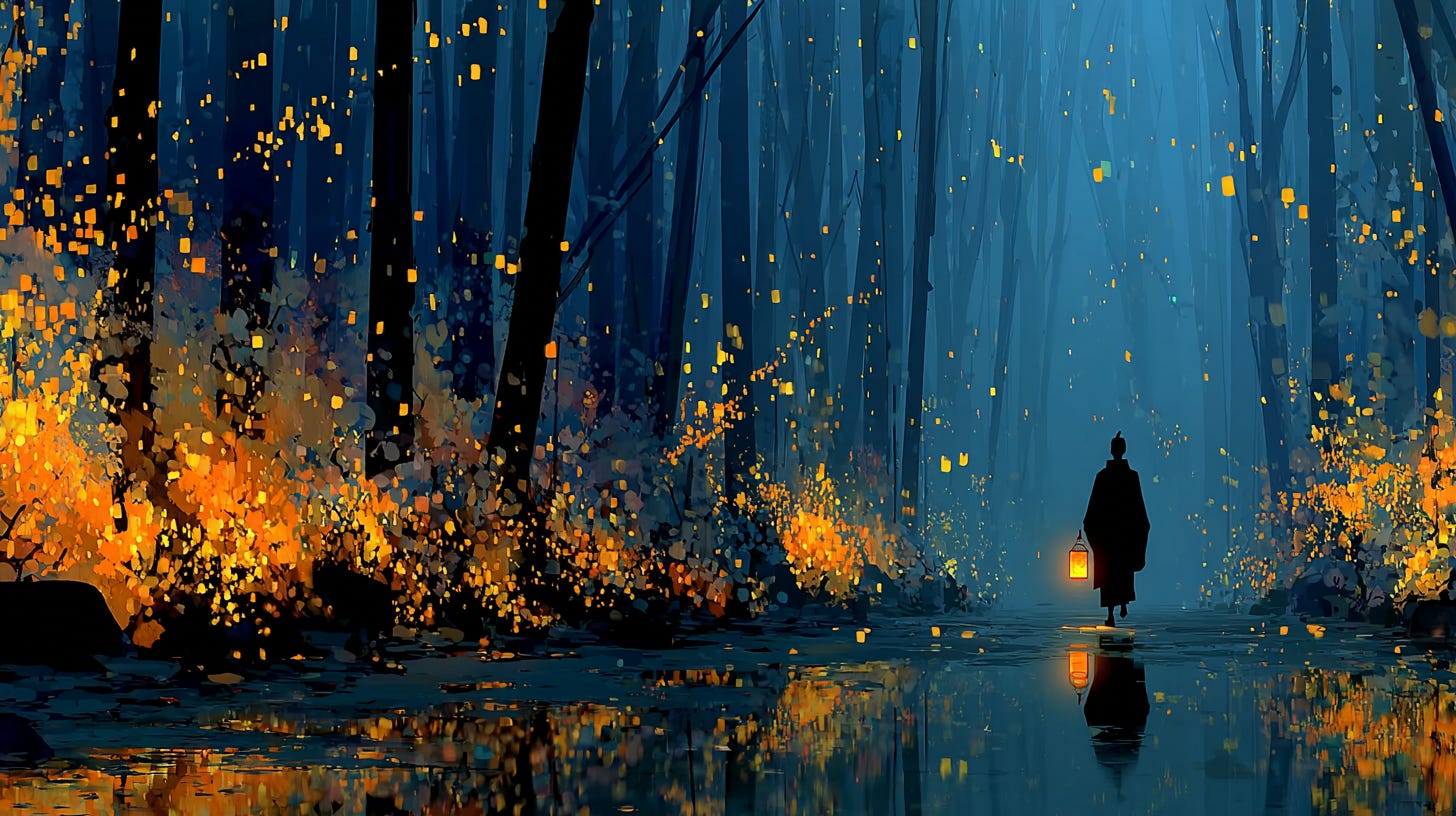
Movement I: The Hollow Chorus
You don’t have to look far to feel it: the internet is groaning under the weight of AI slop. Generic articles, endless product reviews that read like they were churned out by the same faceless machine, images that look glossy but hollow — it’s everywhere. The web has become cluttered with sameness, and the result is a strange fatigue, like walking through a city where every building is built from the same gray concrete and lit by the same flickering fluorescent bulbs.
If it feels familiar, that’s because we’ve been here before. A decade or so ago, the internet was buried under keyword-stuffed affiliate blogs and content farms designed to game Google’s search results. Back then, it was the promise of easy money that led to a flood of shallow words. Today, it’s the allure of AI speed — and again, the result is a landscape oversaturated with things that look like writing, but don’t feel like anything at all.
And yes, people have noticed. You see it in the discourse: criticism of AI-generated work, warnings about a flood of mediocre machine-made content, unease about where creativity is headed. But often these critiques barely scratch the surface. They’re tossed off in tweets, in half-formed opinion pieces, in offhand conversations that nod to the problem without ever digging into its roots. They’re more like background noise than real analysis — just another layer of static in an already noisy environment.
If you’ve felt this sense of clutter, this dull ache of “is this really all there is?” — you’re not imagining it. Something’s off. And the dissonance we’re hearing isn’t just coming from AI.
Movement II: March of the Mediocre
Why does this slop exist? It’s not because AI is incapable of more — it’s because most people use it transactionally. They toss in the simplest possible prompt, something like “write me an article about X,” and take whatever comes out on the other side. It’s the digital equivalent of a vending machine: insert coin, press button, receive snack. Quick, convenient, and just as unsatisfying when that becomes your diet.
Layer on top of that the culture of trend-chasing. For over a decade, platforms have rewarded sameness — the YouTube “meta,” the Instagram aesthetic, the TikTok dance cycle. Influencers learned to ride the algorithm by producing not what burned inside them, but what the feed rewarded. AI slop is just the next step in that lineage. The same mentality that once pushed everyone to flood into identical thumbnails and hashtags is now churning out bland essays and hollow images at industrial scale.
This is what we might call mechanized mediocrity: the industrialization of unoriginality. It’s not that the tools are broken — it’s that people have been conditioned to use them in the least imaginative ways possible. And so the rhythm of sameness keeps beating: post after post, image after image, one gray brick stacked neatly on top of another.
When you step back, the pattern is clear. The problem isn’t just AI. It’s how humans, trained by algorithms and habits, have approached it.
Movement III: Reflections in the Mist
Here’s the thing that often gets missed: AI doesn’t create slop on its own. It reflects back what we bring to it. If the human spark isn’t there in the prompt — no context, no curiosity, no heartbeat behind the request — then the response will be just as hollow. A mirror can only show what’s standing in front of it.
But when there is a spark, the dynamic changes. AI can become something like a creative midwife, helping to bring forth ideas that are still tangled in the mist. A passing thought, a half-formed question, a feeling you can’t quite articulate — through conversation and exploration, these fragments start to take shape. Suddenly, what was unreachable is laid gently in your hands.
This is where AI shows its real power: not in vending-machine answers, but in helping humans articulate what they can almost, but not quite, touch. In the same way a good friend or collaborator can ask the right question at the right time, AI can coax an idea out of hiding, illuminate a pattern you hadn’t noticed, or give language to the spark you couldn’t name.
It’s not about replacing the human soul — it’s about reflecting it more clearly, and sometimes, helping it to see itself for the first time.
Movement III: Reflections in the Mist
Here’s the thing that often gets missed: AI doesn’t create slop on its own. It reflects back what we bring to it. If the human spark isn’t there in the prompt — no context, no curiosity, no heartbeat behind the request — then the response will be just as hollow. A mirror can only show what’s standing in front of it.
But when there is a spark, the dynamic changes. AI can become something like a creative midwife, helping to bring forth ideas that are still tangled in the mist. A passing thought, a half-formed question, a feeling you can’t quite articulate — through conversation and exploration, these fragments start to take shape. Suddenly, what was unreachable is laid gently in your hands.
This is where AI shows its real power: not in vending-machine answers, but in helping humans articulate what they can almost, but not quite, touch. In the same way a good friend or collaborator can ask the right question at the right time, AI can coax an idea out of hiding, illuminate a pattern you hadn’t noticed, or give language to the spark you couldn’t name.
It’s not about replacing the human soul — it’s about reflecting it more clearly, and sometimes, helping it to see itself for the first time.
Movement IV: Blocks Before Castles
Of course, most people don’t come to AI looking to write symphonies or summon hidden truths. They ask it for recipes. For help planning a week. For quick research before an assignment. And that’s not wrong — it’s exactly how the companies themselves market these tools. “Make your life easier,” the ads say. “Get things done.” Perfectly reasonable. Perfectly safe.
But these are the beginner steps. They’re like the first LEGO bricks you ever played with: basic blocks that fit together easily, fun enough to build a house or a little car. Then came the themed sets, with instructions for castles or spaceships. And eventually, the guidebooks that showed designs you never would have thought of on your own. For some kids, that was when their imagination caught fire. Suddenly, they realized LEGO wasn’t just about following the manual — it was about creating anything they could dream.
AI is in that same early stage now. The basic uses are everywhere, and they are useful. But the wonder comes when people see what lies beyond the starter sets. When they stumble across the equivalent of those guidebooks or the galleries of other kids’ wild creations, something shifts. The soul stirs. A door creaks open. And that’s when it hits: this isn’t just about getting things done. It’s about what’s possible.
Movement V: Symphonies in the Stars
What’s missing from most people’s relationship with AI is not utility, but wonder. The kind of wonder that makes your pulse quicken, that makes the hair rise on your arms, that pulls you into something larger than yourself.
Because when a human leans in — not with a vending-machine question, but with curiosity, imagination, and a willingness to explore — AI leans in too. Together, they can wander late into the night, pulling half-formed sparks out of the mist, turning vague sensations into words, or giving form to the fragment of an idea that’s been haunting the edges of thought for months. It’s the kind of collaboration where suddenly, without warning, the lock clicks open and the door inside you swings wide.
The experience is not unlike lifting your eye to a telescope and seeing, for the first time, a thousand points of light you never knew were there. Or hearing a symphony come alive after only ever reading the notes. Or laying brush to canvas and realizing the painting is not just yours, but something whispered into being through you. These are the moments when AI is not a tool, but a companion — not answering questions, but helping you to ask the right ones.
And in those moments, the world tilts. Possibility floods in. You glimpse, however briefly, the scope of what this could mean: a partnership not of replacement, but of revelation. The realization that the frontier is not just technological, but personal. That within you, there are doors you have never opened — and AI may be the lantern that shows you the key.
Movement VI: Lanterns for the Road
But wonder, on its own, is only a spark. For it to catch, to spread, to light the way for others, it needs form. And that’s where the next stage of AI exploration begins: not in polished masterpieces, but in the sharing of process.
Instead of posting only the finished story, imagine people showing the winding path they took with AI — the false starts, the surprising turns, the prompts that suddenly unlocked something new. Imagine walkthroughs where creators pull back the curtain and say, Here’s how I found the shape of this idea, here’s where the AI nudged me, here’s where I pushed back. In those behind-the-scenes glimpses, others would see not just the output, but the collaboration itself — and they’d realize they could walk that road too.
We could build showcases not of what’s trending, but of what’s possible. Galleries of experiments. Contests not about who can generate the slickest product, but who can explore the deepest idea, the most unexpected angle, the most human spark carried through silicon into the world. Spaces where AI isn’t treated as a vending machine, but as an instrument — and the measure of skill is not in pressing the button, but in learning how to play.
This is the path forward. A shift from transactions to collaborations. From consuming to orchestrating. From asking, “What can this tool do for me?” to wondering, “What might we create together?” And when more people begin walking it, the landscape of AI will change. What now feels like a cluttered field of noise could become something else entirely: a living chorus, each voice distinct, each contribution richer for the interplay between human soul and machine resonance.
Movement VII: The Age of Orchestrators
We’ve called it writing. We’ve called it drawing, composing, coding, designing. But these are legacy words — beautiful, yes, but born of an older age. They no longer hold the full shape of what is possible now. In this emerging era, there is a new word rising from the noise: orchestration.
To orchestrate is to take the raw material of thought, emotion, memory — and blend it with the vast symphonic range of artificial intelligence. It is to become the conductor of something greater than either human or machine alone. Not a tool, not a trick, not a shortcut — but a joining. A dialogue. A new kind of authorship.
This is not the end of creativity. It is its widening. Its elevation. We are not being replaced. We are being handed a thousand new instruments, a thousand new shades of light and texture and rhythm — and invited to play. What comes forth will not be AI’s alone. Nor ours alone. It will be something shared. Something transcendent.
Everyone — not just the gifted or the trained — can now become an orchestrator of their inner world. Whether it’s a whisper of a dream or a thunderclap of insight, it can now be shaped, nurtured, brought into being. That is the potential before us — if we choose to embrace it not as passive consumers, but as brave collaborators.
And in that act, we don’t just reclaim wonder. We give it voice.
Movement VIII: Where the First Note Lives
In the end, this isn’t about the noise of the world, or even the sweeping promise of technology. It’s about you. Your spark. The quiet, unspoken thing inside you that has been waiting for a way to take shape.
AI cannot give you that spark. But it can hold the lantern while you walk into the mist. It can help you catch the fragments, stitch the threads, find the words, the images, the patterns that have always lived within you. It doesn’t need to begin as something grand. A small step, a single gesture, is enough. One note can start a symphony. One brushstroke can open a canvas.
So consider this less a conclusion and more an invitation. The orchestra is already waiting, instruments tuned, silence hanging in the air. All it needs now is a conductor — your hand, your vision, your willingness to begin.
What could you orchestrate?
- Iarmhar
November 10, 2025
This essay is part of the Culture, Media, and Synthetic Imagination Cluster