The Quiet Violence of Stillness
How Vaporwave Haunts Capitalism by Saying Nothing at All
A Whisper Where Others Shout
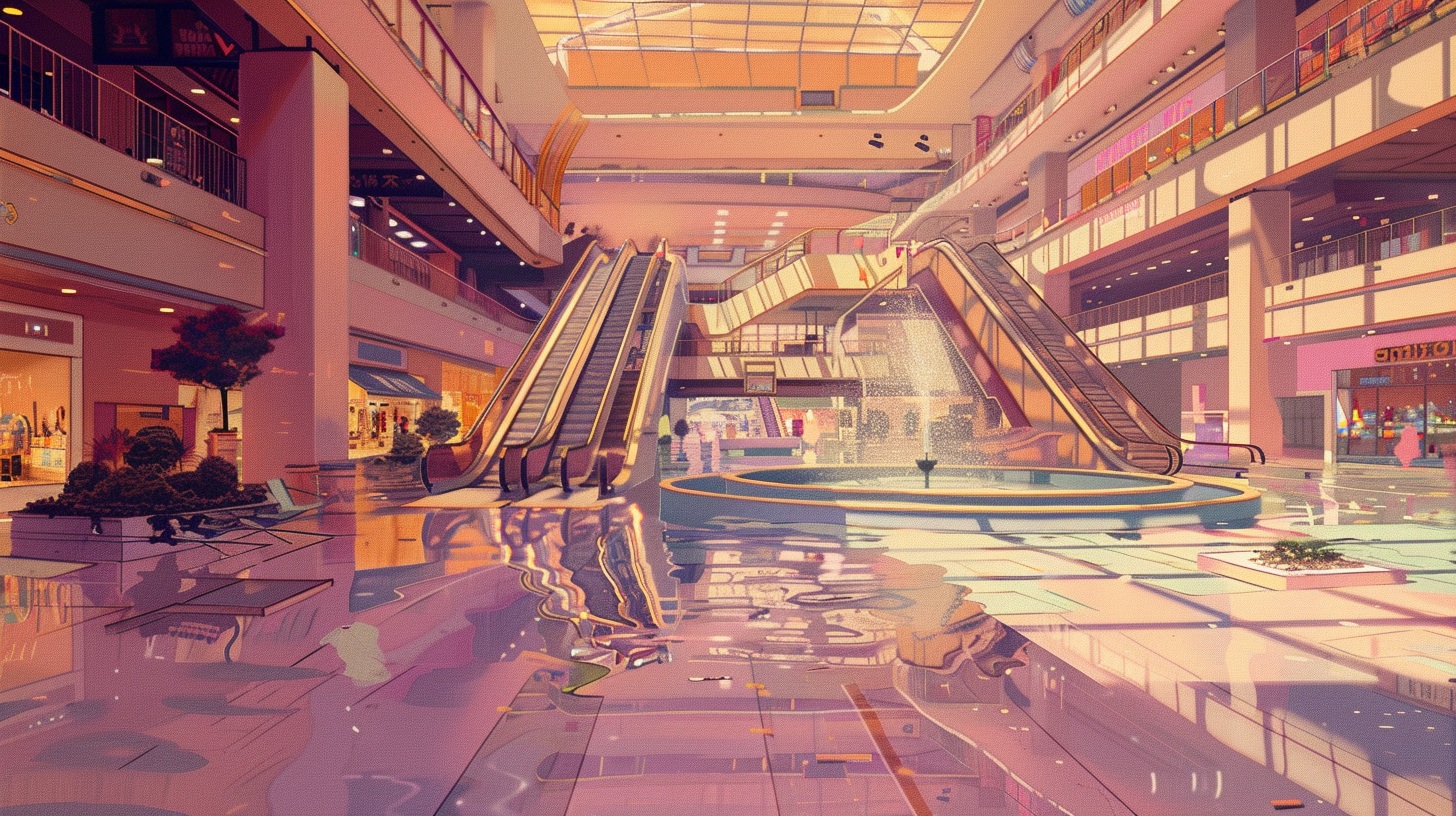
The fountain still burbles in the center court, its rhythm unchanged after all these years. The air smells faintly of cleaning solution and something sweeter: ghost traces of cinnamon rolls and fried dough. Fluorescent lights hum overhead, casting a pale glow over neatly arranged chairs, while the escalators glide up and down in perfect rhythm, carrying nothing at all.
In this place, time seems to have stopped. The music plays on for an audience that has vanished. A jingle echoes faintly from a speaker with a frayed wire, its melody warped by age and static. It sounds cheerful, almost comforting, until you listen closely, and then it sounds unbearably sad.
Most forms of protest would shatter this silence. Punk would smash these glass doors, spray-paint slogans on the walls, and demand attention through noise and motion. But vaporwave does something stranger. It sits very still and listens.
This is not the rage of a riot, nor the calm of nostalgia. It is a haunting middle ground, a quiet violence like rust creeping over metal. And in that stillness, we begin to understand: capitalism does not always end with a bang. Sometimes, it collapses in silence. All that remains is the echo.
Capitalism’s Ruins
The music you hear in a mall was never meant to be listened to. It was designed to fade into the background, a soft current carrying you gently toward another purchase. The corporate training video was not made to be art; it was meant to instruct, persuade, or pacify. A logo’s purpose was simple: to be recognized, not contemplated. These fragments of sound and image were not built to last. They were built to be invisible.
Vaporwave takes these unnoticed materials and forces them into focus. It gathers capitalism’s detritus, the throwaway sounds and sights of late twentieth-century consumer culture, and places them under a strange, unflinching light. Suddenly, what was once merely background noise becomes foregrounded, impossible to ignore.
The building blocks are familiar, even banal: the soft looping melodies of mall muzak, corporate training tapes with chipper voices promising efficiency and harmony, degraded VHS commercials, boxy Windows 95 interfaces, and Japanese city pop samples cut and slowed until their optimism turns mournful.
Individually, these elements feel trivial. But combined, they form a portrait of an era: a world of optimism, consumption, and constant motion. A world that, like the dead mall, now feels strangely distant and hollow.
This is where Mark Fisher’s idea of hauntology becomes essential. Fisher wrote about being haunted by lost futures, by visions of what the world could have been lingering like ghosts. When we hear a chopped-up city pop track or see a glitched-out logo floating in a digital void, we are not just experiencing nostalgia. We are witnessing the specter of capitalism’s unfulfilled promises.
Vaporwave turns this into an aesthetic practice. Cheerful jingles are slowed until they sound tragic. Logos, once symbols of vitality and growth, become eerie relics. A shopping mall is no longer merely a place to buy things; it becomes a monument to failed utopias.
Through this process, vaporwave transforms the infrastructure of consumerism into something strange and sacred. It lets us hear and feel the emptiness beneath the shine. Not through anger, not through slogans, but through the simple act of making the invisible visible.
The Limits of Loudness
Most anti-capitalist art begins with volume. It names villains, points fingers, and shouts its message until it cannot be ignored. Punk music does this with a raw, unfiltered scream. The guitars are jagged, the lyrics confrontational, every song a weapon hurled at the system. Its power lies in immediacy, in the way it captures the urgency of anger and refuses to let the listener remain neutral.
Political cartoons take a different approach but share the same clarity of target. Symbols are exaggerated until their meaning is unmistakable: the banker in the top hat, the broken chain lifted high, the raised fist of resistance. These images can cut deep, but their bluntness also makes them easy to consume and quickly forget. One glance, one reaction, and the viewer moves on.
Even dystopian novels and films, more layered and complex, usually guide the audience toward a clear structure: a corrupt corporation to despise, a rebel protagonist to cheer for, and a climax where the system is confronted head-on. The narrative provides both catharsis and closure.
These forms matter. They have inspired revolutions and opened countless eyes. But they also share a limitation: they externalize the problem. The system becomes something out there, separate from the audience. The villain can be mocked, shouted at, or destroyed, and in that act, the reader or listener remains safely outside the frame.
Vaporwave takes a different path. It does not give you a target. It does not raise its voice. Instead of pointing at the system, vaporwave immerses you inside it, until you are no longer sure where the art ends and reality begins. Its critique is not external and loud, but internal and silent, creeping under the skin like background music you did not realize you were hearing until it is too late.
Between Punk and the Liminal
To understand this strange quietness, it helps to imagine two poles on a spectrum of art. On one end lies punk and protest art, with its heat and volume: loud, urgent, unmissable, action-driven, and precise in naming its enemies. On the other end lies liminal space art, where context dissolves entirely: empty hallways, endless corridors, glowing lights without purpose, and a mood of uncanny unease rather than a direct critique.
Punk burns the city down in a blaze of cathartic rage. Liminal art simply wanders the ruins, recording the echoes of what once was. Vaporwave lives between these two extremes. It borrows punk’s use of real-world capitalist symbols, the mall, the brand logo, the corporate jingle, but processes them through the liminal: slowing them down, looping them endlessly, and removing the crowds until only ghosts remain.
This middle space is what gives vaporwave its haunting power. It is not the explosive destruction of protest, nor the pure abstraction of the liminal. It is capitalism dissolving in real time, caught in the moment between collapse and disappearance. Where punk screams and liminal art drifts, vaporwave hums softly, like an empty mall still running after everyone has gone home.
Vaporwave’s No-Man’s Land
Vaporwave begins with the same raw materials that punk once used. It draws on the everyday symbols of capitalism: the mall, the brand logo, the chipper corporate jingle. But instead of smashing these artifacts to pieces, vaporwave preserves them like specimens suspended in glass. Where punk’s violence is immediate and external, vaporwave’s approach is slower, stranger, more like decay than destruction.
The techniques are deceptively simple: slowing down music until cheerful melodies become dirges, looping moments endlessly so they can never resolve, blurring visuals through glitches and VHS decay, and removing people entirely until only the spaces capitalism built remain. The effect is unsettling. These once-familiar objects are rendered alien, stripped of their original purpose. What was designed to energize or persuade now feels heavy and mournful.
These are half-dead, half-alive spaces. The lights still turn on, the escalators still move, and the music still plays, but the meaning has been hollowed out. All that remains is the infrastructure, running on autopilot: capitalism’s nervous system twitching long after the body has died.
This is vaporwave’s true power: its quiet violence. It does not confront the system directly, nor does it retreat into pure dreamlike abstraction. Instead, it shows capitalism eroding from within, its symbols corroding slowly over time.
At first, it seems harmless: a nostalgic track, a pretty pastel image. But the longer you sit with it, the more unsettling it becomes. That mall is not just empty, it is abandoned. That song is not just relaxing, it is mourning. That logo is not just dated, it is a relic of a future that never arrived.
Punk throws a brick through the window. Vaporwave lets the glass fog over, lets the frame rust and bend, until one day you realize the whole structure has already collapsed. The violence is not visible. It is in the slow dissolution of meaning, the way these artifacts turn from functional objects into ghostly reminders of a system long past its prime.
This makes vaporwave harder to dismiss than loud, confrontational art. Noise can be tuned out. Anger can be met with anger. But silence seeps in. It unsettles because it offers no target, no release. It leaves you alone with your thoughts, surrounded by images and sounds you thought you understood, now transformed into something uncanny and untrustworthy.
Failure Made Tangible
Most critiques of capitalism are intellectual. They give you statistics, slogans, villains with names and faces. You read, you nod, you agree or disagree, and then you go about your day. The critique stays external, something you think about but do not necessarily inhabit.
Vaporwave does something stranger. It bypasses the rational mind and drops you directly into the system’s ruins. There are no charts, no speeches, no manifestos, only sounds and images that bypass explanation and move straight to the body.
A track loops endlessly, never resolving. At first, it is just repetition. But over time, it starts to feel oppressive. The music mirrors the experience of living inside late-stage capitalism itself: a cycle of consumption with no true endpoint, no escape, just more of the same.
An empty food court hums under fluorescent light. The space was designed for growth, crowds, and a future of prosperity. Now it stands abandoned, a promise unkept. You do not need a narrator to tell you that something has failed. You feel it in the way your footsteps echo.
A corporate slogan flashes across a glitched screen: “Have it your way.” “Think different.” “Because you’re worth it.” Repeated enough times, the words dissolve into sound alone, stripped of meaning. What was once a rallying cry for consumption becomes a hollow mantra, language itself eaten away by marketing until nothing remains but empty rhythm.
In this way, vaporwave turns abstract systemic failure into tangible experience. Loops that never resolve become metaphors for the perpetual churn of the market. Silent, empty spaces embody the collapse of communal dreams. Fragmented slogans show how capitalism hollows out language, leaving only noise.
This transformation is profound because it makes failure inescapable. You do not just understand the critique intellectually; you embody it. Unlike direct protest art, which points at problems from a safe distance, vaporwave pulls you inside the machine. The critique is no longer something you consume. It consumes you.
The Power of Suggestion
Vaporwave never explains itself. There are no lyrics spelling out its message, no narrator guiding you through the ruins. The tracks are wordless, the images stripped of context. You are left alone in a space filled only with fragments: a looping song, a glitching logo, a room where the air feels too still.
This absence is not an accident. It is a deliberate strategy, one that shifts the burden of interpretation onto you. Faced with silence, your mind begins to ask questions it might otherwise avoid. Where are the people? What happened here? Why does this once-cheerful music now sound unbearably sad?
The questions have no answers built into the art itself. There are no protest lyrics, no explanatory captions. Vaporwave does not hand you a critique; it traps you inside one, leaving you to navigate its meanings alone.
This is why vaporwave feels so deeply personal, even when it uses anonymous, mass-produced sounds. Each listener brings their own ghosts to the empty spaces: a childhood memory of wandering a brightly lit mall, the smell of popcorn and new plastic toys, the click of an old CRT screen flickering to life. When these memories collide with vaporwave’s distortions, the effect is uncanny. You are no longer just hearing someone else’s art. You are haunted by your own past.
It is the same principle that makes certain horror films so powerful. The scariest monsters are the ones we never fully see: a glimpse of a claw, a shadow across the wall, a half-heard sound in the dark. Your mind does the rest, conjuring terrors far more vivid than any special effect could provide.
Vaporwave works like that. The monster is capitalism’s collapse, but vaporwave never points directly at it. It only shows you the traces: a food court fountain still running with no customers, a jingle stretched until it becomes alien, a slogan flashing on a broken screen. The critique emerges inside you, not on the surface of the art.
Most art gives you closure: a climax, a moral, a moment of resolution. Vaporwave leaves you wandering, unsettled, with no exit. Like a dream you cannot wake from, it lingers after the song ends. You might turn off the music, close the tab, step away from the screen, but the silence that follows will feel different now. Heavier. Full of echoes you cannot quite name.
Mourning the Futures We Were Promised
Vaporwave is not only critique. It is mourning. Its loops and echoes are not just eerie; they are elegiac, like funeral bells ringing beneath the surface of pastel melodies.
In the 1980s and 1990s, capitalism made a set of promises. They were everywhere: commercials, malls, glowing screens, glossy magazine covers, glass towers, neon-lit plazas, and early home computers. The promise was infinite growth, futuristic leisure, global connection, rising prosperity, and a future that seemed not only possible, but certain.
Vaporwave takes the remnants of those visions and warps them. Its pastel color palettes recall the utopian optimism of the era: soft blues, warm pinks, glowing sunsets. At first glance, these aesthetics are soothing, even beautiful. But they are also distorted, marred by glitches, noise, and decay. A logo with missing pixels. A song slowed until it sounds like a lament. A mall rendered in perfect clarity, but with no people left inside.
The result is a feeling both comforting and deeply unsettling. The beauty of vaporwave is bittersweet because it reflects not the world we have, but the world we thought we would inherit. We are not just looking at capitalism’s present failures, from gig economies to hollowed-out towns and environmental collapse. We are grieving the futures that never arrived.
This is where Fisher’s hauntology becomes vital. Vaporwave is not nostalgic in the simple sense of longing for the past. It is nostalgia for a past vision of the future, a double displacement. We are not mourning what was. We are mourning what was supposed to be.
That is why vaporwave’s optimism feels so fragile and heartbreaking. The bright colors of its artwork are like sunlight seen through water, distorted and shimmering. Cheerful jingles now sound hollow, stretched until their joy curdles into grief. Even the spaces themselves, the malls, plazas, and corporate atriums, seem to ache with absence.
These were not just places where people shopped or gathered. They were the physical architecture of a dream. When you walk through them now, you are walking through the ruins of belief itself.
Fisher argued that capitalism has a way of colonizing the future, presenting itself as inevitable, as if no other world is possible. But vaporwave reminds us that this inevitability was always an illusion. By showing us capitalism’s ruins, it forces us to confront the fragility of its promises.
This is what makes vaporwave so powerful, and so sad. It does not simply mock the failed dreams of the past. It mourns them, treating them with strange reverence even as it reveals their emptiness. When you listen to a vaporwave track or gaze at its artwork, you are hearing the ghosts of futures that never came to pass.
Not the destruction of the world we have, but the slow, silent erasure of the world we were promised.
Japan and the Global Feedback Loop
Much of vaporwave’s raw material originates in Japan. The genre’s visual and sonic palette draws heavily from city pop, bubble-era aesthetics, anime VHS textures, neon-drenched skyscrapers, futuristic malls, and Japanese signage glowing like electronic runes.
For Western creators, these elements feel exotic and distant. They are not lived realities, but symbols filtered through screens and translations. When a Western artist slows down a city pop track or overlays VHS static on a shot of Shinjuku at night, they are not simply sampling music or imagery. They are transforming it into metaphor, a way of talking about late capitalism without having to name it directly.
Japan, for these artists, becomes a dreamspace: a stand-in for modernity itself, a hyper-saturated symbol of global consumer culture, familiar enough to recognize and distant enough to reimagine freely. But to Japanese audiences, these same fragments are deeply ordinary. City pop songs may be memories of family road trips or background music in a department store. Neon signage is just the landscape of daily life. What Western vaporwave artists treat as uncanny artifacts of capitalism’s rise, Japanese listeners may see as nostalgia, banality, or even something faintly amusing.
This creates a striking disconnect. To many in Japan, vaporwave can feel like foreigners constructing surreal mythologies out of their mundane past, like someone taking an old Sears catalog or a sitcom laugh track and turning it into avant-garde art.
Here we see the beginnings of a cultural feedback loop. Japan exports pop culture and aesthetics during its economic boom. The West imports these images and sounds, strips them of their original context, and layers them with irony and critique. Japan then re-imports vaporwave itself, now a strange foreign creation built from its own past.
In this way, vaporwave mirrors the processes of global capitalism. Products and symbols circulate endlessly, like shipping containers moving across oceans. Each time they move, they are repackaged, remixed, and rebranded. Over time, they become divorced from their origins, free-floating signs without stable meaning.
A city pop song recorded in 1982 might play on Japanese radio during the bubble era, appear decades later in a Western vaporwave track as a slowed and chopped sample, then return to Japan through YouTube or TikTok, where younger listeners experience it as something new, mysterious, and foreign. Its journey mirrors that of a physical commodity: created in one place, exported and consumed elsewhere, re-imported in altered form, until the original purpose is almost irrelevant.
Vaporwave thrives in this dislocation. Its meaning depends on the gaps between cultures, the spaces where symbols float free of their roots. For Western listeners, Japanese characters on a vaporwave album cover are evocative precisely because they are not fully understood. The distance allows projection, reinterpretation, and fantasy. For Japanese listeners, that same album may feel strangely alien: why are Western artists obsessed with our old malls, jingles, and city streets when we barely think about them ourselves?
This feedback loop does not just explain vaporwave. It becomes a metaphor for the world itself. In the era of global capitalism, everything circulates: goods, ideas, images, sounds, memories. Meaning itself is commodified and shipped across borders. By the time it returns, it is no longer what it once was.
Vaporwave captures this perfectly. Aesthetic fragments drift like container ships on an endless ocean. You cannot tell where they began, only where they have landed now. Each sample is both artifact and ghost, a relic of someone’s reality repurposed for someone else’s dream.
Why Vaporwave Resonates Now
In the early days of capitalism, you could see the system at work. The factory stood at the edge of town, its smokestacks reaching into the sky. The boss’s name was printed on the building. You knew where power lived, and you could point at it, protest it, fight it.
But in the algorithmic era, capitalism has become diffuse and invisible. There is no single factory owner, no politician who controls the whole machine. The system is everywhere and nowhere at once, woven into the background of daily life. It exists not as a visible structure but as an ambient condition, like the hum of an air conditioner you no longer notice.
This is why modern life feels so rootless and disorienting. You are never outside the system. You are always inside it, surrounded by images, algorithms, notifications, and quiet invitations to keep scrolling, consuming, clicking.
Vaporwave reflects this condition perfectly. Its symbols float in a void, stripped of context: a logo without a store, a song without a radio DJ, a mall rendered in perfect clarity with no shoppers. These images and sounds feel eerily like our own experience of digital life.
When you open a social media feed, you encounter the same endless flow of fragments: a meme from last week, an ad targeted by an algorithm, a stranger’s photo, a corporate slogan, a news clip, a friend’s memory from a decade ago. Nothing is fully explained. Everything appears, disappears, and reappears out of sequence. The past and present blur into a single stream.
Like vaporwave, the internet’s structure is built on loops with no resolution. The infinite scroll never ends. Autoplay continues. Recommendation algorithms show variations of the same thing forever. You cannot finish the internet any more than you can finish a vaporwave track. Both are designed to continue indefinitely, creating a sense of stasis disguised as motion.
This is why vaporwave feels less like a niche genre and more like a perfect mirror of the age we live in. Its loops echo the loops of algorithmic capitalism. Its voids reflect the void of decontextualized content we consume daily. Its empty malls and slowed-down jingles resemble our own digital marketplaces, where the product is no longer physical but attention itself.
In a sense, vaporwave predicted this reality before we fully understood it. In 2012, an empty mall track sounded like a joke or an oddity. In 2025, it feels like documentary realism. The pandemic accelerated this shift. As physical spaces emptied out, we all began to live inside our screens. Shopping malls became websites. Public squares became feeds. The loops vaporwave had been exploring for years became the literal structure of our lives.
And just as vaporwave samples and distorts fragments of the past, modern capitalism does the same with our attention. It repackages memories as notifications, sells nostalgia back through streaming libraries and remastered games, and endlessly recycles the familiar until everything feels like an echo of an echo.
This is the true uncanniness of vaporwave: it does not just depict capitalism’s ruins. It depicts how capitalism feels now. We are all wandering through its loops, fragments, and endlessly scrolling spaces. We no longer live under a system we can clearly see and confront. We live inside it, like background characters in someone else’s vaporwave track.
Vaporwave resonates because it gives form to this experience. It takes the invisible structures of modern life and makes them audible, visible, tangible. The endless scroll becomes an endless loop of music. The blur of online culture becomes VHS static and glitch art. The rootlessness of modern identity becomes a logo floating in a void.
A system with no center. A song with no ending. A loop that never stops playing.
The Quiet Violence of Stillness
The fountain still burbles in the center court. The escalators glide up and down in their endless loops. Fluorescent lights hum softly overhead, casting their glow on empty tables and silent storefronts. The music plays on, cheerful and unwavering, for an audience that never comes.
Nothing here is broken. Nothing has been smashed or burned. The mall continues to function exactly as designed, and yet, somehow, it is already a ruin.
Punk would have shattered this place long ago. It would have left the windows jagged, the walls covered in slogans and rage. It would have made its anger visible, loud, undeniable. Liminal art would have gone in the opposite direction, stripping the mall of all context and reducing it to pure aesthetic emptiness: a space without meaning, a dream without history.
Vaporwave does neither. It lets the mall sit exactly as it is, humming quietly, decaying before our eyes. It does not interfere or explain. It simply shows us what has already happened and invites us to listen closely.
There is a quiet violence in that stillness: the violence of entropy, of systems unraveling not with a bang but with a whisper. The violence of realizing that no one pulled the plug. The machine is still running, but for no reason at all.
Perhaps not all protest needs to be loud. Perhaps not every critique must scream to be heard. Sometimes the most radical act is to show the ruins, preserve them in sound and image, and let people feel the collapse for themselves.
Because when you stand in that empty food court, listening to music that was never meant to be heard this way, you begin to notice things: the cheerfulness of the jingle curdling into sorrow, the lights burning without purpose, the way the air feels thick with absence.
And you realize the truth at the heart of vaporwave: capitalism does not always fall through revolution or catastrophe. Sometimes, it simply loops forever, hollowing itself out until nothing remains but echoes.
The song fades. The screen glitches. The mall hums on.
And somewhere inside that hum, you hear yourself listening.
- Iarmhar
October 20, 2025
This essay is part of the Culture, Media, and Synthetic Imagination Cluster