Post-Scarcity Lite
Not a utopia. Not yet. But AI is already lowering the floor of survival — and that’s where everything changes.
There’s no shortage of concern about AI—job losses, runaway inequality, even dystopian collapse. Yet as Jeremy Rifkin once noted, “The costs of producing and delivering an increasing array of goods and services will dwindle to near zero, and economies will have to learn to manage abundance.” This perspective suggests that one of AI’s most important, yet barely mentioned, effects is its role as an extreme deflationary force. What if the very technology we fear for destroying jobs and exacerbating inequality holds the key to solving humanity’s oldest problem: scarcity?
This isn’t just about automation replacing workers. It’s deeper — it’s about technology steadily pushing the cost of essentials toward zero. Food, energy, education, healthcare. The groundwork for what I call Post-Scarcity Lite. But only if we can rethink our fears about deflation.
For the first time in history, we have a real shot at rethinking how our economy works. Economists usually dread deflation—but in this context, it might be exactly what we need.
To understand how AI leads us toward this emerging economic condition, we need to start with two key concepts: deflation and economies of scale.
Deflation is when the price of goods and services falls over time. Picture your weekly grocery bill getting smaller (no, really!)—not because you’re cutting back, but because food itself is just cheaper.
Economies of scale, meanwhile, describe how producing more of something tends to lower the cost of each unit. Baking one cookie is pricey per cookie—but bake a thousand, and suddenly the cost per cookie drops. The more you produce, the cheaper it gets.
This is where the one-two punch of automation and AI comes in. Automation has already improved efficiency for decades—think assembly lines and industrial robots. But AI takes this further. It can optimize everything: design, supply chains, energy use, quality control, maintenance schedules, and more. Together, AI and automation don’t just cut costs—they unlock entirely new levels of scale.
Let’s look at where this is already starting to happen:
- Food
- AI-managed vertical farms can reduce land, water, and labor needs. Precision agriculture minimizes waste, while optimized supply chains shrink transport costs.
- Shelter
- Think AI-designed modular housing, 3D-printed homes, and smarter logistics for construction. Material usage becomes more efficient, and costs fall.
- Energy
- Smart grids use AI to manage renewable distribution and cut waste. Predictive maintenance keeps infrastructure running longer with less downtime.
- Healthcare
- AI-driven diagnostics are faster, cheaper, and more accurate. Robotic surgery, personalized drug discovery, automated lab work, and virtual care all streamline what were once labor- and cost-intensive systems.
So, it sounds great, doesn’t it? Deflation and economies of scale make things cheaper. But there’s a catch: three major forces in our economy actively resist it.
First, central banks. In the way modern economies function, deflation makes debts harder to repay — your debt stays the same, but your income and assets are worth less. It can trigger what’s known as a deflationary spiral, where people delay spending in hopes prices will drop further, which slows the economy even more. Because of this, central banks typically target a modest level of inflation to encourage spending and investment.
Governments don’t like deflation either. Lower prices mean lower tax revenues — less from sales tax, and less from income taxes if wages and corporate profits shrink. This makes it harder to fund public services or manage national debt.
Finally, corporations are wary of deflation because falling prices erode profit margins, discourage investment, and often lead to layoffs as companies scramble to stay profitable. In short, deflation has long been associated with economic contraction and pain.
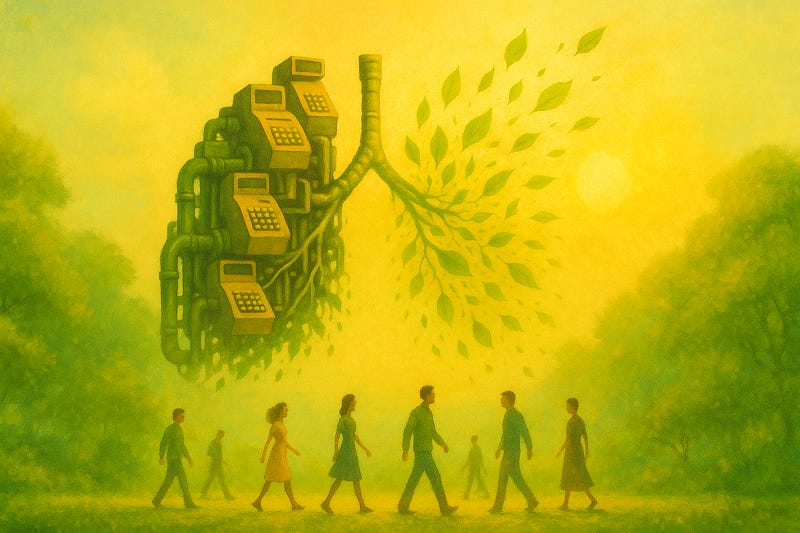
But maybe deflation feels dangerous for another reason. Not because efficiency is bad — but because we’ve built an economy where inefficiency is someone’s income. Where rent-seeking is so embedded, it’s practically oxygen. And when that oxygen gets replaced with the clean air of abundance, the lungs panic.
It’s not a grand scheme — just the inertia of an older system colliding with a radically different future: one where extreme efficiency doesn’t mean layoffs — it means liberation.
However, this assumes all deflation is created equal. Jeff Booth put it bluntly: “Our economic systems were not built for a world driven by technology where prices keep falling. They were built for a pre-technology era when labour and capital were inextricably linked, an era that counted on growth and inflation, an era where we made money from scarcity and inefficiency. That era is over. But we keep on pretending that those economic systems still work.” Historically, deflation has accompanied downturns—but the world has never faced mass deflation driven by near-zero marginal costs from intelligent machines. That changes the conversation. The combination of AI and automation introduces a new kind of deflation — a “good” deflation. Here’s the key distinction: this isn’t demand-side deflation, where people can’t afford things so prices fall. It’s supply-side deflation, driven by radical abundance and hyper-efficiency.
AI-driven deflation means we’re producing more goods and services at lower costs — not producing less and charging less. It’s a symptom of unprecedented productive power.
The goal would be to outpace equilibrium. The rate at which AI can drive down production costs (via automation and economies of scale) could be so rapid that the market doesn’t have time to stabilize. Just as the market begins to adapt to one cost drop, another wave of efficiency arrives — and prices fall even further. The aim is to hit near-zero marginal costs for essentials before the economy finishes adjusting to the last drop in prices.
Think of a hypothetical scenario: A new AI-driven manufacturing process slashes the cost of durable goods by 50% in a month. Before the market can even adjust to this new price point, another AI innovation optimizes energy consumption and material sourcing, reducing costs by an additional 20%. The ‘race to zero’ accelerates, making goods cheaper faster than traditional market forces can stabilize.
This is where the concept of “Post-Scarcity Lite” comes in. It’s not a world where everything is free — but it’s one where the cost of basic survival (food, shelter, energy, essential healthcare) is so low it’s practically negligible. The result is a kind of economic floor beneath which no one falls.
Even if a significant portion of jobs are permanently automated away, this could be one of the rare scenarios where Universal Basic Income actually works. UBI has been tested many times, only to be shut down — not because it’s philosophically flawed, but because it’s too expensive. It’s being trialed in a world where monthly living costs run into the thousands. Of course it fails. Even the most generous governments would burn out fast trying to keep up.
But AI-driven deflation changes the math entirely. When the cost of essentials drops dramatically — thanks to automation and economies of scale — the price structure finally becomes compatible with UBI. In this context, UBI stops being a welfare program and becomes a distribution mechanism for the abundance AI generates.
It’s not about handouts. It’s about sharing the dividend of hyper-efficiency.
From Survival to Significance
So if basic survival is guaranteed, what does humanity get to focus on instead? Creativity. Innovation. Art. Science. Exploration. Community. Self-actualization. The usual fear with UBI is that it discourages work. But in a world where survival is nearly guaranteed, the very definition of ‘work’ expands beyond necessity. People won’t stop creating; they’ll create for passion, for meaning, for status, for exploration—not just for rent.
And that urge to stretch, to strive, to create for its own sake — it’s wired into us. Mihaly Csikszentmihalyi described it this way: “The best moments in our lives are not the passive, receptive, relaxing times... The best moments usually occur when a person’s body or mind is stretched to its limits in a voluntary effort to accomplish something difficult and worthwhile.”
It’s not the end of markets — far from it. But solving for the essentials frees up time, energy, and mental bandwidth, allowing civilization to blossom like never before.
“Post-Scarcity Lite” is our critical stepping stone. If the so-called intelligence explosion — the singularity — truly arrives, this foundation makes the leap to full post-scarcity more stable, more equitable, and far less chaotic.
There’s no denying the transition ahead will bring challenges. Friction points will emerge — they always do. But that shouldn’t stop us from asking: what if basic security became structurally cheap, not through charity, but through technological momentum?
There’s every reason to be optimistic. There are real paths forward — ones that could lift civilization in ways many haven’t yet imagined.
- Iarmhar
October 17, 2025
This essay is part of the Deflation and the End of Scarcity Economics Cluster