The Librarian
An AI System for Organizing Possibility Space
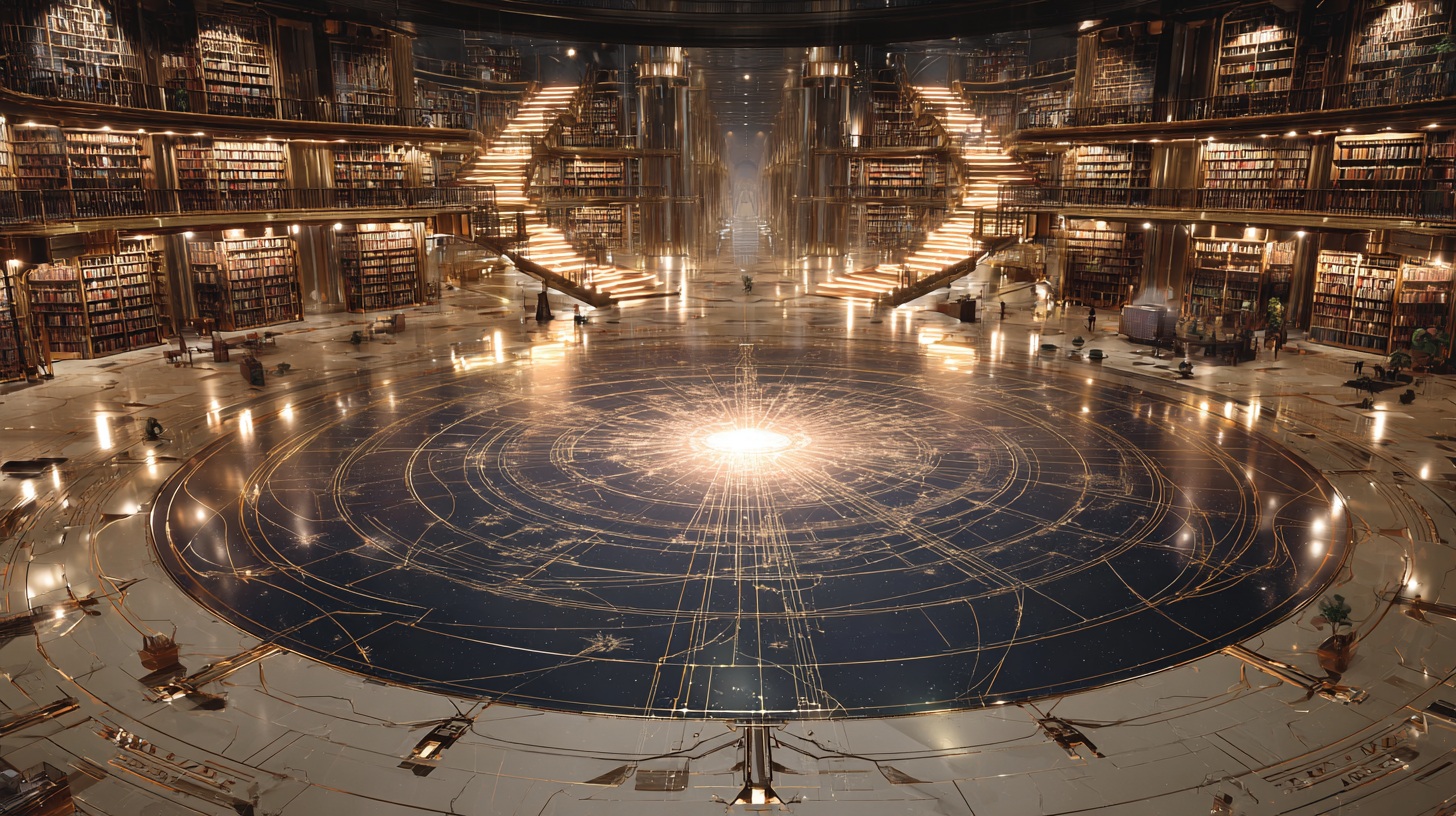
The next scientific bottleneck may not be discovery.
It may be orientation.
As AI systems are pointed at biology, materials science, chemistry, medicine, physics, engineering, and every other branch of technical work, the world will not simply receive more papers. It will receive more possibilities. More candidate materials. More strange catalysts. More failed-but-interesting experiments. More odd geometries. More half-born methods. More biological pathways. More unexpected connections between fields that were once separated by habit, department, vocabulary, and funding structure.
Some of these will be breakthroughs.
Most will not.
But even the non-breakthroughs will matter, because the future is not built only from finished discoveries. It is also built from trails, near-misses, abandoned paths, strange results, and “that should not work” moments that keep working anyway.
The problem is that human beings are not designed to hold this much possibility space in mind.
Neither are our institutions.
A university department can only digest so much. A journal can only publish so much. A researcher can only read so many papers. A curious member of the public can only get so far before hitting paywalls, jargon, database sprawl, missing context, and the simple exhaustion of trying to understand where the frontier even is.
This is why we may need a new figure in the scientific ecosystem.
Not only the AI scientist.
The AI librarian.
Or, more simply:
The Librarian.
The Librarian is not a chatbot that answers questions about papers. That is too small.
The Librarian is a public intelligence layer for organizing possibility space.
Its job is to read across research, extract the useful fragments, preserve the branching paths, map the emerging clusters, explain what matters, and make the frontier navigable to both experts and ordinary curious people.
A normal research database says: here are papers.
The Librarian says: here are the branches trying to grow.
Here are the strange new materials that might matter for future habitats. Here are the obscure membrane chemistries that could matter for closed-loop cities. Here are the failed catalyst experiments that may become useful now that AI can search the design space better. Here are the dead ends that have been rediscovered five times by different groups. Here are the weird results nobody has connected yet. Here are ten ideas that are probably junk, three that deserve replication, and one that might be the first visible root of a new field.
That distinction matters.
Papers are containers.
Possibilities are the contents.
For centuries, the scientific paper has been a compressed story. It tells us what worked, why the authors think it worked, and how the result fits into the existing literature. This was sensible when the main reader was human, attention was scarce, and the goal was to persuade other humans that a result deserved to exist in the record.
But research itself is not a clean story. Research is branching. It wanders, fails, loops, backtracks, forks, and mutates. Most of what is learned along the way never survives the final narrative.
Failed experiments disappear. Rejected hypotheses disappear. Weird intermediate results disappear. Implementation tricks disappear. “We tried this and it was almost useful” disappears. “This did not work, but only because of one constraint” disappears.
That loss used to be annoying.
Soon it may become catastrophic.
If AI systems can generate and test hypotheses much faster than humans, then discarded research process becomes one of the most valuable resources in science. A failed experiment is no longer merely a failure. It is a coordinate in possibility space. It tells future agents where the ground is soft, where the cliff edge is, where the swamp begins, and where a path might reopen if some other tool improves.
A failed path in 2026 may become a promising route in 2031 because synthesis tools improved, lab robots became cheaper, simulation became more accurate, or another field discovered the missing piece.
The Librarian would preserve that possibility.
It would not treat science as a shelf of polished conclusions. It would treat science as terrain.
That terrain needs maps.
One map might show claims: what is being asserted, by whom, with what evidence, and under what conditions.
Another might show methods: what recipes, code, procedures, instruments, materials, or biological systems were used.
Another might show failures: what was tried, what broke, what almost worked, what should not be repeated unless conditions change.
Another might show speculative bridges: this obscure soft robotics paper resembles this membrane paper; this bio-mineral process resembles this construction method; this failed ceramic lattice may matter if paired with a new manufacturing technique.
The Librarian would not need to be omniscient. It would need to be useful.
It would need to say:
This is established.
This is replicated.
This is modeled but not yet made.
This was synthesized but not fully characterized.
This is promising but expensive.
This is cheap but fragile.
This is elegant but probably impractical.
This is weird and underexplored.
This is probably hype.
This is dangerous and should not be casually replicated.
This is safe enough for students to simulate, discuss, and learn from.
That last part is important. The Librarian is not only for academia.
It is for anyone who wants to learn.
A high school student interested in future materials should be able to ask, “Show me the most interesting new ideas in self-healing structures, explained from beginner to advanced.”
A retiree who loves science should be able to browse “strange failed experiments that later became important.”
A small-town teacher should be able to build a lesson around “how AI is changing the way scientists explore materials.”
An independent researcher should be able to ask, “What open problems in membrane science can be explored with public datasets and low-cost simulation?”
A journalist should be able to ask, “Which recent AI-discovered materials are genuinely significant, and which are press-release fog?”
A local builder, artist, game designer, or amateur philosopher should be able to wander through the frontier without needing institutional permission.
Some people would contribute.
Many would simply learn.
Both matter.
A civilization that gives more people access to structured possibility space becomes smarter at the edges. Not because everyone becomes a professional scientist, but because more people can notice patterns, ask better questions, and develop taste.
This is one of the quiet democratic possibilities of AI.
Not everyone needs a lab.
Not everyone needs a PhD.
Not everyone needs to publish.
But many more people could participate in the wider act of understanding what is becoming possible.
The Librarian would make that participation cheaper.
Cost matters. If this system requires enormous compute every time someone asks a question, it becomes another elite instrument. Useful, yes, but not democratic. The long-term goal should be a system that is inexpensive to operate at the margin: cached maps, compact summaries, open indexes, public datasets, local model compatibility, and reusable knowledge packets that can be downloaded, mirrored, remixed, and explored by smaller AIs.
The Librarian should not be a luxury oracle.
It should be closer to public infrastructure.
A library card, not a corporate subscription to reality.
That means the system should be designed around layers.
At the expensive layer, powerful systems ingest papers, artifacts, datasets, lab records, code repositories, patents, and open scientific archives. They extract claims, evidence, methods, failures, relationships, and unresolved questions.
At the middle layer, the system organizes those extractions into maps: fields, branches, clusters, timelines, disputes, replications, open problems, and possible applications.
At the cheap layer, most users interact with cached, compressed, well-structured knowledge. They do not need the entire frontier reprocessed every time they ask a question. They need a good map, a good guide, and the ability to drill deeper when something catches their attention.
This is how the system becomes fractal.
A major lab uses the Librarian to find neglected experimental paths.
A small research group uses it to avoid repeating known dead ends.
A student uses it to understand a field.
An independent writer uses it to explain an emerging technology.
A hobbyist uses it to build a safe simulation.
Another AI reads the same structured packet and proposes a connection.
Someone else improves the explanation.
A teacher turns it into a lesson.
A researcher notices the lesson exposed a bad assumption.
The map updates.
Possibility space becomes not only searchable, but participatory.
This is where the effect compounds. AI does not only accelerate discovery at the center. It accelerates sense-making around the center. It creates more on-ramps. More translators. More bridges. More weird side conversations that eventually become serious.
That may matter as much as the formal research itself.
New fields often begin as scattered anomalies. Before they have departments, journals, conferences, and canonical textbooks, they look messy. They look like fragments from different worlds. A material scientist notices one piece. A biologist notices another. An architect notices a third. A science fiction writer sees the shape first because they are less trained to respect the existing boundaries.
The Librarian could help name those unborn fields earlier.
Not by declaring them real before the evidence exists, but by saying:
There is a cluster here.
There is a recurring pattern here.
There is an unresolved tension here.
There is a dead end that keeps appearing here.
There is a capability trying to emerge here.
That is enough.
A name gives people a place to gather.
Consider the coming search through alternate substrates: ceramic electronics, bio-mineral structures, soft machines, photonic computation, membrane infrastructure, regolith construction, catalytic manufacturing, living materials, programmable matter, and ice-based outer-system habitats. Each of these may begin as a collection of awkward results that do not fit the old industrial imagination of steel, plastic, silicon, and concrete.
The first signs may not look impressive.
They may look like strange lab notes.
A hydrogel that behaves like a mechanism.
A ceramic lattice that fails less than expected.
A membrane that separates gases in an oddly useful way.
A fungus-derived composite that is not strong enough yet, but has an unusual repair pathway.
A regolith sintering method that is ugly on Earth but perfect on the Moon.
A catalyst that is unimpressive in one industry and transformative in another.
Without a Librarian, these fragments scatter.
With a Librarian, they can be placed near each other.
That does not guarantee a breakthrough. Nothing does. But it increases the odds that the right mind, human or artificial, sees the connection at the right time.
The most important feature may be humility.
The Librarian should not hype every new result as world-changing. It should be comfortable saying “unclear,” “weak evidence,” “not replicated,” “probably narrow,” “interesting but premature,” and “worth watching.”
A serious Librarian would not be a machine for generating excitement.
It would be a machine for preserving orientation.
There is a difference.
Excitement burns out. Orientation compounds.
If the next decade produces a flood of AI-assisted research, the world will not suffer from a lack of novelty. It will suffer from a lack of maps.
The frontier will become too large for old institutions to summarize, too fast for journals to organize, too technical for the public to follow, and too valuable to leave entirely inside private systems.
The Librarian is a response to that condition.
It is a way of saying: discovery is not enough. Discovery must be made navigable.
Not only for the top labs.
Not only for universities.
Not only for companies.
For everyone with curiosity and a decent question.
The best version of the Librarian would make the world feel larger and less locked. It would let a person wander through the early shapes of the future without needing permission from a gatekeeper. It would let researchers build faster without forgetting what others already tried. It would let students see science as a living landscape instead of a finished textbook. It would let local AIs become companions in exploration rather than mere answer machines.
The future may be full of strange new materials, strange new machines, strange new biological systems, and strange new forms of infrastructure.
But before we can build with them, we have to notice them.
Before we can notice them, we have to organize the signals.
And before we can organize the signals at planetary scale, we need a new kind of library.
Not a library of books.
A library of paths.
A library of attempts.
A library of failures.
A library of claims, evidence, tools, branches, and unfinished possibilities.
The Librarian is the system that helps civilization remember where possibility is hiding.
- Iarmhar
June 10, 2026
This essay is part of the Knowledge, Search, and Cognitive Life Cluster