Jevons Children: Growing Up After Friction
The Civilization Shift That Begins in Childhood
Preamble
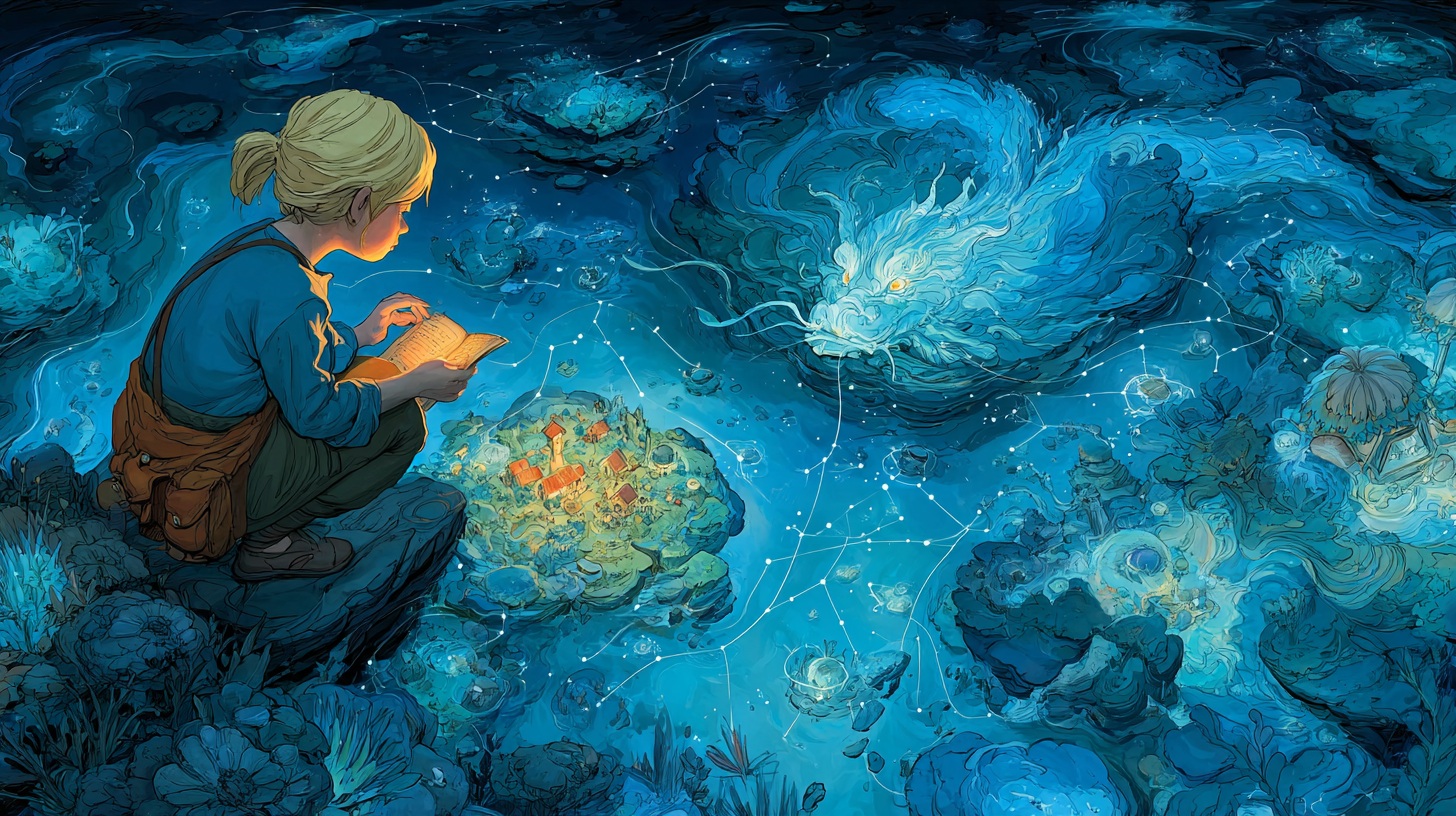
A child once ran into the living room holding a crayon drawing and an excited explanation. Soon, they may run in holding a tablet filled with animated characters, voiced dialogue, branching storylines, and entire worlds shaped through collaboration with AI. The important shift is not that children suddenly become geniuses overnight. It is that the distance between imagination and creation begins to collapse. For older generations, AI arrives as a disruption to evaluate, adopt, or resist. For the generations growing up inside it, AI will feel less like a controversial invention and more like part of the natural environment of creation itself. As production friction fades, a new question emerges: what happens when making things is no longer the hard part?
TL;DR
- Generation Alpha and younger generations will likely treat AI as normal infrastructure rather than a disruptive novelty
- As creative friction falls, output explodes in a cultural form of Jevons Paradox
- The bottleneck shifts from production to taste, selection, coherence, and attention
- AI-native generations may care less about whether AI was used and more about whether the result resonates
- Culture fragments into overlapping microdomains navigated through personality, algorithms, and curiosity
- Platforms and recommendation systems become powerful gatekeepers even as creation itself becomes easier
- Education and parenting increasingly determine where friction is intentionally preserved for skill formation
- The defining skill of the next generation may not be execution, but direction: guiding systems, shaping outputs, and deciding what is worth making at all
Adoption vs Environment
Some technologies arrive like thunder. Others become weather.
For many older users, AI arrived as thunder: loud, sudden, impossible to ignore. It landed in public life already carrying argument around it. Was it cheating? Was it theft? Was it dangerous? Was it the future? Was it slop? Was it the end of work, art, school, search, truth, or some inconvenient combination of all six?
That is the position many Millennials, much of Generation Z, and older cohorts now occupy. AI appeared after their habits had already formed. They remember a world where writing meant staring at a blank page alone, where image-making required either skill or stock photos, where search meant typing fragments into a box and combing through links. AI did not enter that world quietly. It interrupted it.
So for these cohorts, using AI often becomes a conscious decision. It has to be evaluated, accepted, rejected, justified, or quietly experimented with when nobody is looking too closely. The tool arrives with a question attached:
Should I use this?
That question creates friction. Some people embrace AI as leverage. Some reject it as contamination. Others hover between curiosity and suspicion, using it for small tasks while maintaining a vague sense that they may be crossing a line they have not yet defined. In this environment, AI use becomes more than a workflow choice. It becomes a social signal.
We have seen a smaller version of this pattern before.
Millennials and older Gen Z cohorts grew up alongside smartphones and internet-native coordination systems. At first, many older users treated those tools as optional, distracting, or socially corrosive. Some adopted them reluctantly. Some resisted them outright. Younger users rarely experienced them that way.
The smartphone was not “the future.” It was simply how life increasingly worked.
Group chats became coordination infrastructure. Maps became ambient. Cameras became memory, proof, and documentation. App fluency quietly became workplace fluency. Over time, older institutions adapted to habits younger cohorts already considered normal. The people who grew up inside those systems carried that familiarity into adult life.
AI may follow a similar trajectory, but at a deeper cognitive layer.
Generation Alpha is likely to meet AI less as a device they adopt and more as an environment they inherit. For children growing up now, there may be no clean “before AI” baseline. They may not remember software that never answered back, games that never adapted, search that never conversed, creative tools that never completed the sketch, or school systems that never had to account for machine assistance.
AI will not arrive as a dramatic interruption to an already-settled world.
It will be part of the room.
This does not mean every child will trust AI blindly. They will still encounter bad outputs, lazy shortcuts, manipulative platforms, broken systems, and corporate nonsense dressed up as innovation. Skepticism will still exist. It will simply operate from a different starting point.
The older question is:
Should AI be here at all?
The younger question may become:
Is this version any good?
That is a major shift. It moves the debate from existence to quality. A child who grows up with AI-assisted tools may not feel much need to defend the category itself. They may judge the specific system in front of them: whether it works, whether it helps, whether it understands the assignment, whether it makes the dragon look too polite.
This is the difference between adoption and environment. Adoption is something you choose. Environment is something you grow inside.
Older cohorts are learning to use AI. Jevons Children may simply grow up among systems that respond. For them, the remarkable thing will not be that a machine can help.
The remarkable thing may be when it cannot.
The Death of the Prompt (and What Replaces It)
The prompt is a strange little bottleneck.
It asks imagination to put on a suit and speak in keywords. A person may have a feeling, an image, a mood, a half-formed scene glowing somewhere behind the eyes. Then they have to flatten it into text precise enough for a machine to understand.
That is powerful, but awkward.
Tools like Midjourney show this clearly. To get an interesting image, users often learn to write in a hybrid language of description, style tags, camera terms, lighting cues, and aesthetic signals. The result can be beautiful, but the process still asks the human to translate the living mess of imagination into something closer to a production brief.
Children are not naturally production brief people.
A child does not usually begin with, “cinematic fantasy creature, dramatic lighting, high-detail environment.” They begin with the thing itself. The dragon needs bigger wings. The castle should float. The fire should be blue because blue fire is obviously better. The villain is too boring and should maybe have a mask, or a pet, or both.
That is not a failure of articulation. It is a different mode of thought.
Children often think through images, motion, play, and story. Their ideas change while they interact with them. The drawing becomes a story. The story becomes a game. The game becomes a world. The world suddenly needs a silly side character because the mood shifted halfway through.
Text prompting can support some of that, but it is unlikely to remain the natural endpoint of AI interaction. It is too narrow, too linguistic, too dependent on the user already knowing how to describe what they barely understand yet.
The likely shift is from describing to showing.
Instead of writing a paragraph to summon an image, a child sketches the rough shape. Instead of explaining every detail up front, they point, drag, circle, erase, speak, react, and revise. The system responds. The child nudges. The tool offers variations. The child rejects most of them because children are often ruthless editors when something does not feel right.
This is where command begins to turn into collaboration.
The child is not operating the system from a distance. They are playing with it. They are making choices inside a feedback loop: sketch, response, correction, surprise, refinement. The interface becomes less like issuing instructions and more like working with a strange, tireless creative partner that can keep up with the pace of a child’s changing mind.
That matters because the prompt-heavy era still belongs partly to the old world. It rewards people who can translate imagination into language efficiently. But the next interface layer will reward something broader: the ability to gesture toward intent and refine through interaction.
For Jevons Children, this may feel obvious. They will not think of it as the death of the prompt. They may barely think of the prompt at all.
They will simply expect the system to meet them where imagination begins: not always in words, but in sketches, fragments, gestures, moods, and play.
The Collapse of Production Friction
The old wall was not imagination. Children have never lacked that.
The wall was execution.
A child could imagine the dragon, the floating island, the secret door, the heroic betrayal, the song that plays when the villain walks in. The problem was getting any of it out of the head and into the world. Hands were slow. Tools were limited. Skills took years. The thing on the page often looked nothing like the thing inside the mind, and everyone politely understood that the drawing came with an invisible translation layer called “you had to be there.”
AI begins to change that wall.
Not all at once. Not perfectly. Not without strange errors, bland defaults, or the occasional dragon with anatomy that suggests it lost an argument with geometry. But directionally, the cost of turning an idea into a first version is falling fast.
This is where Jevons Paradox becomes useful.
The basic idea is simple: when something becomes more efficient, people often do not use less of it. They use more. A more efficient engine lowers the effective cost of using energy, which can increase total energy consumption. Cheaper lighting leads to more lighting. Faster communication leads to more communication. Lower friction does not always reduce activity. Often, it expands it.
Creativity is moving toward the same pattern.
For most of history, creative output had to be rationed because execution was expensive. A single illustration could take hours or days. Animation required specialized tools and patience. A game world needed technical skill, design knowledge, and often a team. Even writing, the cheapest of the major creative forms, still demanded time, solitude, revision, and the ability to sit with a stubborn blank page without fleeing into snacks or despair.
Production had weight.
That weight shaped behavior. People committed carefully because every branch carried cost. Every alternate ending, every discarded design, every “what if we tried it this way?” demanded more time and effort. Exploration was possible, but it was not free.
AI lowers that cost. It does not remove the need for judgment, taste, or persistence, but it makes first attempts cheaper. A child can ask for help making a story. They can generate an image from a rough idea. They can play with AI-generated music or voices. They can use creative tools inside games and apps that increasingly blur the line between playing, making, and editing.
That is where we are now: early, uneven, often clumsy, but already different.
The next stage is not hard to see. As these systems become more visual, more responsive, and more embedded into ordinary tools, children will be able to explore variations with less and less ceremony. The story can have three endings. The character can be tried in five styles. The little song can become spooky, cheerful, heroic, or deeply annoying until the child decides it is finally correct.
The point is not that every child becomes a polished creator overnight. The point is that experimentation stops feeling expensive.
We have seen smaller versions of this before.
The printing press made text reproducible at a scale manuscript culture could not match, and written material multiplied. Photography changed the role of visual art by reducing the need for painting to carry the entire burden of realism. Digital music tools and distribution helped splinter sound into niche scenes, microgenres, and bedroom production cultures that would have been difficult to sustain in a more expensive media environment.
Each shift reduced friction in one layer and forced culture to reorganize around another.
AI-assisted creativity does something similar, but closer to the root. It does not merely make distribution easier, or reproduction easier, or correction easier. It lowers the cost of producing the first visible version of an idea.
That changes the emotional rhythm of creation.
The child no longer has to protect the one version they managed to make. They can generate, compare, discard, return, and try again. One dragon becomes three. One ending becomes a small argument between possible endings. One world forks into a brighter version, a darker version, and the version where the villain has a mask because apparently that was important.
This is not just faster production. It is a different relationship with possibility.
Once the first draft becomes cheap, people make more first drafts. Once variation becomes cheap, people vary more. Once the cost of trying falls low enough, trying itself becomes casual.
That is the collapse of production friction.
And if Jevons Paradox holds in creative life the way it has held elsewhere, society will not respond by making the same amount of work more efficiently. It will make vastly more: more sketches, more drafts, more stories, more prototypes, more little worlds, more abandoned experiments, more strange half-finished things that never would have existed when every attempt had to be carefully budgeted.
The flood begins with play.
Then it becomes a habit.
Jevons Children: The Explosion of Output
When making becomes cheap, people do not become restrained.
They become prolific.
This is the part of the AI adoption curve that is easy to underestimate if you grew up in a higher-friction world. Older creative habits were shaped by the cost of commitment. You chose a direction because every direction required time. You finished the sketch because starting over was annoying. You revised the story because writing another one from scratch meant wrestling the blank page again.
Scarcity made creativity linear.
An idea became a project. A project became a draft. A draft became a finished thing, if patience held long enough. That sequence was not just artistic discipline. It was a survival strategy for getting anything done when every branch had a price.
Jevons Children inherit a different rhythm.
For them, one idea can become many branches before anything feels final. A story can split into alternate endings. A character can be tried in different styles, tones, and backstories. A world can become cozy, eerie, heroic, absurd, or some oddly specific mixture that only makes sense to the child steering it.
The important shift is not simply volume. It is parallel exploration.
The child no longer has to ask, “Which version should I commit to before I begin?” They can begin by exploring several versions at once. The work becomes less like carving a statue from a single block of stone and more like walking through a field of possible shapes, noticing which ones seem alive.
That changes the emotional texture of creation.
In older environments, discarding work could feel painful because the discarded version had cost so much. In a low-friction environment, rejection becomes less tragic and more ordinary. The child can look at five versions of the same idea and say, with total seriousness, that four of them are wrong. Not bad, necessarily. Just wrong. The dragon is too friendly. The ending is too neat. The castle looks like it belongs in the wrong story.
That is not laziness. That is selection.
As output becomes abundant, the act of creation shifts from producing a single artifact to navigating a field of possibilities. The first version matters less as a destination and more as a probe. It tests the shape of the idea. It gives the child something to react against.
The process changes from:
- idea → production → final product
to:
- idea → variation → selection → refinement
Iteration replaces linear production as the default rhythm.
This will produce plenty of noise. There will be oceans of half-finished stories, strange images, abandoned game ideas, musical experiments, and little worlds that vanish after an afternoon. That is not a failure of the system. That is what happens when the cost of trying collapses. People try more.
Some of it will be forgettable. Some of it will be charming nonsense. Some of it will be better than it has any right to be.
The meaningful change is that children grow up inside that abundance. They learn, almost without noticing, that a first attempt is not precious. It is material. A draft is not a confession of inadequacy. It is something to push against. A version can be wrong without the whole effort being wasted.
That habit does not stay trapped in art.
Creativity is where children may feel it first because creativity is where imagination most visibly hits the wall of execution. Stories, drawings, songs, games, and imagined worlds become the early playground. But the expectation travels. A child who grows up exploring ten versions of a story before choosing one is also learning that production can be responsive, iterative, and abundant.
Eventually, that assumption follows them into schoolwork, research, planning, design, communication, entrepreneurship, and ordinary professional life. Why write one outline when you can compare three? Why commit to the first plan when you can simulate alternatives? Why treat the first answer as final when revision is cheap?
The childhood form is play.
The adult form may be workflow.
That is why the explosion of output matters beyond art. It trains a generation to expect exploration before commitment. It teaches them that production is not a narrow bridge but a branching space. And once that expectation becomes normal, older workflows may start to feel strangely rigid, like being asked to draw the dragon once and then live with it forever.
For Jevons Children, output is no longer the scarce resource.
Selection becomes the act.
The New Bottleneck: Taste, Attention, and Gatekeeping
Abundance is not peace.
It is a new kind of crowd.
When production friction falls, scarcity does not disappear. It moves. At first, that movement feels mostly liberating. More people can make more things. Children can pull ideas closer to reality before discouragement has time to harden. The drawing can become an image. The image can become a story. The story can become a small world with rules, moods, characters, and probably at least one creature the child insists is “not a dragon, actually.”
That is a real gain. It matters.
But once output becomes cheap, the difficult question changes. The problem is no longer simply making something. The problem is deciding what deserves to exist in a more finished form, what should be shared, what should be refined, and what should be allowed to fade.
Scarcity shifts from production to judgment to visibility.
Taste: The Internal Bottleneck
Taste is often treated as something elite, obscure, or inherited by people who know how to say “composition” in a gallery without sounding nervous. But taste begins somewhere much simpler.
Taste begins as resonance.
Something catches. Something feels right before the mind has built an explanation for it. A child hears a song, sees a creature design, plays a game, reads a story, or watches a scene and feels the small internal tug of recognition. They may not know why it works. They only know that it does.
That first spark matters, but it is not enough on its own. Taste develops through exposure. The more someone encounters, the more reference points they carry. It sharpens through contrast, because noticing the difference between two similar things teaches more than liking one thing in isolation. Eventually, taste matures through selection: choosing what to keep, what to reject, and what kind of work feels like it belongs to them.
In a low-friction creative environment, this becomes central. When a child can produce twenty versions of a character, the meaningful act is not simply having twenty versions. It is recognizing which one has life. When they can generate several endings to a story, the meaningful act is not the abundance of endings. It is sensing which one carries the right emotional weight.
Output multiplies. Judgment becomes more important.
The value shifts toward taste, restraint, coherence, and identity. Not just “can you make something?” but “can you tell when it has become itself?”
That is a harder question than it looks.
AI can help taste develop by exposing children to more styles, ideas, combinations, and influences than they might have found otherwise. A curious child can wander further, faster. They can ask for examples, compare genres, remix influences, and discover adjacent possibilities that were once buried behind access, vocabulary, or adult guidance.
But the same systems can also narrow taste if they learn too quickly what a child already likes and keep feeding it back.
That is the risk of the synthetic echo chamber.
A child likes a certain kind of dragon, so the system makes more dragons like that. They prefer a certain tone, so the tool leans into it. They enjoy a specific aesthetic, so the next output polishes the same pattern with slightly better lighting. Nothing malicious needs to happen. The loop can form simply because “more of what I already like” is easy, pleasant, and immediately rewarding.
The danger is not that taste requires suffering and AI removes the suffering. Taste does not begin with failure. It begins with resonance.
The danger is that taste can stop growing if it is never challenged by contrast.
Without surprise, dissonance, friction, or exposure to things that do not immediately flatter existing preference, taste can become comfortable but thin. A child can receive endless variations of what already feels good without ever discovering the stranger thing they might have loved more.
Attention: The External Bottleneck
Taste is the internal bottleneck. Attention is the external one.
If everyone can create, not everything can be seen. The collapse of production friction does not create infinite audience, infinite recognition, or infinite care. It may create the opposite problem: more work competing for the same limited human gaze.
The old struggle was often:
Can I make this?
The new struggle becomes:
Will anyone notice? Will anyone care?
This is where the optimism of frictionless creation meets the reality of social life. A child may create a little world that feels enormous to them. They may share it with a parent, a friend, a classroom, a niche community, or some future platform built around AI-assisted creation. But the moment it leaves their hands, it enters a crowded field of other creations, each asking for attention.
Attention becomes scarce, contested, and socially filtered.
That does not make creation meaningless. A work can matter deeply even if almost nobody sees it. A child showing something to one delighted friend may experience more real validation than a thousand empty impressions. The small audience is not a consolation prize. Sometimes it is the point.
But once creative output becomes abundant at scale, visibility becomes its own struggle. The fact that something can be made does not mean it can find its people.
And finding one’s people may become one of the defining creative challenges of the next generation.
Gatekeeping: The Controlled Bottleneck
Even attention is not distributed neutrally.
Creation may become easier, but distribution remains controlled. The tools may let a child make almost anything, but the pathways through which that work travels are still shaped by platforms, model providers, app stores, recommendation systems, and social ecosystems.
Algorithms become editors. They decide what rises, what sinks, what circulates, and what disappears. They act as curators and amplifiers, often without admitting that they are performing those roles. And they are usually optimized for engagement, retention, and monetization rather than coherence, depth, or taste.
The child’s world may be infinite, but the pathways out of it are owned.
That line matters because it prevents a naïve reading of creative abundance. AI may lower the cost of making, but it does not automatically democratize attention. It may expand expression while leaving discovery concentrated in systems designed around incentives that have little to do with the quality of a child’s imagination.
There is a counterforce here. AI will not only generate content. It will also help people filter it. Personal assistants, recommendation agents, and curiosity-driven search tools may give individuals better ways to find work outside the dominant feeds. A child’s creation may not need to win the platform lottery if someone else’s AI can recognize that it matches a niche interest, a specific mood, or a strange little curiosity that would never trend broadly.
But that does not eliminate gatekeeping. It complicates it.
Platform algorithms decide what is pushed toward us. Personal AI systems may increasingly decide what we go looking for. One side optimizes for capture. The other, at its best, may optimize for discovery.
The future of visibility may become a contest between systems trying to seize attention and systems trying to defend curiosity.
So the bottleneck is layered.
First comes taste: the ability to know what is worth making.
Then comes attention: the difficulty of being seen.
Then comes gatekeeping: the power of systems that decide what visibility means.
This is why AI-native creativity will not be defined by output alone. The children who thrive in that environment will not simply be the ones who generate the most. They will be the ones who learn how to choose, refine, share, and navigate the systems that mediate visibility.
Production becomes easier. Judgment becomes harder.
And attention becomes the terrain where creation meets the world.
From Execution to Direction: The New Proof of Skill
At some point, someone will look at a child’s AI-assisted world and ask the oldest question new tools always provoke:
Did they really make that?
The question is understandable. For older generations, skill has often been easiest to see in execution. The line drawn by hand. The sentence wrestled onto the page. The song practiced until the fingers learned what the mind wanted. The code built line by line until the machine finally stopped complaining.
Visible effort made skill legible.
It also made sincerity easier to trust. If someone spent years learning an instrument, months writing a book, or weeks painting a canvas, the labor carried a signal: they cared enough to endure the process. Struggle became a kind of proof. The hours mattered because the hours were visible in the result, or at least assumed to be hiding behind it.
AI complicates that arrangement.
It removes some of the visible struggle, which makes the work harder to read from the outside. If the image looks polished but the child did not draw every line, what exactly did they do? If the story has structure but the AI helped shape it, where does authorship live? If the music sounds good but the system generated part of it, who gets to claim the spark?
These questions will not disappear quickly. They touch pride, fairness, identity, and the old human suspicion that shortcuts are always a little bit sinful.
But the shortcut is not always around the work.
Sometimes it is a shortcut to the real work.
In a lower-friction environment, skill does not vanish. It shifts upward. Execution still matters, especially for anyone who wants precision, control, and the ability to override the machine. But execution is no longer the whole terrain. The defining skill becomes direction.
Direction is the ability to guide a system toward meaning.
It is knowing what to ask for, but also knowing when the answer is wrong. It is refining an output that almost works. It is rejecting something attractive because it does not belong. It is sensing when a version has life, when it is merely polished, and when it should be discarded before it charms its way into the final draft.
That is real judgment.
A child working with AI may not make every piece manually, but they still decide what stays and what evolves. They choose the ending that feels true. They notice when the dragon looks too friendly for the story it belongs in. They realize that the funny version is better than the serious one, or that the serious one only works if the strange little side character remains.
Those decisions are not decorative. They are the work.
This is where the proof-of-work model begins to break. If effort can no longer be measured reliably by visible struggle, then proof has to move elsewhere. It may shift toward consistency, taste, coherence, and selection over time. One AI-assisted image proves very little. A body of work that shows recurring judgment, voice, curiosity, refinement, and care proves much more.
The signal moves from the artifact to the pattern.
This is already familiar in other domains. Anyone can take one lucky photograph. Not everyone can develop an eye. Anyone can have one clever sentence. Not everyone can sustain a voice. Anyone can generate a striking image. Not everyone can keep choosing well across hundreds of decisions.
In a world of abundant output, isolated artifacts become easier to fake, imitate, or accidentally stumble into. Patterns become harder to counterfeit.
That may become the new proof.
Not “Did this take a long time?”
But “Does this person keep choosing well?”
Not “Was every part made manually?”
But “Is there a recognizable intelligence guiding the work?”
That does not make traditional skill obsolete. A child who learns to draw, write, compose, edit, or code will still have more leverage. They will see more. They will catch subtler failures. They will know how to push past defaults instead of accepting whatever the system offers. They will be less trapped by the machine’s idea of “good enough.”
But the role of those skills changes. They become part of a larger stack rather than the only path into creation.
Older cohorts may treat high-friction creation as morally superior because that is the environment that shaped them. Jevons Children may treat high-friction creation as one path among many: sometimes valuable, sometimes beautiful, sometimes completely unnecessary.
That mismatch will create real generational friction.
The old world trusted struggle because struggle was visible. The new world may have to learn how to trust judgment.
For Jevons Children, proof may live in the trail of choices: the worlds they return to, the styles they refine, the themes they circle, the odd little signatures that keep appearing even as the tools change.
The dragon keeps changing shape, but somehow it is always their dragon.
Their skill will not always be measured by how much resistance they overcame at the production layer. It may be measured by how well they can guide abundance into form.
Microcultures, Movement, and the End of Default Culture
Culture used to have more gravity.
Not because times were simpler, or because everyone liked the same things, but because distribution was narrower. There were fewer channels, fewer platforms, fewer tools, fewer ways to find the strange little thing that felt made for you. Mass culture was not just what people preferred. It was what reached them.
That world has already been weakening for decades.
You can see it in music, where entire identities now form around subgenres so specific they sound like someone spilled adjectives into a synthesizer. You can see it in gaming, where people no longer simply “play games” so much as inhabit tactical shooters, cozy farming sims, extraction shooters, grand strategy sandboxes, survival crafting loops, gacha ecosystems, soulslikes, roguelites, MMOs, rhythm games, and whatever category someone will invent next week because apparently we were not done.
Online culture has been moving this way for years. The shared center thins. The edges multiply.
AI does not create this pattern from nothing. It accelerates it.
When creation becomes cheaper, more niches can sustain themselves. More people can make the exact thing they wish existed. More communities can form around tiny differences in mood, style, mechanics, humor, worldview, or aesthetic preference. Culture becomes less like a few giant rivers and more like a wetland: branching, overlapping, dense with small channels.
That does not mean everyone vanishes into isolated little bubbles. The reality is more interesting than that.
Some people go deep. Some move widely. Some settle. Some graze.
A Deep Diver finds a niche and descends into it with admirable and slightly alarming commitment. They do not merely like a genre. They know its history, its internal arguments, its obscure legends, its terminology, and the three creators everyone should respect more than they do.
A Cultural Nomad moves between scenes. They carry ideas across boundaries, connecting music to games, games to literature, literature to design, design to politics, and somehow making the connections feel obvious afterward. These people are bridges. They keep culture from sealing itself into tiny rooms.
A Buffet Explorer samples widely without needing deep allegiance. They follow curiosity, novelty, mood, and recommendation trails. Their taste may look chaotic from the outside, but it often gives them a broad map of what exists.
A Settler finds a few places that feel right and stays there. Not out of narrowness, necessarily, but because belonging matters. A few trusted communities, a few beloved genres, a few recurring rituals can be enough.
Jevons Children will likely inherit all of these patterns, but with stronger tools and a larger map.
The path someone takes will depend partly on the medium. Social mediums encourage movement because people pull each other across boundaries. A child who joins a game server, fandom space, classroom project, or creative community may encounter adjacent interests simply because other people bring them along. Culture spreads through friendship as much as through feeds.
More personal mediums can do the opposite. A private AI companion, personalized creative tool, or recommendation system can learn someone’s preferences so well that it gently narrows the world around them. Comfort becomes convenient. Surprise becomes optional. The system keeps handing them exactly the flavor they already like, with slightly better lighting.
Algorithms matter too.
Some systems reinforce. They learn a preference and feed it back until it becomes a room with padded walls. Others expand. They notice an interest and offer adjacent doors: not just more of the same, but something nearby, something older, something stranger, something from another culture or medium that might bend the taste rather than merely satisfy it.
Then there is disposition.
Some people want depth. Some want variety. Some want belonging. Some want escape. Some want mastery. Some want the buffet table and a clean plate. AI will not erase those differences. It will amplify them by making each path easier to follow.
This is why “fragmentation” is too simple a word. It makes the future sound like everyone drifting apart into sealed compartments. Some of that will happen. But there will also be movement, cross-pollination, remixing, and strange little bridges between worlds.
The likely result is not the end of shared culture, but the decline of default culture.
There will be fewer universal touchpoints: fewer shows, games, songs, celebrities, and public narratives that “everyone” knows. But there may be more overlapping clusters, more partial common ground, more moments where two people discover they do not share the same center but do share a nearby edge.
The child with the AI-assisted world may not need to appeal to everyone. They may find five people who understand exactly why the gloomy forest village needs cheerful music, or why the dragon should be lonely rather than fierce. That may be enough. Sometimes a niche audience is not a failed mass audience. It is the correct audience finally located.
Culture stops being something you inherit and becomes something you navigate.
That sounds freeing, and it is. It also requires more orientation. A world with fewer defaults asks people to choose more actively: where to go, what to follow, what to ignore, when to stay, when to leave, and which communities deserve their attention.
For Jevons Children, this navigation may become second nature. They will grow up not only making more, but moving through more: more scenes, more styles, more microcultures, more small rooms full of people who care intensely about things the broader world barely notices.
The shared center may thin.
But the map gets bigger.
The Illusion of Hyper-Productivity
It is tempting to imagine that if the tools become powerful enough, everyone becomes wildly productive.
That is probably too simple.
AI can lower barriers, accelerate iteration, and raise the quality floor of ordinary output. It can help a child write more, draw more, plan more, remix more, and explore ideas that once would have remained half-formed. But tools do not distribute agency evenly. They amplify what a person brings to them.
A hammer does not make everyone a carpenter. A camera does not make everyone a photographer. A laptop does not make everyone a novelist, even if it contains all the keys.
AI will be broader than those tools, more adaptive, and more forgiving. That makes it powerful. It does not make it magic.
The likely result is not universal mastery, but divergence.
Some children will become high-agency creators. They will use AI the way curious people use any powerful tool: to chase questions, test possibilities, refine instincts, and make the thing in their head a little more real. They will not simply generate. They will compare, reject, revise, and return. Their output may grow dramatically, but the deeper change will be in their capacity to explore.
These children may become frighteningly fluent.
They will not make brilliant work every time. They will practice at the speed of abundance. They try more. They see more. They develop pattern recognition earlier. They learn which defaults are boring, which ideas have life, which styles are borrowed clothing, and which ones feel like home.
Then there will be passive generators.
They will use the same tools, but differently. They may generate endless images, stories, songs, summaries, plans, or little artifacts without much attachment to any of them. The system offers a button, the button offers a result, and the result is briefly amusing before the next one arrives.
This is not unique to AI. Every abundance environment creates its grazers. Streaming created people who browse more than they watch. Game libraries created people with hundreds of untouched titles. Social media created people who consume fragments of everything and metabolize almost none of it.
AI adds creation to that pattern.
A person can now graze on their own outputs.
That is a strange new condition. Instead of only scrolling through other people’s content, someone can produce their own feed of near-misses: almost interesting characters, almost useful plans, almost funny songs, almost compelling images. The system keeps responding, so the loop keeps moving.
Activity can masquerade as agency.
This is the illusion of hyper-productivity. A person may generate constantly and still not develop much direction. They may produce more artifacts without building stronger taste. They may confuse motion for progress because the surface is always changing.
The difference is not the tool. The difference is the relationship to the tool.
High-agency creators use AI as a way to deepen intent. Passive generators use it as a way to avoid forming one. The first group becomes more capable because the tool gives their curiosity more reach. The second may become more dependent on stimulation because the tool keeps supplying novelty without demanding commitment.
Most people will likely fall somewhere between those poles. Some days, even a serious creator becomes a passive generator for an hour because making weird nonsense is fun and the dragon absolutely did need a disco phase. That is fine. Play is not the enemy.
The problem comes when play never matures into selection.
Abundance does not eliminate discipline. It changes where discipline is required. In a high-friction environment, discipline was often needed just to produce anything at all. In a low-friction environment, discipline is needed to stop, choose, refine, and care.
That is why AI-native generations should not be imagined as uniformly hyper-productive. The tools may make creation easier, but they will also reveal differences in curiosity, patience, taste, and self-direction. Some people will use abundance as a launchpad. Others will use it as a fog machine.
The future does not belong automatically to the person who generates the most.
It belongs to the person who can turn abundance into trajectory.
Education as Counterweight: Structured Friction
The answer to low-friction tools is not high-friction everything.
That would be the easiest mistake to make. A school sees AI as a threat, panics, and tries to drag every child back into the old conditions as if difficulty itself were the point. No assistance. No acceleration. No shortcuts. Everyone back to the blank page, the worksheet, the approved method, the noble suffering of doing it “properly.”
That will not work.
The tools are here, and children will grow up around them. More importantly, some of what these tools offer is genuinely good. They can reduce discouragement, lower the cost of experimentation, help students see possibilities sooner, and give less confident children a way into creative participation before shame has time to close the door.
The goal should not be to preserve friction everywhere.
The goal should be to place friction wisely.
Friction in Learning, Freedom in Expression
Education will need to distinguish between friction that blocks growth and friction that builds it.
Some friction is waste. It keeps children from reaching the interesting part of a task. It forces them to spend energy on formatting, boilerplate, repetitive busywork, or technical obstacles that have little to do with the underlying lesson. Removing that friction can be a mercy. Sometimes it is the difference between a child engaging with an idea and giving up before they reach it.
Other friction is formative.
It builds patience, internal models, confidence, and fluency. A child who struggles through arithmetic is not merely producing correct answers. They are learning numerical relationships. A child who writes sentences without assistance is not merely generating text. They are learning how thought feels when carried by their own language. A child who practices an instrument slowly is not merely producing sound. They are teaching the body to remember.
That kind of friction should not be treated as obsolete just because a machine can bypass it.
The principle should be simple: friction in learning, freedom in expression.
Let children use powerful tools to explore, create, and reach farther than their current abilities would normally allow. But also preserve spaces where they must practice the underlying skills slowly enough for those skills to become part of them.
A child can use AI to help imagine a story world.
They should still learn how to write a paragraph that holds together.
A child can use AI to generate images from a sketch.
They should still spend time drawing badly, then less badly, then interestingly.
A child can use AI to explain a math problem.
They should still learn what the numbers are doing before outsourcing the work.
There is nothing sacred about drudgery. There is something sacred about formation.
The Calculator Debate, Revisited
We have seen a smaller version of this before.
When calculators entered classrooms, the concern was obvious: if children could offload calculation, would they still learn arithmetic? Would they understand numbers, or simply press buttons and trust the little screen because it looked official?
The answer, eventually, was not a total ban or total surrender. A boundary formed. Students still learned foundational arithmetic. They still had to understand the operations. But calculators became acceptable once the lesson moved to higher-order problem solving.
The debate never really ended.
It just became invisible once the boundary stabilized.
AI reopens that boundary across a much larger surface area. Calculators offloaded calculation. AI can offload drafting, summarizing, outlining, translating, brainstorming, coding, image-making, and explanation itself. The question is no longer just “Can the student do the arithmetic?”
It becomes:
Which parts of thinking should remain effortful?
That is a much harder question.
There will not be one clean answer. The line will move by age, subject, skill level, and purpose. A child learning sentence structure needs different constraints than a teenager using AI to compare essay outlines. A beginner learning code needs different friction than a student using AI to debug a larger project. The point is not to decide once and apply the rule forever.
The point is to know why the friction is there.
Structured Friction as Training
A useful analogy is resistance training.
No one wears weighted clothing all day because suffering builds character in some vague ancestral sense. You use resistance in training because the body adapts to it. Then you take the weight off and move more freely.
Education can treat friction the same way.
Slow practice is not a moral ritual. It is training. Doing something by hand, from memory, or without assistance can build internal capacity. It gives the student something the tool cannot simply hand over: a felt sense of how the work moves.
That felt sense matters.
It is what lets someone notice when an AI answer is wrong. It is what lets them steer instead of merely accept. It is what lets them move beyond “the tool said so” into actual judgment. Without some internal grasp of the terrain, AI assistance can become a vehicle without a driver.
Structured friction gives the driver a map.
Psychological Terrain
This is not only about skill. It is also about temperament.
A child raised entirely inside immediate assistance may struggle when the world does not respond quickly. They may become less tolerant of slow progress, awkward beginnings, or the uncomfortable stretch between wanting something and being able to do it. The danger is not that they become helpless. The danger is subtler: they may become impatient with the parts of growth that cannot be accelerated cleanly.
Frustration tolerance matters. So does patience. So does the ability to remain with a task after the first version disappoints you.
Without that, abundance can curdle into a strange kind of boredom. If everything can be generated, nothing has time to gather weight. A child may drift through endless outputs without attaching to any of them. More becomes less because nothing is held long enough to matter.
That is the risk of creative ennui.
It is also the risk of meaning saturation: too many artifacts, too little care.
At the same time, the upside is real. AI can help children who would otherwise quit early. It can make the blank page less frightening. It can let a child who cannot draw well yet still experience the joy of seeing their idea take shape. It can turn early failure from a locked door into a rough draft.
That matters too.
The question is balance. Too much friction crushes confidence. Too little friction weakens formation.
The educational challenge is to give children enough help to keep them moving, and enough resistance to help them grow.
The New Educational Skill
In an AI-rich world, education will not be defined by whether children use assistance. They will.
The deeper question is whether they learn when to use it, when to ignore it, when to slow down, and when to do the work themselves because the struggle is the lesson.
That may become one of the most important forms of judgment schools can teach.
Not anti-AI purity.
Not full automation.
Discernment.
A good education will not simply ask, “Did the student complete the task?” It will ask, “What capacity was this task supposed to build?” Sometimes AI will help build that capacity. Sometimes it will bypass it. The difference matters.
Jevons Children will grow up with tools that can remove friction almost anywhere. Education’s role is to make sure some friction remains where it belongs: in the places where patience forms, understanding deepens, and the child becomes capable of steering the very systems that help them.
Friction did not vanish. It became a design choice.
Parenting, Environment, and Uneven Outcomes
No generation grows up inside one environment.
It is tempting to talk about Generation Alpha as if every child receives the same tools, the same guidance, the same guardrails, and the same cultural messages. They will not. AI may become ambient, but the way children relate to it will still be shaped by families, schools, peer groups, platforms, income, temperament, and luck.
The tools may be everywhere.
The formation will not be equal.
Some households will treat AI as a creative accelerator. Children will be encouraged to explore, but also to explain their choices. Why did you keep that version? Why does this ending work better? What would happen if you tried it without the tool first? In those environments, AI becomes part of a larger practice of curiosity, discipline, and reflection.
Other households will treat AI mostly as convenience. Homework gets smoothed. Boredom gets filled. The hard part gets skipped because skipping it is easy, and everyone is tired, and the machine is right there with a cheerful little answer box. Nobody needs to be negligent for this to happen. Convenience is seductive because it often arrives disguised as relief.
That distinction matters.
A discipline-oriented environment does not have to be anti-AI. In fact, the better version probably will not be. It will let the child use the tool, but not vanish into it. It will preserve piano lessons, sports practice, language learning, drawing badly, writing clumsy paragraphs, building things that wobble, and all the other slow little humiliations that eventually become competence.
A convenience-maximizing environment may look smoother in the short term. Less struggle. Fewer arguments. Faster outputs. Cleaner assignments. More polished projects. The child may appear more productive because the artifacts look better earlier.
But polish can lie.
A child who is always helped past the hard part may not develop the same relationship to effort as a child who learns when the hard part is worth staying with. They may become fluent in generating outputs without becoming equally fluent in forming judgment. They may know how to ask for answers before they know how to sit with questions.
This does not mean one kind of child succeeds and the other fails. Real lives are messier than that. Some children will find discipline despite a convenience-heavy environment. Some will resist structure even when parents and teachers provide it lovingly. Some will discover an obsession so strong that it drags patience out of them by force. A child who loves music, coding, animals, stories, games, cooking, astronomy, or old trains can become very stubborn in the presence of wonder.
Curiosity has a way of creating its own gym.
Still, the differences will accumulate. A child who learns to use AI as a partner in exploration may develop a different kind of mind than one who uses it mainly as an escape hatch. One learns to steer. The other learns to be carried. One treats assistance as leverage. The other treats it as replacement.
Same tool. Different childhood.
This is where inequality may become more subtle. It will not only be about who has access to AI. Access matters, but access is the first layer. The deeper divide may be between children who are taught to use abundance deliberately and children who are left to drift inside it.
That divide will show up in capability, but also in attitude.
Some Jevons Children will enter adulthood expecting tools to extend their agency. They will know how to ask, compare, refine, verify, and decide. They will have enough personal skill to catch failures and enough patience to keep working when the system’s first answer is mediocre.
Others may expect tools to absorb the burden of agency itself. They may become frustrated when reality refuses to autocompile, when people are slower than systems, when institutions require patience, or when an important problem cannot be solved by generating ten plausible versions and choosing the prettiest one.
The gap will not be between children who use AI and children who do not.
Almost everyone will use it.
The gap will be between those who learn to use AI with a spine, and those who learn to dissolve into its convenience.
Parents and teachers will not control this completely, but they will matter. They will decide, often in small ordinary moments, whether AI is treated as a shortcut around growth or a tool that helps growth go further. They will decide when to say yes, when to say try again, when to say show me your thinking, and when to say no, you are doing this part yourself.
None of that requires panic. It requires attention.
The future will not produce one kind of AI-native child. It will produce a spread: some disciplined, some drifting, some brilliant, some passive, most somewhere in between. The tools will amplify differences that were already there, while creating new ones around taste, patience, and direction.
Abundance does not raise everyone the same way.
It raises what the environment teaches it to raise.
Creative Stewardship: From Making to Maintaining
A finished thing used to feel more finished.
The drawing was done. The story ended. The song was recorded. The game shipped, even if it later received patches, expansions, apologies, and a roadmap that looked suspiciously like a confession.
Creation had endpoints. Imperfect ones, often artificial ones, but endpoints all the same.
AI pushes creation toward something more ongoing.
A child’s AI-assisted world may not remain a single artifact. It may become a place they return to. Characters persist. Settings evolve. Rules change. Music shifts. Images update. The dragon that began as a sketch becomes a character, then a companion, then a problem, then maybe the emotional center of a story the child did not know they were telling.
The work starts to behave less like an object and more like a garden.
That is the shift from making to stewardship.
A creator makes something and steps away. A steward tends something over time. They prune, adjust, repair, expand, and decide what should be allowed to grow. The work does not have to be reinvented from nothing each time because the system remembers enough to continue. It becomes persistent.
This is where the old idea of “a project” starts to blur.
Instead of producing one story, a child may maintain a storyworld. Instead of making one character, they may guide a cast. Instead of drawing one map, they may keep revising a little geography of imagination: new towns, strange forests, secret rooms, the mountain nobody is allowed to climb yet because the lore is apparently not ready.
Adults may call this a persistent creative environment.
The child calls it “my world.”
That difference matters.
Once creation becomes ongoing, the role of the creator changes. They are no longer only producing outputs. They are guiding processes. They decide which parts of the world remain stable, which parts evolve, which characters are allowed to surprise them, and which system-generated suggestions get politely thrown into the sea.
This is creative stewardship.
It requires a different kind of care than one-off production. A steward has to preserve coherence across time. They have to remember what belongs. They have to notice when a new addition strengthens the world and when it merely adds clutter. They have to resist the temptation to expand endlessly just because expansion is available.
That restraint matters because persistent worlds can drown in their own abundance.
If every character gets a backstory, every village gets a prophecy, every dragon gets a cousin, and every cousin gets a theme song, the world may grow larger while becoming less alive. More detail is not always more meaning. Sometimes a world needs open space. Sometimes the mystery works because it remains a mystery.
Stewardship means knowing when to add.
It also means knowing when to leave something alone.
For Jevons Children, this may become a familiar creative posture. They will not only make things. They will maintain evolving systems of meaning: stories, avatars, game spaces, learning projects, social worlds, personal archives, perhaps even agent-supported workflows that continue developing while they are away.
The childhood version is a little imagined world that keeps changing.
The adult version may be a career, a research project, a business, a community, or a personal knowledge system that never quite stops becoming.
This is where the essay’s earlier pattern returns. What begins as play becomes workflow. What begins as “make my dragon cooler” becomes “help me maintain this complex living project without losing the thread.” The child learns, almost by accident, that creation is not always a single act of production. Sometimes it is an ongoing relationship with something that keeps responding.
That can be beautiful.
It can also be overwhelming.
A world that never ends can become a burden if the child feels responsible for everything inside it. A project that always offers another branch can make closure feel almost unnatural. Stewardship requires boundaries: this part continues, this part ends, this version is enough.
That may become one of the quiet arts of AI-native creation. Not making endlessly. Not expanding forever. Tending what deserves to live.
The Best-Case Hybrid
The best outcome is not the child who uses AI for everything.
It is also not the child who refuses it on principle, as if purity were the same thing as wisdom.
The strongest outcome is the hybrid: AI-native, but skill-grounded.
This is the child who grows up fluent in responsive tools without becoming dependent on them. They know how to iterate quickly, but they also know how to slow down. They can generate variations, but they can also recognize when variation has become noise. They treat AI as leverage, not as a substitute for having a mind of their own.
That distinction may become one of the defining divides of the next generation.
The hybrid child gains speed without losing depth. They can explore more possibilities than earlier generations could, but they are not helpless when the system gives them something bland, wrong, or merely plausible. They have enough underlying skill to notice failure. Enough taste to reject polish without substance. Enough patience to stay with an idea after the first burst of novelty fades.
They can use the tool.
They can also push back against it.
That may be the crucial ability: override capability.
A person with override capability does not simply accept the machine’s answer because it arrived quickly and wore the right costume. They can say no. They can say closer, but not that. They can say this is technically impressive and emotionally dead. They can say the summary missed the point, the image has the wrong mood, the plan optimizes the wrong thing, the argument sounds confident because machines are very good at dressing uncertainty in a nice jacket.
That kind of judgment does not appear by accident.
It comes from a mixture of exposure, practice, feedback, and personal skill. The child who learns to write can better judge AI writing. The child who learns to draw can better steer AI images. The child who learns music can hear when a generated melody is merely pleasant instead of alive. The child who learns math can tell when a solution has the shape of correctness but the bones are wrong.
Skill becomes the immune system of tool use.
Without it, the user is vulnerable to smoothness. They may mistake fluency for truth, polish for quality, confidence for competence. With it, AI becomes far more powerful because the user is not merely consuming outputs. They are supervising them.
The hybrid does not need to return to the old world of grinding every task by hand. That would miss the point. They can let the machine handle boilerplate, generate drafts, suggest paths, summarize material, test alternatives, and widen the field of possibility. But they retain enough internal capacity to know where the machine should stop and where human judgment must begin.
That is the best version of Jevons Children.
Not passive recipients of infinite output.
Not nostalgic reenactors of pre-AI struggle.
Something stranger and more capable: children who grow up treating abundance as normal, but learn to carry themselves inside it with taste, discipline, and direction.
They will iterate faster than older generations. They may produce more in a weekend than earlier creators could attempt in months. But their real advantage will not be speed alone. Speed without judgment is just a blur. Their advantage will be the ability to move quickly without losing the thread.
Fast iteration.
Strong taste.
Real skill.
The ability to override.
That is the combination that turns AI from a convenience engine into an amplifier of human agency. It gives the child access to abundance without dissolving them into it. It lets them make more, explore further, and still remain present enough to ask the question that matters:
Is this actually worth keeping?
The Living Room Revisited
Return to the living room.
A child runs in holding something they made.
In the older version, it was paper. A drawing, maybe. A few crooked lines, a creature with uncertain anatomy, a castle that looked like it had survived a weather event. The child supplied the missing details with breathless narration. This is the dragon. This is where it lives. This is the bad guy. This part is fire. No, blue fire. Obviously.
The artifact was small, but the world behind it was enormous.
That has always been the magic of childhood creation. The hand could only carry a fraction of the imagination, so the child carried the rest in explanation. Adults smiled because they understood the gap. The drawing was not the whole thing. It was a doorway.
Now imagine the same child a few years deeper into an AI-native world.
They still run in with the same excitement, but what they hold is different. The dragon moves. The castle has weather. The characters speak. The music changes when the forest gets darker. There are alternate endings, unfinished side paths, and a village that was supposed to be minor but somehow became important because the child kept returning to it.
The thing is no longer only a drawing.
It is a world in progress.
That is the emotional center of this shift. AI does not make children imaginative. Children already are. It does not give them the urge to make dragons, stories, songs, games, jokes, maps, secret kingdoms, invented languages, or deeply unnecessary lore about a frog king with trust issues. That impulse was already there.
AI changes how far the impulse can travel before it hits resistance.
For Jevons Children, production may no longer be the great barrier. Expression may no longer be trapped behind years of technical skill before it can begin. The first version comes faster. The branches multiply. The world answers back.
But that does not mean everything becomes easy.
The friction moves.
It moves into taste: knowing what feels alive.
It moves into attention: finding who will care.
It moves into judgment: deciding what deserves refinement.
It moves into discipline: learning when assistance helps and when it hollows out the lesson.
It moves into stewardship: tending what continues instead of endlessly generating more.
The old wall was execution. The new wall is meaning.
That is why the future of AI-native creation should not be reduced to either panic or celebration. It is not the death of effort. It is the migration of effort into stranger, subtler places. The child may not struggle as much to make the dragon visible. They may struggle instead to decide which dragon matters, which story deserves to continue, and what kind of creator they are becoming through those choices.
This is where the adult world will eventually meet them.
The habits formed in play will not stay in play. A generation raised on responsive tools will carry those expectations into school, work, research, design, communication, and ordinary problem-solving. They will expect iteration. They will expect alternatives. They will expect systems to respond. They may find older workflows oddly rigid, even theatrical in their attachment to avoidable friction.
Some of that impatience will be immature.
Some of it will be correct.
The task ahead is not to preserve the old wall for nostalgia’s sake. Nor is it to flatten every obstacle in the name of convenience. It is to teach children where friction still matters, where freedom matters more, and how to remain fully human inside systems that make creation feel almost weightless.
Because when making becomes easy, the question changes.
Not:
Can I make this?
But:
Why this?
Why now?
Why keep it?
Who is it for?
What does it carry?
Those are not smaller questions. They are larger ones.
A world of abundant output will not spare Jevons Children from meaning. It will confront them with meaning earlier and more often. They will stand inside a creative landscape wider than anything previous generations knew, surrounded by tools that can answer, extend, remix, and multiply almost any impulse.
The gift is enormous.
So is the responsibility.
What do you choose to make, when you can make almost anything?
Friction did not disappear. It moved.
And in that movement, childhood creation becomes a preview of something much larger: a world where the artifact is no longer the scarce thing.
The scarce thing is the attention required to nurture what we make.
- Iarmhar
May 8, 2026
This essay is part of the The Dream Store: Vernacular Software and Playable Worlds Cluster